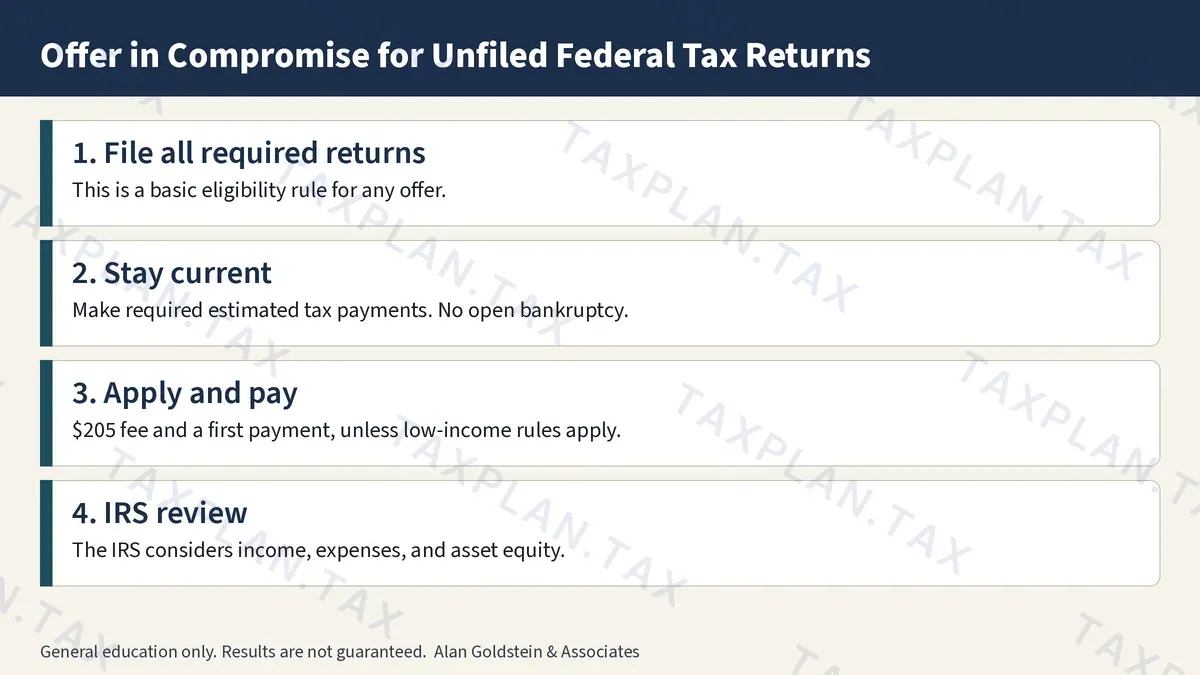

An offer in compromise for unfiled federal tax returns is not available until you file every required return. The IRS lists filing all required returns as a basic eligibility rule. After that, an offer may let you settle a tax debt for less than you owe, but only if you meet the IRS financial tests. This article explains the offer in compromise for unfiled federal tax returns, who may qualify, the costs, and what happens after you apply.
Key Takeaways
- An offer in compromise (OIC) may let you settle a tax debt for less than the full amount.
- To be eligible, you must file all required returns and make required estimated tax payments.
- You cannot be in an open bankruptcy.
- Every application needs a $205 fee and a first payment, unless you meet low-income rules.
- The IRS generally will not accept an offer if you can pay in full through a payment plan or asset equity.
- After the IRS accepts your application for processing, it generally may not levy.
What is an offer in compromise?
An offer in compromise is an IRS program that may allow you to settle your tax debt for less than the full amount you owe. The IRS says it may consider this if you cannot pay in full or if paying would cause financial hardship (IRS: Offer in compromise).
The authority is IRC §7122. The IRS looks at your income, expenses, and asset equity. It does not simply look at the size of the debt.
Can you get an offer in compromise for unfiled federal tax returns?
No. The IRS says that to be eligible, you must file all required tax returns. If you apply without doing so, the IRS may return your application.
The IRS says that if you apply and are not eligible, it returns your application and fee. It applies your lump sum or periodic payments to your tax debt. Because of that, you should file first. Our guide to filing past-due federal tax returns explains the process.
What other eligibility rules apply?
The IRS lists three rules for most taxpayers. You must file all required returns. You must make required estimated tax payments. You must not be in an open bankruptcy. Employers must also make required federal tax deposits for the current and prior two quarters (IRS: Offer in compromise).
Meeting those rules does not mean the IRS will accept your offer. It only means the IRS will consider it.
How does the IRS decide whether to accept an offer?
The IRS compares your offer with what it could collect from your income and assets. It generally will not accept an offer if you can pay your debt in full.
What does the IRS review?
The IRS says it considers your income, expenses, and asset equity. It also says it generally will not accept an offer if you can pay in full through a payment plan, equity in assets, or both (IRS).
For that reason, you should explore other options first. A payment plan may fit better if you can pay over time. See our article on IRS collections for high net worth taxpayers for another view of these tools.
What forms do you need?
Individuals can apply through their IRS online account. Businesses and individuals without an account can use the forms and instructions in Form 656-B, Offer in Compromise Booklet. The IRS may also ask for a collection information statement, such as Form 433-A for individuals.
What does an offer in compromise cost?
The IRS charges a $205 application fee and requires a first payment, unless you meet the low-income qualifications. Only individuals qualify for the low-income rule (IRS: Offer in compromise).
How do the payment options work?
You can choose a lump sum or periodic payments. With a lump sum offer, you pay 20% of the offer amount when you apply. If the IRS accepts the offer, you pay the balance in five or fewer payments. The statute requires the 20% payment with a lump-sum offer (IRC §7122(c)).
With a periodic payment offer, you make the first payment when you apply. You keep making periodic payments while the IRS considers the offer. If the IRS accepts it, you continue until the offer is paid in full.
Do low-income applicants pay the fee?
Not if they qualify. The IRS says that if you meet the low-income qualifications, you do not have to pay the application fee, the initial payment, or periodic payments while the IRS reviews your offer.
What happens after you apply?
If the IRS confirms your eligibility and processes your application, collection generally pauses. The IRS also extends your collection period. It may file a Notice of Federal Tax Lien during this time.
Does an offer stop IRS collection?
Generally, yes while it is pending. The IRS says it suspends most collection activities after it processes your application. Under IRC §6331(k)(1), the IRS may not levy while an offer is pending. The ban also covers 30 days after a rejection. An appeal filed within that period extends the protection while it is pending.
You must still make required offer payments. You do not need to keep paying an existing payment plan on the same balance during the review.
How long does the IRS have to decide?
The IRS says your application is automatically approved if it does not accept or reject it within two years. That window starts when the IRS receives the application. It does not include time spent on appeal (IRS). The statutory rule is IRC §7122(f).
What if the IRS accepts your offer?
You must meet all offer terms in Section 7 of Form 656 to keep your offer in place. The IRS says it will not release federal tax liens until you pay the offer in full. Some of your offer information becomes publicly available in the public inspection file.
What if the IRS rejects your offer?
The IRS does not return the application fee in that case. It applies any payments to your balance. You can appeal the rejection to the IRS Independent Office of Appeals (IRS: Appeal your rejected offer in compromise).
What if an IRS substitute return caused the balance?
If the IRS filed a substitute return for you, you should still file your own return. The IRS says an SFR may not include deductions you could claim. Filing may lower the balance before you decide whether an offer is worth pursuing (IRS: Filing past due tax returns).
Our article on what a substitute for return is explains how that process starts. A professional can help you decide whether an offer, a payment plan, or another option fits.
What is a practical order of steps?
File first, review your account, then compare options. The outline below is general, not advice for your case.
- File all missing returns. The IRS requires this for an offer.
- Stay current. Make estimated tax payments, and make deposits if you are an employer.
- Review your account. Use Get Transcript to confirm your balances.
- Compare options. Weigh a payment plan, hardship status, and an offer against your finances.
- Prepare complete financial information. The IRS reviews your income, expenses, and assets.
Frequently Asked Questions
Can I submit an offer in compromise before I file my returns?
No. The IRS requires you to file all required returns to be eligible.
How much does an offer in compromise cost?
The application fee is $205, plus a first payment, unless you meet the low-income qualifications.
Will the IRS accept my offer if I can pay in full?
Generally not. The IRS says it generally will not accept an offer when you can pay in full through a payment plan or asset equity.
Does an offer in compromise stop a levy?
Generally, while the offer is pending. The statute also covers 30 days after a rejection and any timely appeal.
What is the difference between a lump sum and a periodic payment offer?
A lump sum offer needs 20% of the offer up front, with the rest in five or fewer payments. A periodic offer starts with the first payment and continues with payments during review.
Can I file for an offer while in bankruptcy?
No. The IRS says you cannot be in an open bankruptcy to be eligible.
Does an accepted offer remove a tax lien right away?
No. The IRS says it will not release liens until the offer is paid in full.
Can I appeal if the IRS rejects my offer?
Yes. You can appeal to the IRS Independent Office of Appeals.
Conclusion
An offer in compromise can help some taxpayers settle a debt for less, but unfiled returns must come first. Then the IRS decides based on your income, expenses, and assets. Many people find a payment plan fits better. No one can promise that the IRS will accept an offer.
If you have unfiled returns and a balance you cannot pay in full, contact Alan Goldstein, MBA, IRS Enrolled Agent, at Alan Goldstein & Associates in Coral Gables, Florida. We offer a confidential review of your unfiled returns and IRS collection and resolution options. We do not guarantee outcomes, because every case depends on its facts.
Sources
- IRS: Offer in compromise
- IRS Form 656-B, Offer in Compromise Booklet
- IRS Form 433-A, Collection Information Statement for Wage Earners and Self-Employed Individuals
- IRS: Appeal your rejected offer in compromise (OIC)
- IRS: Filing past due tax returns
- IRS: Get Transcript
- 26 U.S.C. §7122
- 26 U.S.C. §6331
This article is provided for general educational purposes and does not constitute individualized tax, legal, or accounting advice. Tax consequences depend on the taxpayer’s specific facts and applicable law.
