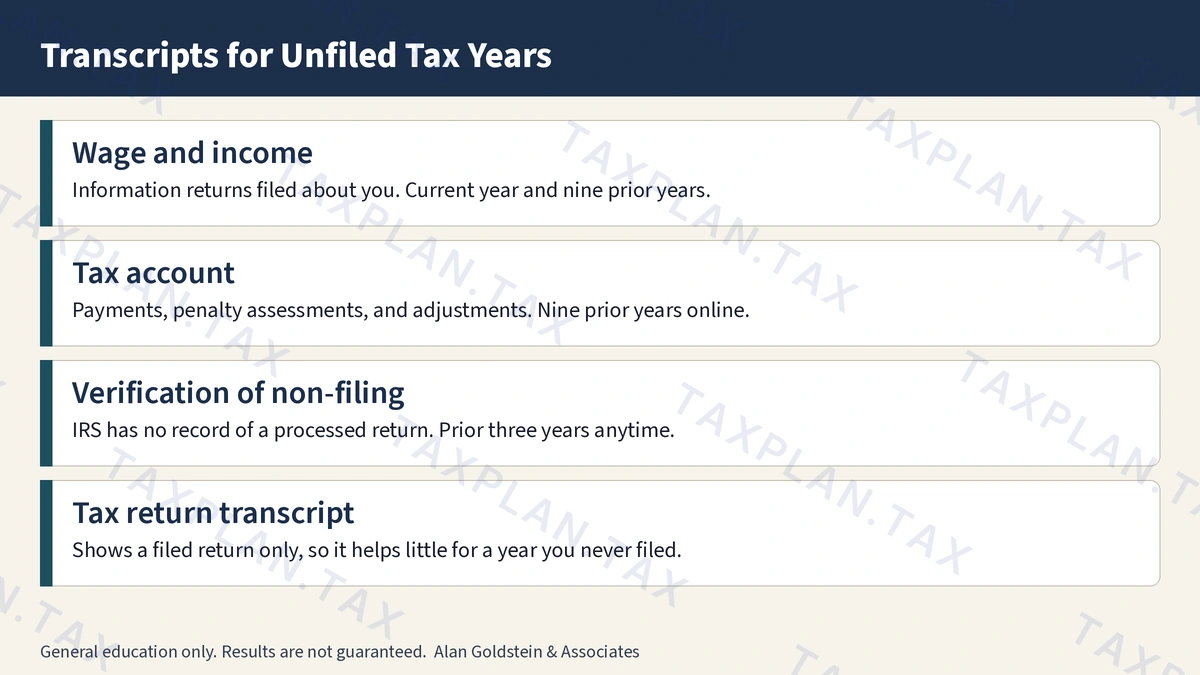

You can get IRS transcripts for unfiled tax years through your online account, by mail, by phone, or with Form 4506-T. However, a year with no filed return has no return transcript. For those years, the useful records are the wage and income transcript, the account transcript, and the verification of non-filing letter. This guide explains how to get each one and what limits apply.
Key Takeaways
- A tax return transcript reflects a filed return, so it is not much help for a year you never filed.
- The wage and income transcript is generally available for the current year and nine prior years.
- The fastest route is your IRS Individual Online Account. Mail, phone, and Form 4506-T are alternatives.
- A verification of non-filing letter says the IRS has no record of a processed return. It does not say you must file.
- Transcripts may be incomplete. Use them with your own records, not instead of them.
Which transcripts for unfiled tax years can you request?
You can request five transcript types. For an unfiled year, three of them matter most: wage and income, account, and verification of non-filing.
A transcript is an IRS summary of tax data. It is not a photocopy of your return. The IRS lists the types and years on its transcript types page.
| Transcript | What it shows | Years available (IRS) |
|---|---|---|
| Tax return | Line items from your original return as filed | Current and three prior years |
| Tax account | Filing status, taxable income, payments, and later changes | Current and nine prior years online; three prior years by mail or phone |
| Record of account | Return and account transcripts combined | Current and three prior years |
| Wage and income | Data from information returns such as W-2, 1098, 1099, and 5498 | Current and nine prior years |
| Verification of non-filing | Letter that the IRS has no record of a processed Form 1040-series return | Prior three years anytime; current year after June 15 |
Older years are available through Form 4506-T. For more on the filing side, see our guide to filing past-due federal tax returns.
Which transcripts matter most for unfiled years?
The wage and income transcript usually matters most. It shows what payers reported about you. The account transcript and non-filing letter then show what the IRS has on file.
What does the wage and income transcript show?
It shows data from information returns the IRS received, such as Forms W-2, 1098, 1099, and 5498. It helps you rebuild income for a year with no return.
The IRS says the transcript only displays information returns filed with the IRS, which may not reflect every document issued to you. It is also limited to roughly 85 income documents online. Treat it as a starting point, not a complete record of income.
What does the account transcript show?
It shows account activity, such as payments, penalty assessments, and adjustments. For an unfiled year, it can show whether the IRS has already assessed tax.
According to Form 4506-T, an account transcript includes payments made, penalty assessments, and adjustments after a return was filed. If the IRS prepared a substitute return for you under IRC §6020(b), an assessment may appear here. Check each year before you file. Our article on what a substitute for return is explains why.
What is a verification of non-filing letter?
It is an IRS letter saying it has no record of a processed Form 1040-series return for that year, as of the request date. It does not say whether you were required to file.
The IRS says the letter is available for the prior three years at any time and for the current year after June 15. Use Form 4506-T for older years. Lenders and other agencies sometimes ask for this letter. For filing purposes, it mainly confirms what the IRS sees.
How do you get transcripts online?
Sign in to your IRS Individual Online Account and open Tax Records, then Transcripts. This is the fastest method, and it is available 24 hours a day.
The IRS says you need to register through Login.gov or ID.me before you can sign in (IRS transcript FAQs). The Get Transcript page says you can view, print, or download transcripts there. Also, a secondary taxpayer on a joint return can request any available transcript.
If you cannot verify your identity, use mail, phone, or Form 4506-T instead.
How do you get transcripts by mail or phone?
You can request a tax return or tax account transcript by mail through Get Transcript, or by calling 800-908-9946. Delivery takes 5 to 10 calendar days.
The IRS says these methods cover only the current and three prior years, and they use the address on your latest return. If your address changed, the IRS says to file Form 8822 before you request by mail. Those channels do not offer the wage and income transcript. For that transcript, use the online account or Form 4506-T.
How does Form 4506-T work for older years?
Form 4506-T lets you request any transcript type, including years not available online. For wage and income data, check line 8.
The April 2025 revision of Form 4506-T says the IRS may provide Form W-2, 1099, 1098, and 5498 data for up to 10 years. It says most requests are processed within 10 business days. The form must reach the IRS within 120 days of the signature date. In addition, the IRS mails transcripts only to your address of record. The IRS does not fax transcripts or mail them to third parties.
The IRS also tells past-due filers to use Form 4506-T and check line 8 if they need wage and income information (IRS: Filing past due tax returns).
Can a tax professional get transcripts for you?
Yes, with proper authorization. The IRS self-service tools are for taxpayers to retrieve their own records. Professionals use a separate system.
The IRS says tax professionals with proper authorization can use the Transcript Delivery System through e-Services (About tax transcripts). A representative generally needs a signed Form 2848 or Form 8821 on file. Form 8821 allows a person to receive your confidential information. Form 2848 also allows representation.
What if the transcript will not generate or looks wrong?
Try another method and check the IRS notes below. The most common problems are volume limits, timing, address mismatches, and identity theft.
- Too many documents. If you have more than about 85 income documents, the online transcript will not generate. Submit Form 4506-T.
- Current year shows no record. The IRS says the information may not have populated yet. It generally becomes available in early February.
- Address mismatch. Use the exact address from your latest return, or file Form 8822 first.
- Possible identity theft. The IRS says to call 800-829-1040 if the transcript contains unfamiliar information.
IRS records are not always conclusive. In Roberts v. Commissioner (11th Cir. 2003), the court noted that a different record, Form 4340, is presumptive evidence that tax was validly assessed. An account transcript is not Form 4340. Still, the case shows why you should review IRS records carefully and raise errors early.
What should you do after you get your transcripts?
Compare them with your own records, then plan the returns. Transcripts are inputs, not a finished return.
- Check each year for an existing substitute-return assessment.
- List all income on the wage and income transcripts.
- Add income that no payer reported, such as cash receipts.
- Gather records for deductions and credits.
- Prepare and file each required return.
Frequently Asked Questions
Can I get a tax return transcript for a year I never filed?
Generally no. A return transcript shows your original return as filed. If you never filed, request wage and income, account, and non-filing records instead.
How far back can I get wage and income transcripts?
The IRS says the current year and nine prior years through the online account. Form 4506-T says up to 10 years. Availability can vary, so check the IRS page for your year.
Are transcripts free?
Yes. The IRS says it offers these transcript types at no charge.
Why does my transcript show only partial Social Security numbers?
The IRS partially masks personal identifiers, while financial amounts remain fully visible. It says it provides unmasked wage and income transcripts when needed to prepare and file returns.
Does a non-filing letter mean I did not need to file?
No. The letter only says the IRS has no record of a processed return. It does not indicate whether you are required to file.
Can a transcript replace my records?
No. It shows only information returns filed with the IRS, which may not reflect all income. You still must report all income, including amounts no payer reported.
Can I get transcripts for a business?
Yes, but the process differs. The IRS directs business taxpayers to its business transcript options through a business tax account.
Should I get transcripts before contacting the IRS?
Often yes. Transcripts show what the IRS already has, and you can order them online without contacting anyone. If you received a notice, still follow its deadline.
Conclusion
Getting transcripts for unfiled tax years is usually the first step in catching up. The wage and income transcript shows reported income, and the account transcript shows what the IRS has already done. Neither replaces a complete review of your own records.
Alan Goldstein, MBA, IRS Enrolled Agent, of Alan Goldstein & Associates in Coral Gables, Florida, helps taxpayers obtain transcripts and prepare past-due returns. We can review what the IRS has on file, rebuild missing records, and evaluate payment and relief options. We cannot guarantee any outcome. To request a confidential review of your unfiled returns, visit our Tax Resolution Services page.
Cases Cited
Sources
- IRS: Transcript types for individuals and ways to order them
- IRS: Get transcript
- IRS: Transcript services for individuals, FAQs
- IRS: About tax transcripts
- IRS: Form 4506-T, Request for Transcript of Tax Return (Rev. April 2025)
- IRS: Filing past due tax returns
- IRS: About Form 2848, Power of Attorney and Declaration of Representative
- IRS: About Form 8821, Tax Information Authorization
- IRC §6020, Returns prepared for or executed by Secretary
- Roberts v. Commissioner, 329 F.3d 1224 (11th Cir. 2003) (opinion text, Public.Resource.Org; pinpoint page not confirmed)
This article is provided for general educational purposes and does not constitute individualized tax, legal, or accounting advice. Tax consequences depend on the taxpayer’s specific facts and applicable law.
