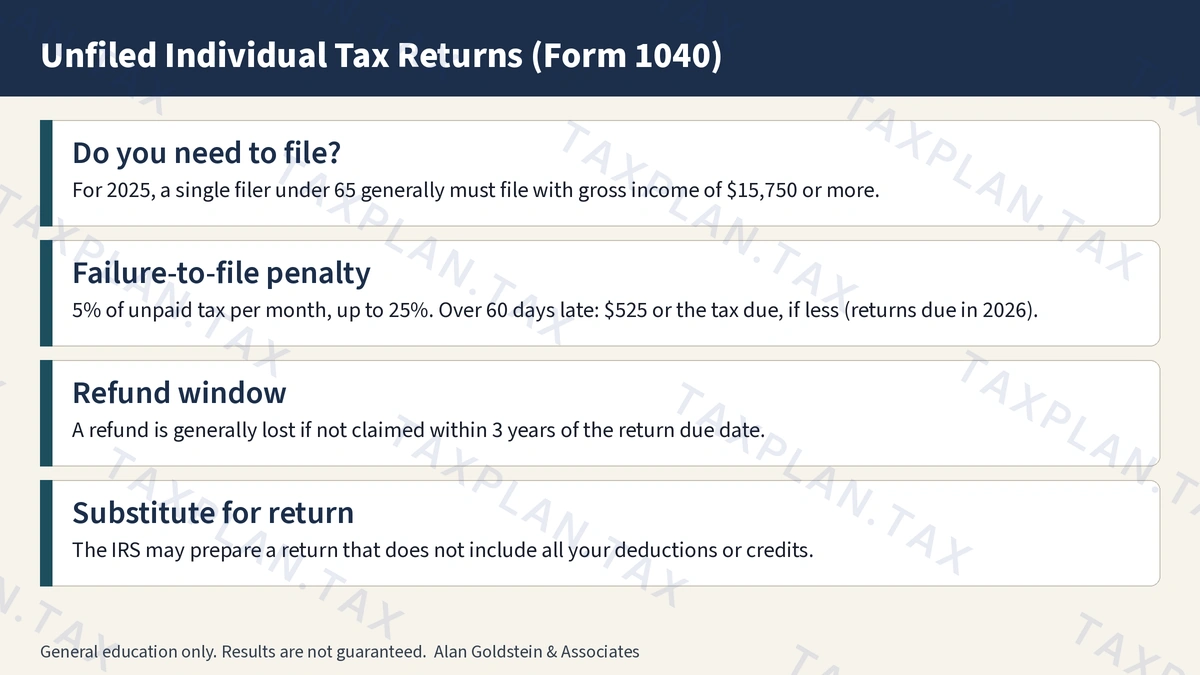

Unfiled individual tax returns can grow into a costly problem, but they can usually be fixed. If you were required to file Form 1040 and did not, penalties and interest may apply to any unpaid tax. You may also lose refunds, and the IRS may file a return for you. This guide explains who must file Form 1040, what happens when you do not, and how to catch up.
Key Takeaways
- Whether you must file depends on your filing status, age, and gross income. Self-employed people face a lower threshold.
- The failure-to-file penalty is 5% of unpaid tax per month, up to 25%, with a minimum after 60 days.
- A refund is generally lost if you do not file within about 3 years of the original due date.
- If you do not file, the IRS may prepare a substitute return that may not include all your deductions.
- Most late filers face civil penalties, not prosecution. Criminal charges require willfulness.
Who has to file Form 1040?
You generally must file if your gross income meets the threshold for your filing status and age. Special rules also apply, such as for self-employment income.
For 2025 returns, the IRS lists these gross income thresholds for most people (IRS: 2025 Instructions for Form 1040):
| Filing status (2025) | Age at end of 2025 | File if gross income was at least |
|---|---|---|
| Single | Under 65 | $15,750 |
| Married filing jointly | Both under 65 | $31,500 |
| Married filing separately | Any age | $5 |
| Head of household | Under 65 | $23,625 |
In addition, the IRS says you generally must file if your net earnings from self-employment were $400 or more (IRS: Self-employed individuals tax center). Thresholds change each year, so check the instructions for each missing year. You can also use the IRS tool to check whether you need to file.
Should you file even if you are not required to?
Often, yes. The IRS notes that you should file to get a refund of any federal income tax withheld. It also says you should file if you qualify for certain credits, such as the earned income credit. So a low-income year can still be worth filing.
What penalties apply to unfiled individual tax returns?
The main penalties are failure to file and failure to pay. Both are based on unpaid tax, and interest runs on top of them.
Under IRC §6651(a)(1), the failure-to-file penalty is 5% of the unpaid tax for each month or part of a month, up to 25%. If the return is more than 60 days late, a minimum penalty applies. For returns due after December 31, 2025, the IRS lists $525 or 100% of the unpaid tax, whichever is less (IRS: Failure to file penalty). The minimum was $510 for returns due in 2025.
The failure-to-pay penalty is generally 0.5% per month, up to 25% (IRS: Failure to pay penalty). When both apply in the same month, §6651(c)(1) reduces the failure-to-file penalty by the failure-to-pay amount. However, if the failure to file is fraudulent, §6651(f) raises the rate to 15% per month, up to 75%.
How much interest does the IRS charge?
The IRS underpayment rate is 7% for October through December 2026 (IRS: Quarterly interest rates). It rises to 8% for the quarter beginning January 1, 2027 (IR-2026-144). Interest compounds daily and also runs on penalties. For a full comparison, see our post on the failure-to-file vs. failure-to-pay penalty.
What happens if the IRS files a return for you?
The IRS may prepare a substitute for return (SFR) using information from employers, banks, and other payers. That return might not give you credit for deductions you could claim.
The authority comes from IRC §6020(b). Typically, the process starts with a notice such as the CP59, which says the IRS has no record that you filed your prior year return (IRS: Understanding your CP59 notice). Later, the IRS may send a Notice of Deficiency CP3219N proposing a tax assessment. Then you have 90 days to file your past-due return or petition the Tax Court (IRS: Filing past due tax returns).
Filing your own accurate return is usually the best response. To learn more, read IRS substitute for return: risks and how to respond.
Can you still get a refund on unfiled individual tax returns?
Only if you file within the refund window. In general, you must claim a refund within 3 years of filing the return or 2 years of paying the tax, and refund limits apply (IRS: Time you can claim a credit or refund).
For a late original return, the return itself is the claim. Under IRC §6511 and §6513, withholding and estimated payments are generally treated as paid on the original due date. As a result, a refund is usually lost if you file more than 3 years after that date. For details, see our article on the refund deadline for unfiled federal tax returns.
How far back can the IRS go on unfiled Form 1040s?
Legally, there is no assessment deadline for a year with no return. Under IRC §6501(c)(3), the IRS may assess tax at any time for that year.
In practice, though, IRS policy generally limits delinquency enforcement to six years. The Internal Revenue Manual (IRM 4.12.1) says the enforcement period under Policy Statement P-5-133 is not to be more than six years. Still, it allows longer or shorter periods based on the facts.
Can you go to jail for unfiled individual tax returns?
It is possible but uncommon, and it requires willfulness. Under IRC §7203, a willful failure to file is a misdemeanor, with a fine of up to $25,000, up to one year in prison, or both.
The Supreme Court defined willfulness in Cheek v. United States (1991). The Court said the standard is the “voluntary, intentional violation of a known legal duty” (498 U.S. at 201). That is a high bar. Most people who fall behind face civil penalties instead. If your facts involve hidden income or false statements, however, speak with a qualified professional first.
Can you get penalty relief on a late Form 1040?
Possibly. The IRS may grant relief for reasonable cause or under First Time Abate. Neither is guaranteed.
First Time Abate (FTA) requires timely compliance for the prior three years (IRS: Administrative penalty relief). The IRS also says it is moving to an Automatic Exemption from Penalty (AEP) for Form 1040, starting with 2025 tax year returns. People with several missing years often will not meet the history test.
Reasonable cause looks at whether you used ordinary care and still could not file (IRS: Penalty relief for reasonable cause). However, relying on a preparer to file on time usually is not enough. In United States v. Boyle (1985), the Supreme Court said “tax returns imply deadlines” (469 U.S. at 251).
How do you file unfiled individual tax returns?
Gather your income records, file each missing year on that year’s form, and then address any balance.
- Get your transcripts. First, request wage and income transcripts through Get Transcript. They show what employers and payers reported.
- Use the right forms. Next, use the form for each tax year. The IRS posts prior-year forms and instructions.
- Add your own records. Then include income the IRS may not have, plus deductions and credits you can support.
- File and track. After that, file each return and keep proof of filing.
- Resolve the balance. Finally, review payment plans and penalty relief.
For a step-by-step checklist, see how to file past-due federal tax returns.
Frequently Asked Questions
Do I have to file if I had no income?
Generally, no, if your gross income was below the threshold for your status and age. Even so, filing may get you a refund of withholding or refundable credits.
Why is the married filing separately threshold only $5?
That is the figure in the IRS chart for married filing separately. So almost anyone using that status with income must file.
What is the minimum penalty on a late 2025 Form 1040?
For a return due after December 31, 2025 that is more than 60 days late, the IRS lists $525 or 100% of the unpaid tax, whichever is less.
Will I get a refund for a year I never filed?
Only if you file within the refund period. Once it closes, the refund is generally lost, even though you must still file if required.
Is it a crime not to file a tax return?
A willful failure to file is a misdemeanor under §7203. Willfulness means a voluntary, intentional violation of a known legal duty, per Cheek.
Can I e-file a past-due return?
Sometimes. E-filing depends on the tax year and your software. Otherwise, you can mail a paper return.
What if I already got a CP59 notice?
Respond by the date in the notice. The CP59 asks you to file right away or explain why you do not need to file.
Conclusion
Unfiled individual tax returns become harder to fix the longer they wait. Penalties and interest grow, refunds expire, and the IRS may assess tax based on its own records. Filing accurate returns for each required year is usually the first and most useful step toward resolving the problem.
Alan Goldstein, MBA, IRS Enrolled Agent, of Alan Goldstein & Associates in Coral Gables, Florida, helps individuals catch up on past-due federal returns. We can obtain your IRS transcripts, prepare missing returns, and evaluate penalty relief and payment options. Every case depends on its facts, and we cannot guarantee any outcome. To request a confidential review, visit our Tax Resolution Services page.
Cases Cited
Sources and Authorities
- IRS: 2025 Instructions for Form 1040, Filing Requirements (Chart A)
- IRS: Self-employed individuals tax center
- IRS: Do I need to file a tax return?
- IRC §6651, Failure to file tax return or to pay tax
- IRS: Failure to file penalty (minimum penalty table)
- IRS: Failure to pay penalty
- IRS: Quarterly interest rates
- IRS: IR-2026-144, Interest rates increase for the first quarter of 2027
- IRC §6020, Returns prepared for or executed by Secretary
- IRS: Understanding your CP59 notice
- IRS: Filing past due tax returns
- IRS: Time you can claim a credit or refund
- IRC §6511, Limitations on credit or refund
- IRC §6513, Time return deemed filed and tax considered paid
- IRC §6501, Limitations on assessment and collection
- IRM 4.12.1, Nonfiled Returns (Enforcement Period, P-5-133)
- IRC §7203, Willful failure to file return, supply information, or pay tax
- Cheek v. United States, 498 U.S. 192, 201 (1991) (official U.S. Reports, Library of Congress)
- IRS: Penalty relief due to First Time Abate or other administrative waiver (including AEP)
- IRS: Penalty relief for reasonable cause
- United States v. Boyle, 469 U.S. 241, 251 (1985) (official U.S. Reports, Library of Congress)
- IRS: Get Transcript
- IRS: Prior year forms and instructions
This article is provided for general educational purposes and does not constitute individualized tax, legal, or accounting advice. Tax consequences depend on the taxpayer’s specific facts and applicable law.
