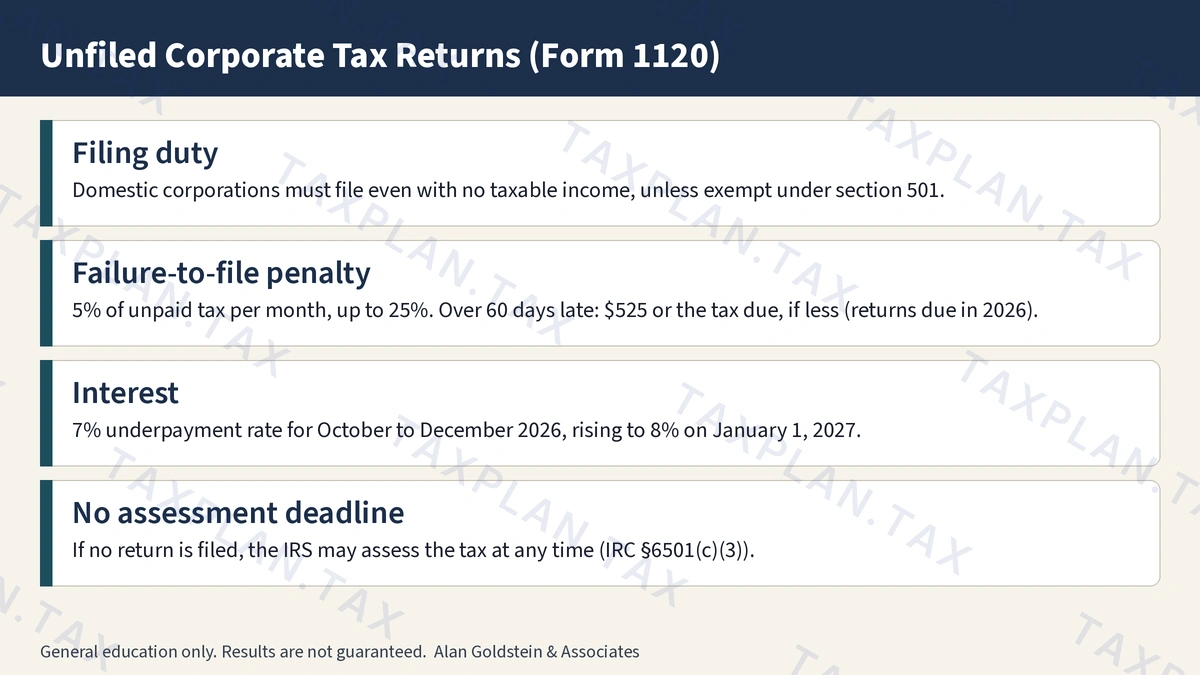

Unfiled corporate tax returns create risks that grow every month. A C corporation must file Form 1120 each year, even when it has no taxable income. If it does not, penalties and interest can build, and the IRS can assess tax at any time for that year. This guide explains what happens when a corporation misses its Form 1120, which penalties may apply, and how to get back into compliance.
Key Takeaways
- Unless exempt under section 501, every domestic corporation must file an income tax return, even with no taxable income.
- Form 1120 is generally due by the 15th day of the 4th month after the tax year ends.
- The failure-to-file penalty is 5% of unpaid tax per month, up to 25%. A minimum penalty may apply after 60 days.
- When no return is filed, the IRS can assess the tax at any time under IRC §6501(c)(3).
- Penalty relief may be available for reasonable cause or a clean compliance history. It is not automatic for long-term non-filers.
Does a corporation have to file Form 1120 if it had no income?
Yes, in most cases. The IRS says that, unless exempt under section 501, all domestic corporations must file an income tax return whether or not they have taxable income (IRS: Instructions for Form 1120).
That rule surprises many owners. A dormant company, a startup with only losses, or a holding company with little activity still has a filing duty. The duty also applies to corporations in bankruptcy. In addition, an LLC that elected to be taxed as a corporation generally files Form 1120 (IRS: About Form 1120).
What is a C corporation for tax purposes?
A C corporation is a corporation that pays federal income tax at the entity level. Under IRC §11(b), the corporate tax rate is 21% of taxable income. By contrast, an S corporation files Form 1120-S and generally passes income through to its shareholders.
When are unfiled corporate tax returns considered late?
A Form 1120 is late if it is not on file by the due date, including any valid extension. Generally, the due date is the 15th day of the 4th month after the end of the tax year.
For a calendar-year corporation, that usually means April 15. The IRS instructions also say that a corporation that has dissolved must generally file by the 15th day of the 4th month after the date it dissolved. So closing the business does not end the filing duty for its final year.
A corporation can request more time with Form 7004. However, the extension must be filed by the regular due date. Also, an extension gives more time to file, not more time to pay.
What penalties apply to unfiled corporate tax returns?
The main penalties are failure to file, failure to pay, and the estimated tax penalty. Interest also runs on unpaid tax.
The failure-to-file penalty comes from IRC §6651(a)(1). The Form 1120 instructions describe it as 5% of the unpaid tax for each month or part of a month the return is late, up to 25%. For a return required to be filed in 2026 that is more than 60 days late, the minimum penalty is the smaller of the tax due or $525.
How has the minimum penalty changed over time?
The minimum depends on the original due date of the return. The IRS publishes this table for Forms 1040 and 1120 (IRS: Failure to file penalty):
| Return due date (without extension) | Minimum penalty (if more than 60 days late) |
|---|---|
| After 12/31/2025 | $525, or 100% of the unpaid tax if less |
| 01/01/2025 to 12/31/2025 | $510, or 100% of the unpaid tax if less |
| 01/01/2024 to 12/31/2024 | $485, or 100% of the unpaid tax if less |
| 01/01/2023 to 12/31/2023 | $450, or 100% of the unpaid tax if less |
| 01/01/2020 to 12/31/2022 | $435, or 100% of the unpaid tax if less |
What about late payment and interest?
The failure-to-pay penalty is generally ½ of 1% of the unpaid tax per month, up to 25%. When both penalties apply for the same month, §6651(c)(1) reduces the failure-to-file penalty by the failure-to-pay amount.
Interest is separate, and it compounds daily under IRC §6621 and §6622. The IRS rate for underpayments is 7% for October through December 2026 (IRS: Quarterly interest rates). The IRS announced that this rate rises to 8% for the quarter beginning January 1, 2027 (IR-2026-144). For large corporate underpayments over $100,000, the rate is 9% for late 2026 and 10% for early 2027.
Finally, a corporation that did not make required quarterly payments may also owe the estimated tax penalty under IRC §6655. For a side-by-side view of the two main penalties, see our article on the failure-to-file vs. failure-to-pay penalty.
How long can the IRS go back on an unfiled Form 1120?
There is no time limit on assessment when no return was filed. Under IRC §6501(c)(3), the IRS may assess the tax “at any time” for that year.
The Supreme Court applied the same principle to a corporation decades ago. In Commissioner v. Lane-Wells Co. (1944), the company filed its regular Form 1120 but not a separate return the regulations required. The Court held that because the required return was not filed, the statute of limitations never began to run (321 U.S. at 224). The Court also stressed that the taxpayer has a duty to comply with the prescribed return forms (id. at 223).
In practice, though, the IRS usually focuses on recent years. Its policy statement P-5-133 sets a normal delinquency enforcement period of no more than six years, with exceptions based on the facts (IRM 4.12.1). Our guide to the statute of limitations on unfiled federal tax returns covers these time limits in more depth.
Can the IRS prepare a corporate return for you?
Yes. Under IRC §6020(b), if any person fails to make a required return, the IRS may prepare one from its own information.
This IRS-prepared return is often called a substitute for return (SFR). It may not reflect the deductions or credits the company could claim on its own return. As a result, the proposed tax can be much higher than the true amount. The IRS’s delinquent return procedures appear in IRM 5.1.11. For more background, read what a substitute for return is and how it affects you.
Could unfiled corporate returns lead to criminal exposure?
Only in limited cases, and willfulness is the key element. Under IRC §7203, a willful failure to file a required return is a misdemeanor.
For a corporation, the statute allows a fine of up to $100,000. Most late filers face civil penalties, not prosecution. Still, a long pattern of non-filing, hidden income, or false statements can raise the stakes. In that case, the business should get professional advice before contacting the IRS.
Can a corporation get penalty relief for unfiled returns?
Possibly. The IRS may remove penalties for reasonable cause or under its administrative relief programs. Neither outcome is guaranteed.
Reasonable cause generally requires that the company used ordinary business care and prudence but still could not file on time (IRS: Penalty relief for reasonable cause). However, relying on an accountant to file is usually not enough. In United States v. Boyle (1985), the Supreme Court said “tax returns imply deadlines.” It also held that reliance on an agent “cannot function as a substitute for compliance with an unambiguous statute” (469 U.S. at 251). Even so, the Court treated reliance on an adviser’s substantive advice differently (id. at 250–251).
Does First Time Abate help a non-filing corporation?
Sometimes, but usually only for an isolated late year. The IRS says First Time Abate (FTA) requires a history of timely compliance for the prior three years (IRS: Administrative penalty relief). The IRS also states that FTA is transitioning to an Automatic Exemption from Penalty (AEP) starting in summer 2026. AEP covers Form 1120 and begins with 2025 tax year returns. A corporation with several missing years often will not meet the three-year history test.
How do you file unfiled corporate tax returns?
Start by confirming which years are missing, then rebuild the books and file the returns in order. A careful sequence helps reduce errors.
- Confirm the filing history. First, check the corporation’s IRS account and any notices. The IRS business tax account may help with this step.
- Confirm the tax classification. Next, make sure the company is a C corporation for each year. An old S election would change the form.
- Rebuild the records. Then reconcile bank statements, payroll filings, and 1099s for each open year.
- Prepare the returns. After that, file the oldest required year first, so carryovers flow correctly.
- Address the balance. Finally, review payment options and penalty relief requests.
Also check the payroll side. Unpaid payroll taxes can lead to the personal Trust Fund Recovery Penalty under IRC §6672. Our guide on unfiled federal tax returns for small business owners covers payroll and information returns.
Frequently Asked Questions
Do I need to file Form 1120 for a corporation that never did business?
Generally, yes, unless the corporation is exempt under section 501. The IRS instructions say domestic corporations must file whether or not they have taxable income.
What is the minimum penalty for a late 2025 Form 1120?
For a return required to be filed in 2026 that is more than 60 days late, the IRS lists the smaller of the tax due or $525.
Is there a penalty if the corporation owes no tax?
The §6651 failure-to-file penalty is a percentage of unpaid tax. So if no tax is due, that penalty is generally zero. Other penalties or notices may still apply.
Can the IRS go back more than six years?
Yes, it can. The six-year period is an enforcement policy, not a statute. Legally, §6501(c)(3) allows assessment at any time when no return was filed.
Will filing late returns stop IRS collection?
Filing alone does not stop collection. However, it is usually a first step before the IRS will consider a payment plan or other resolution option.
Does dissolving the corporation end the filing duty?
No. The IRS says a dissolved corporation must generally file its final return by the 15th day of the 4th month after dissolution.
Can I rely on my accountant’s failure to file as reasonable cause?
Usually not. The Supreme Court held in Boyle that relying on an agent to meet a filing deadline is not reasonable cause.
Conclusion
Unfiled corporate tax returns rarely fix themselves. Penalties and interest can keep growing, and the IRS has no assessment deadline for a year with no return. The good news is that filing accurate returns can replace an IRS estimate and limit further penalties. It also opens the door to payment and relief options.
Alan Goldstein, MBA, IRS Enrolled Agent, of Alan Goldstein & Associates in Coral Gables, Florida, helps businesses resolve unfiled returns and IRS balances. We can review your filing history, prepare past-due returns, and evaluate penalty relief and collection options. Every case depends on its facts, and we cannot guarantee any outcome. To request a confidential review, visit our Tax Resolution Services page.
Cases Cited
- Commissioner v. Lane-Wells Co., 321 U.S. 219, 223–224 (1944)
- United States v. Boyle, 469 U.S. 241, 250–251 (1985)
Sources and Authorities
- IRS: Instructions for Form 1120 (2025), Who Must File, When To File, and Interest and Penalties
- IRS: About Form 1120, U.S. Corporation Income Tax Return
- IRC §11, Tax imposed (corporations)
- IRS: About Form 7004
- IRC §6651, Failure to file tax return or to pay tax
- IRS: Failure to file penalty (minimum penalty table)
- IRC §6621, Determination of rate of interest
- IRS: Quarterly interest rates
- IRS: IR-2026-144, Interest rates increase for the first quarter of 2027
- IRC §6655, Failure by corporation to pay estimated income tax
- IRC §6501, Limitations on assessment and collection
- Commissioner v. Lane-Wells Co., 321 U.S. 219, 223–224 (1944) (official U.S. Reports, Library of Congress)
- IRM 4.12.1, Nonfiled Returns (Enforcement Period, P-5-133)
- IRC §6020, Returns prepared for or executed by Secretary
- IRM 5.1.11, Delinquent Returns
- IRC §7203, Willful failure to file return, supply information, or pay tax
- IRS: Penalty relief for reasonable cause
- United States v. Boyle, 469 U.S. 241, 250–251 (1985) (official U.S. Reports, Library of Congress)
- IRS: Penalty relief due to First Time Abate or other administrative waiver (including AEP)
- IRS: Business tax account
- IRC §6672, Failure to collect and pay over tax
This article is provided for general educational purposes and does not constitute individualized tax, legal, or accounting advice. Tax consequences depend on the taxpayer’s specific facts and applicable law.
