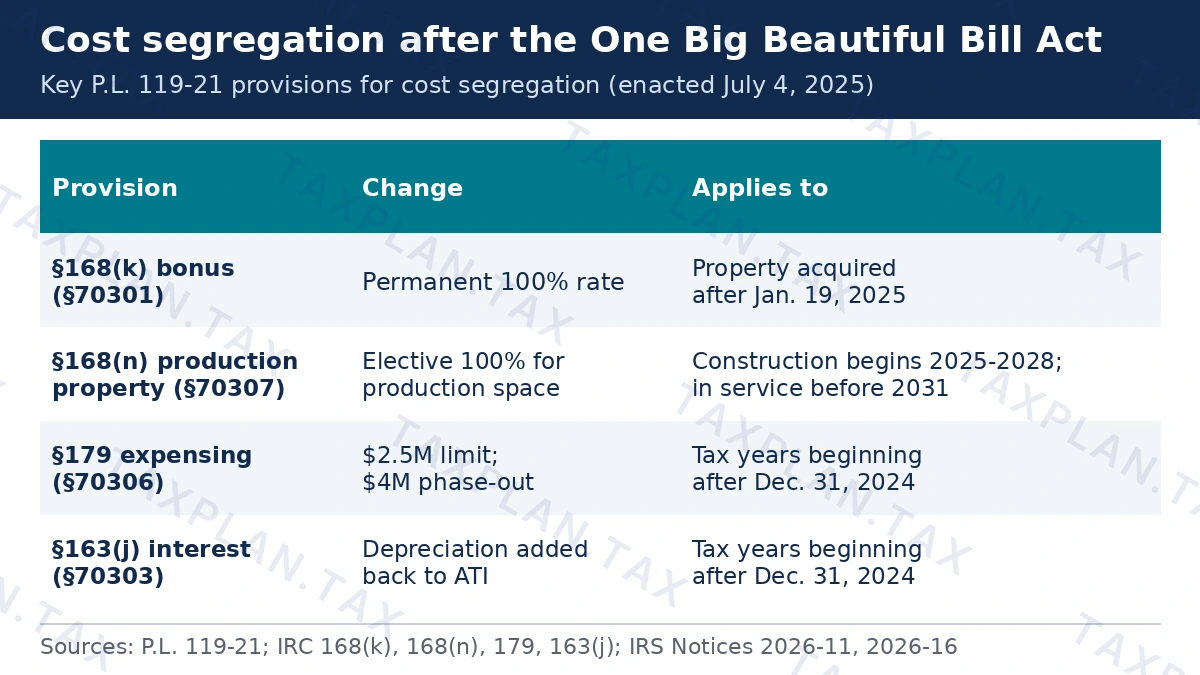

After the One Big Beautiful Bill Act, cost segregation is more valuable for most buildings acquired after January 19, 2025, because the components a study identifies can again be deducted 100% in the first year. The law, Public Law 119-21, was enacted July 4, 2025. First, section 70301 made the §168(k) bonus rate a permanent 100% for qualified property acquired after January 19, 2025. Next, section 70307 added a separate, temporary 100% allowance in §168(n) for certain factory space. Also, section 70306 raised the §179 limit to $2,500,000, with a $4,000,000 phase-out threshold. In addition, section 70303 restored the depreciation add-back in the §163(j) interest limit.
Still, the core rules did not change. Buildings remain 27.5- or 39-year property, and classification still follows the case law. Recapture, passive loss limits, and look-back procedures also work as before. Meanwhile, property acquired under a binding contract signed before January 20, 2025, keeps the old phase-down.
So this guide explains what changed for cost segregation after the One Big Beautiful Bill Act, what stayed the same, and how to plan.
Key Takeaways
- The One Big Beautiful Bill Act made 100% bonus depreciation permanent for qualified property acquired after January 19, 2025.
- However, pre-January 20, 2025, binding contracts keep the old schedule: 40% in 2025 and 20% in 2026.
- New §168(n) allows an elective 100% deduction for qualified production property, with firm deadlines.
- Also, the §179 limit is now $2,500,000, reduced above $4,000,000, for tax years beginning after 2024.
- The §163(j) limit again adds back depreciation, so large deductions no longer shrink it.
- Still, recovery periods, classification tests, recapture, and Form 3115 look-back rules are unchanged.
What Did the One Big Beautiful Bill Act Change?
Direct answer: Four provisions matter most for cost segregation: bonus depreciation, qualified production property, §179 expensing, and the business interest limit.
For reference, the IRS calls the law “commonly known as the One, Big, Beautiful Bill Act” in Notice 2026-11. Before the law, the Tax Cuts and Jobs Act phased bonus depreciation down by 20 points a year after 2022. According to the notice, the rate was 40% for property placed in service in 2025. Under the prior schedule described in the IRS Cost Segregation Audit Techniques Guide, it would have dropped to 20% in 2026 and zero after 2026.
| Provision (P.L. 119-21) | What changed | Effective for |
|---|---|---|
| §70301, bonus depreciation (§168(k)) | Permanent 100% rate | Property acquired after January 19, 2025 |
| §70307, qualified production property (§168(n)) | Elective 100% for certain production space | Construction begins after January 19, 2025, and before 2029; placed in service before 2031 |
| §70306, §179 expensing | $2,500,000 limit; $4,000,000 phase-out threshold | Property placed in service in tax years beginning after December 31, 2024 |
| §70303, §163(j) interest limit | Depreciation added back to adjusted taxable income | Tax years beginning after December 31, 2024 |
For more detail on the bonus rules alone, see our article on permanent 100% bonus depreciation and cost segregation.
How Does Cost Segregation Work After the One Big Beautiful Bill Act?
Direct answer: The study still separates a building’s cost into recovery classes. In other words, the new law mainly changes how much of the short-life amount you can deduct in year one.
Which components get 100% bonus?
Under §168(k)(2)(A), qualified property generally includes MACRS property with a recovery period of 20 years or less. So in a study, that usually means 5- and 7-year personal property and 15-year land improvements. Qualified improvement property also has a 15-year recovery period. By contrast, the building shell stays 27.5- or 39-year property and does not qualify.
How is the acquisition date set?
Notice 2026-11 applies the binding contract rules in Treas. Reg. §1.168(k)-2(b)(5), using January 19, 2025, as the cutoff. So property bought under a written binding contract signed before January 20, 2025, generally keeps the old rate. However, contract terms such as cancellation periods and contingencies can move the acquisition date.
Is there a transition choice?
Yes. Under §168(k)(10), you may elect 40% instead of 100% for qualified property placed in service in your first tax year ending after January 19, 2025. Similarly, the rate is 60% for certain longer production period property. Also, §168(k)(7) still lets you elect out of bonus for any class of property for a year.
How does §168(n) fit with a study?
Section 168(n) allows an elective 100% deduction for the portion of new nonresidential real property used as an integral part of manufacturing, production, or refining. However, it excludes office, administrative, lodging, parking, sales, research, software development, and engineering space. It also excludes space a lessee uses, from the lessor’s point of view. Consequently, a study that separates production space from other space can matter for a manufacturer. In addition, the IRS issued interim guidance in Notice 2026-16. Finally, under §168(n)(5), recapture applies if the property stops serving production within 10 years.
What Are the Benefits of Cost Segregation Under the One Big Beautiful Bill Act?
Direct answer: Larger first-year deductions, more planning flexibility, and fewer collateral limits on those deductions.
- No phase-down cliff. For property acquired after January 19, 2025, the 100% rate has no scheduled end date.
- Bigger §179 capacity. Also, under §179, the limit is $2,500,000. For nonresidential property, §179(e) can also reach certain later improvements, such as roofs, HVAC, fire protection and alarm systems, and security systems. In addition, the dollar amounts are indexed for inflation after 2025.
- Interest limit relief. Under §163(j), business interest is generally limited to 30% of adjusted taxable income. Since depreciation is again added back, a large cost segregation deduction no longer reduces that cap.
- Manufacturing upside. Moreover, section 168(n) can reach structural production space that §168(k) does not cover.
- Look-back value. Owners who placed buildings in service in 2025 without a study can still claim the missed depreciation later.
What Legal Rules Still Apply After the One Big Beautiful Bill Act?
Direct answer: The classification rules, interim nature of the guidance, and the usual limits all remain.
Classification still follows the case law
In short, the One Big Beautiful Bill Act changed rates, not definitions. In Hospital Corp. of America v. Commissioner, 109 T.C. 21, 48-52 (1997), the Tax Court held that the former investment tax credit tests decide §1245 status for depreciation. Similarly, Whiteco Industries, Inc. v. Commissioner, 65 T.C. 664, 672-673 (1975), lists factors for whether property is inherently permanent. Those tests still determine which components are eligible for bonus.
Timing and allocations still matter
In Sears Oil Co. v. Commissioner, 359 F.2d 191, 198 (2d Cir. 1966), the court allowed depreciation from the date an asset was ready and available for use. So that timing matters for the §168(n) placed-in-service deadline. Next, in Peco Foods, Inc. v. Commissioner, 522 F. App’x 840, 843-844 (11th Cir. 2013), the price allocation in its purchase agreements bound the buyer. So negotiate allocations with the study in mind.
Other limits
- Recapture. Also, bonus on components is depreciation for §1245 recapture on a taxable sale.
- Passive losses. In addition, IRC §469 can suspend large rental losses.
- Electing real property trades or businesses. However, a business that elects out of §163(j) must use ADS for its real property and qualified improvement property, under §168(g)(8). ADS property cannot take bonus.
- Interim guidance. Notice 2026-11 also says Treasury and the IRS intend to issue proposed regulations.
- State conformity. Many states do not follow federal bonus depreciation, so check state law.
What about buildings placed in service in 2025?
If you placed a building in service in 2025 and filed without a study, you still have options. Under section 6.01(1)(b) of Rev. Proc. 2025-23, you may amend the 2025 return before filing the 2026 return. Alternatively, you may file Form 3115 and take a §481(a) adjustment.
What Does Cost Segregation Look Like After the One Big Beautiful Bill Act?
Direct answer: The example below uses IRS Publication 946 rates on assumed facts. All amounts and dates are illustrative.
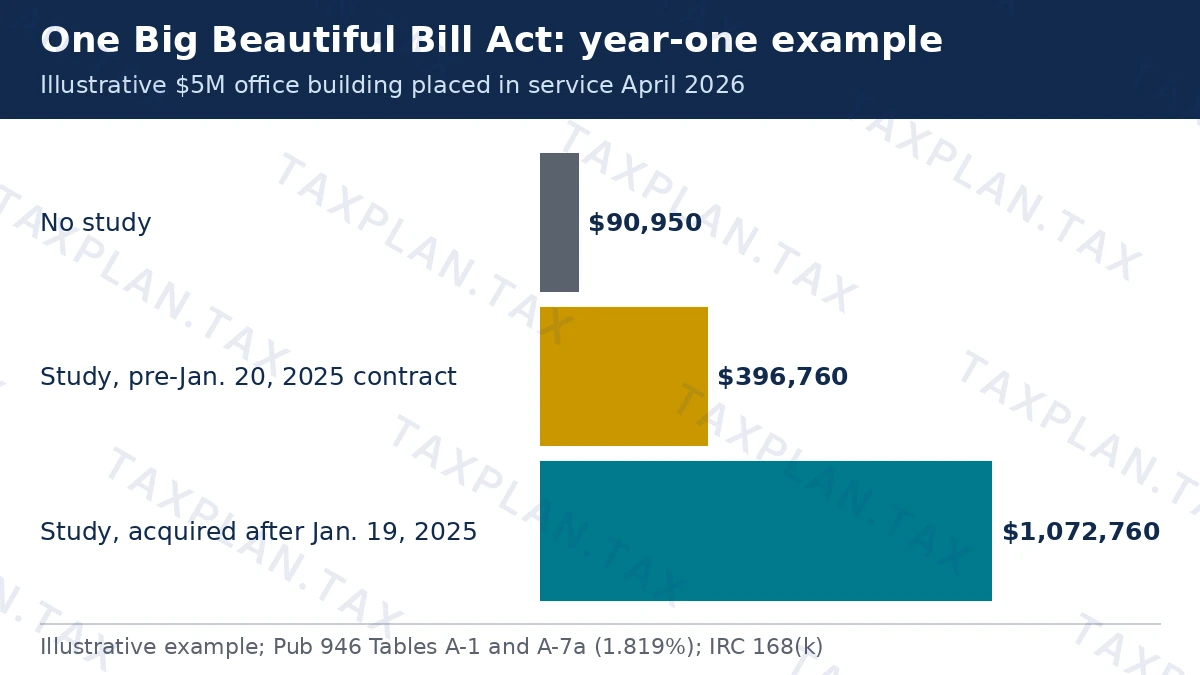
For example, assume an investor places an office building in service in April 2026. The depreciable basis, excluding land, is $5,000,000. Then a study finds $700,000 of 5-year property and $300,000 of 15-year land improvements. Meanwhile, the remaining $4,000,000 is 39-year property, at 1.819% for April under Publication 946 Table A-7a.
| Scenario (illustrative) | Components, year one | Building, year one | Total, year one |
|---|---|---|---|
| No study ($5,000,000 × 1.819%) | n/a | $90,950 | $90,950 |
| Study, pre-January 20, 2025, contract (20% bonus) | $324,000 | $72,760 | $396,760 |
| Study, acquired after January 19, 2025 (100% bonus) | $1,000,000 | $72,760 | $1,072,760 |
In the 20% case, bonus is $200,000. Then regular Table A-1 depreciation applies to the rest: $560,000 × 20% = $112,000 for 5-year property and $240,000 × 5% = $12,000 for 15-year property. That gives $324,000 for the components. By contrast, in the 100% case you deduct the components in full. Therefore, the One Big Beautiful Bill Act adds $676,000 of year-one depreciation in this example, compared with the old 20% rate.
What Are the Common Mistakes After the One Big Beautiful Bill Act?
Direct answer: Most mistakes come from assuming the new law covers every building or every part of a building.
- Using the closing date only. A binding contract signed before January 20, 2025, can lock in the old rate.
- Applying 100% to the building. Under §168(k), only components with recovery periods of 20 years or less qualify.
- Treating §168(n) as permanent. Unlike §168(k), qualified production property has construction and placed-in-service deadlines.
- Claiming §168(n) for leased space. A lessor cannot count space that a lessee uses, so check the lease.
- Forgetting recapture. Faster deductions now can mean ordinary income later.
- Skipping the study. Without one, most of the cost stays in the 27.5- or 39-year class.
Frequently Asked Questions
Did the One Big Beautiful Bill Act make bonus depreciation permanent?
Yes, for qualified property acquired after January 19, 2025. The law has no scheduled end date, although Congress could change it.
Does the One Big Beautiful Bill Act let me deduct the whole building?
Generally, no. Under §168(k), only components with 20-year or shorter recovery periods qualify. Section 168(n) also covers only qualifying production space.
What if I signed my purchase contract in 2024?
Generally, the old phase-down applies, not the One Big Beautiful Bill Act rate: 20% for property placed in service in 2026. Contract terms can change that result, so review them.
Is cost segregation still worth it with 100% bonus?
Often, yes, because the study is what identifies the components that qualify for 100% bonus.
Did the One Big Beautiful Bill Act change recovery periods?
No. Residential rental property is still 27.5 years and nonresidential real property is still 39 years.
Can I still do a look-back study?
Yes. Form 3115 and a §481(a) adjustment remain available for buildings placed in service in earlier years.
Is the IRS guidance final?
No. Notice 2026-11 and Notice 2026-16 are interim guidance, and Treasury expects to issue proposed regulations.
Conclusion: How Should You Plan Cost Segregation After the One Big Beautiful Bill Act?
In summary, the One Big Beautiful Bill Act restored and extended the first-year value of cost segregation for property acquired after January 19, 2025. It also added a manufacturing incentive, a larger §179 limit, and interest limit relief. Nevertheless, the benefit still depends on acquisition dates, contract terms, and a well-supported study.
That is where Emunah Cost Segregation can help. It works with owners and CPAs to apply the new rules to real properties and confirm which components qualify. Alan Goldstein, EA, reviews your contracts and records before any study begins and tells you plainly whether a study makes sense. Contact Emunah Cost Segregation in Coral Gables, Florida, to request a review. For a broader overview, see The Ultimate Guide to Cost Segregation Studies in 2026.
Cases Cited
- Hospital Corp. of America v. Commissioner, 109 T.C. 21, 48-52 (1997) (United States Tax Court). Pinpoint verified against the reporter-paginated opinion text. Opinion
- Whiteco Industries, Inc. v. Commissioner, 65 T.C. 664, 672-673 (1975) (United States Tax Court). Pinpoint verified against the reporter-paginated opinion text. Opinion
- Sears Oil Co. v. Commissioner, 359 F.2d 191, 198 (2d Cir. 1966). Pinpoint verified against the reporter-paginated opinion text. Opinion
- Peco Foods, Inc. v. Commissioner, 522 F. App’x 840, 843-844 (11th Cir. 2013) (unpublished), aff’g T.C. Memo. 2012-18. Pinpoint verified against the reporter-paginated opinion text. Opinion
Sources and Authorities
- 26 U.S.C. §168: https://www.law.cornell.edu/uscode/text/26/168
- 26 U.S.C. §179: https://www.law.cornell.edu/uscode/text/26/179
- 26 U.S.C. §163 (including §163(j)): https://www.law.cornell.edu/uscode/text/26/163
- 26 U.S.C. §1245: https://www.law.cornell.edu/uscode/text/26/1245
- 26 U.S.C. §469: https://www.law.cornell.edu/uscode/text/26/469
- 26 U.S.C. §481: https://www.law.cornell.edu/uscode/text/26/481
- Public Law 119-21 (H.R. 1, 119th Congress), §§70301, 70303, 70306, and 70307: https://www.congress.gov/bill/119th-congress/house-bill/1
- IRS Notice 2026-11: https://www.irs.gov/pub/irs-drop/n-26-11.pdf
- IRS Notice 2026-16: https://www.irs.gov/pub/irs-drop/n-26-16.pdf
- Treas. Reg. §1.168(k)-2: https://www.ecfr.gov/current/title-26/section-1.168(k)-2
- Rev. Proc. 2025-23 (List of Automatic Changes), section 6.01 (DCN 7): https://www.irs.gov/pub/irs-drop/rp-25-23.pdf
- About Form 3115: https://www.irs.gov/forms-pubs/about-form-3115
- IRS Publication 946, including Tables A-1, A-6, and A-7a: https://www.irs.gov/pub/irs-pdf/p946.pdf
- IRS Publication 5653 (2-2025), Cost Segregation Audit Techniques Guide: https://www.irs.gov/pub/irs-pdf/p5653.pdf
- Court opinions: see Cases Cited above.
This article is provided for general educational purposes and does not constitute individualized tax, legal, or accounting advice. Tax consequences depend on the taxpayer’s specific facts and applicable law.
