
Yes, cost segregation can still work for properties purchased years ago, and you can claim the missed depreciation in the current year without amending old returns. A study reclassifies parts of the building into 5-, 7-, and 15-year property as of the date you placed it in service. You then file Form 3115 under section 6.01 of Rev. Proc. 2025-23 (designated change number 7). The catch-up becomes a §481(a) adjustment that covers open and closed years.
However, the value depends heavily on when you bought the property. For a used building acquired after September 27, 2017, the catch-up can include bonus depreciation for the original year, unless you elected out. By contrast, components of a used building bought before September 28, 2017, generally did not qualify for bonus. In that case, the catch-up reflects regular MACRS depreciation only. Remaining basis, sale plans, and records also shape the result, so the review starts with the purchase file.
This guide explains how to judge whether a study on older property is worthwhile, and what the numbers can look like.
Key Takeaways
- Cost segregation for properties purchased years ago uses a Form 3115 automatic method change, not amended returns.
- The §481(a) adjustment captures missed depreciation from open and closed years in one year.
- The purchase date drives the result, because bonus can apply to used property acquired after September 27, 2017.
- For many properties purchased years ago, the catch-up fully recovers 5- and 7-year components, while 15-year items continue.
- Purchase price allocations, prior elections, and replaced components need review first.
- Also, recapture and passive loss rules affect the net benefit.
Why Consider Cost Segregation for Properties Purchased Years Ago?
Direct answer: Many owners depreciated the entire building over 27.5 or 39 years. A study can still recover the faster depreciation they missed.
A building includes many parts that are not structural. For example, certain electrical, finishes, millwork, site lighting, and paving can have recovery periods of 5, 7, or 15 years. So if nobody separated them at purchase, the owner depreciated them as part of the building. That is common with properties purchased years ago. The IRS Cost Segregation Audit Techniques Guide (Publication 5653) recognizes this situation. It also notes that a taxpayer may perform a study on used or previously existing property and then re-compute prior depreciation.
For the general catch-up mechanics, see our guide to bonus depreciation and cost segregation. Also, our article on when a cost segregation study is worth it covers the general screening factors.
How Does a Study Work on Properties Purchased Years Ago?
Direct answer: The study allocates your original basis among components, and the tax preparer compares allowable depreciation with what you actually claimed.
Which method change applies?
Under Treas. Reg. §1.446-1(e)(2)(ii)(d)(2)(i), a change in an asset’s recovery period or method is a change in accounting method. Example 9 of §1.446-1(e)(2)(iii) then applies the rule to a cost segregation study done years after the owner placed the building in service. In addition, section 6.01 of Rev. Proc. 2025-23 provides the automatic change for property you depreciated the same way for at least two years.
How is the catch-up computed?
Section 6.01(5) defines the §481(a) adjustment as the difference between depreciation claimed and depreciation allowable “for open and closed years prior to the year of change.” Then, under section 7.03 of Rev. Proc. 2015-13, you generally take a negative adjustment in the year of change. So a property bought in 2015 can produce one catch-up deduction in 2026 that reflects eleven years of missed depreciation.
Why does the purchase date matter for properties purchased years ago?
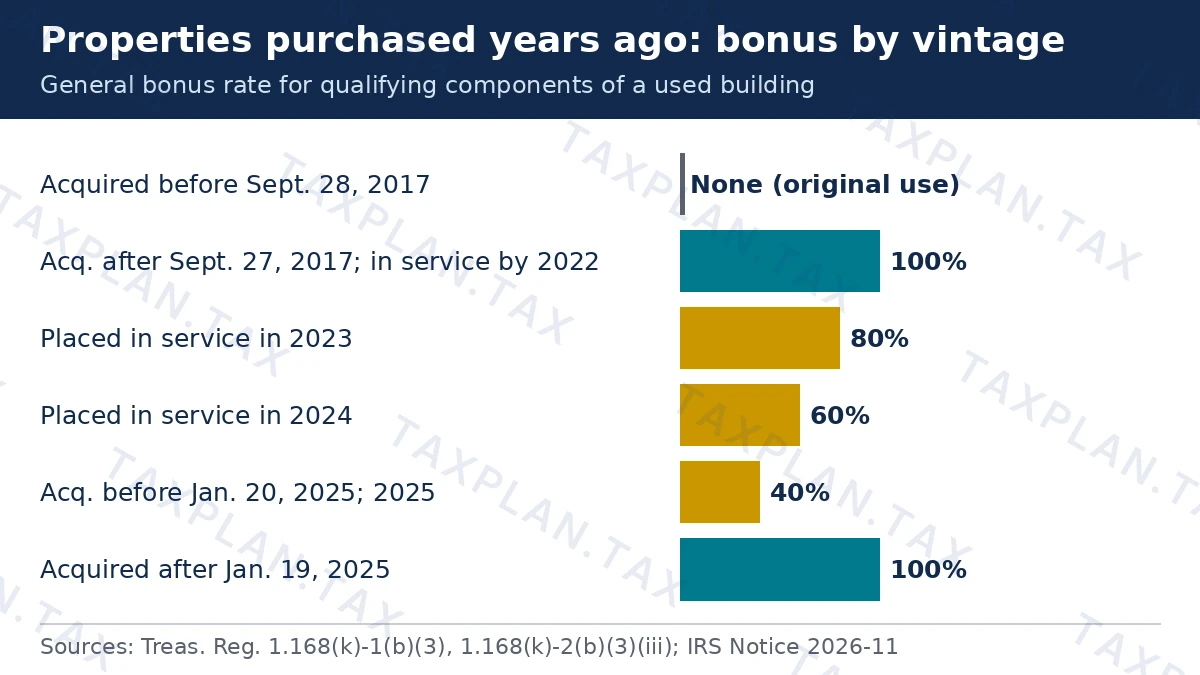
First, the allowable amount depends on the rules in effect when you placed the property in service. Under section 6.01(7)(e)(ii), allowable depreciation includes the §168(k) bonus for qualified property, unless you made a timely election out for that class. So whether a used building’s components counted as qualified property depends on the purchase date:
| When the used building was acquired and placed in service | General bonus rate for qualifying components |
|---|---|
| Acquired before September 28, 2017 | Generally none for used property (original use rule) |
| Acquired after September 27, 2017; placed in service before 2023 | 100% |
| Same acquisition rule; placed in service in 2023 | 80% |
| Same acquisition rule; placed in service in 2024 | 60% |
| Acquired before January 20, 2025; placed in service in 2025 | 40% |
| Acquired after January 19, 2025 | 100% |
Specifically, the pre-2017 rule comes from Treas. Reg. §1.168(k)-1(b)(3), which required that the original use begin with the taxpayer. The current regulation, §1.168(k)-2(b)(3)(iii), adds a path for used property acquired after September 27, 2017. Meanwhile, the later rates come from IRS Notice 2026-11, which describes the TCJA phase-down and the 100% rate for property acquired after January 19, 2025.
What Are the Benefits for Properties Purchased Years Ago?
Direct answer: The main benefit is a large one-year deduction plus faster depreciation on any remaining component basis.
- Closed years still count. The adjustment includes depreciation from years you can no longer amend.
- Fully recovered short-life items. For properties purchased years ago, the catch-up often recovers 5- and 7-year components entirely.
- Continued 15-year deductions. Land improvements also keep producing deductions after the year of change.
- Audit protection. Under section 8.01 of Rev. Proc. 2015-13, a timely Form 3115 generally protects the prior years for that item, subject to exceptions.
- Later improvements. A study can classify renovation costs incurred after the purchase too.
What Legal Rules Apply to Properties Purchased Years Ago?
Direct answer: The method change rules, the bonus regulations for the purchase year, basis rules, and case law on classification and allocations all apply to properties purchased years ago.
Why can you still recover depreciation you never claimed?
Under IRC §1016(a)(2), depreciation reduces basis, but by “not less than the amount allowable.” In Virginian Hotel Corp. v. Helvering, 319 U.S. 523, 525-526 (1943), the Supreme Court explained that the allowable amount reduces basis each year, whether or not it is claimed. Consequently, you would otherwise lose unclaimed depreciation through a lower basis. The accounting method change fixes that, because you claim the difference through the §481(a) adjustment.
Why did the rules change in 2004 and 2006?
At first, two appeals courts treated reclassifications as changes in useful life, which did not need consent. See Commissioner v. Brookshire Bros. Holding, Inc., 320 F.3d 507, 513 (5th Cir. 2003), and O’Shaughnessy v. Commissioner, 332 F.3d 1125, 1132 (8th Cir. 2003). Treasury responded with T.D. 9105 and then T.D. 9307. Today, however, the regulations treat a reclassification as a method change. According to the ATG, they apply to assets placed in service in a tax year ending on or after December 30, 2003.
Can the original purchase agreement limit the study?
Yes. In Peco Foods, Inc. v. Commissioner, 522 F. App’x 840, 843-844 (11th Cir. 2013), the taxpayer bought two plants and later filed Form 3115 based on a study. However, the court held that the allocation schedules in its purchase agreements bound it. Therefore, review the contract before ordering a study on an older acquisition.
What other limits matter?
- Classification tests. Hospital Corp. of America v. Commissioner, 109 T.C. 21, 48-52 (1997), applied the former investment tax credit tests to decide §1245 status.
- Prior elections. If you elected out of bonus for a class, the catch-up excludes bonus for that class. Also, DCN 7 does not cover late or revoked elections.
- Replaced components. The partial disposition election under Treas. Reg. §1.168(i)-8(d)(2) generally requires a timely original return for the year of disposition.
- Recapture. Gain on reclassified §1245 property is generally ordinary income to the extent of depreciation.
- Passive losses. IRC §469 can limit a large deduction from a rental activity.
What Do the Numbers Look Like for Properties Purchased Years Ago?
Direct answer: The examples below use IRS Publication 946 table rates and assumed facts. All amounts and dates are illustrative.
Example 1: A used office building bought in March 2015
First, assume an investor bought a used office building and placed it in service in March 2015. The depreciable basis, excluding land, was $3,000,000. Then, for 2015 through 2025, the investor used 39 years for everything. In 2026, a study finds $300,000 of 5-year property and $150,000 of 15-year land improvements.
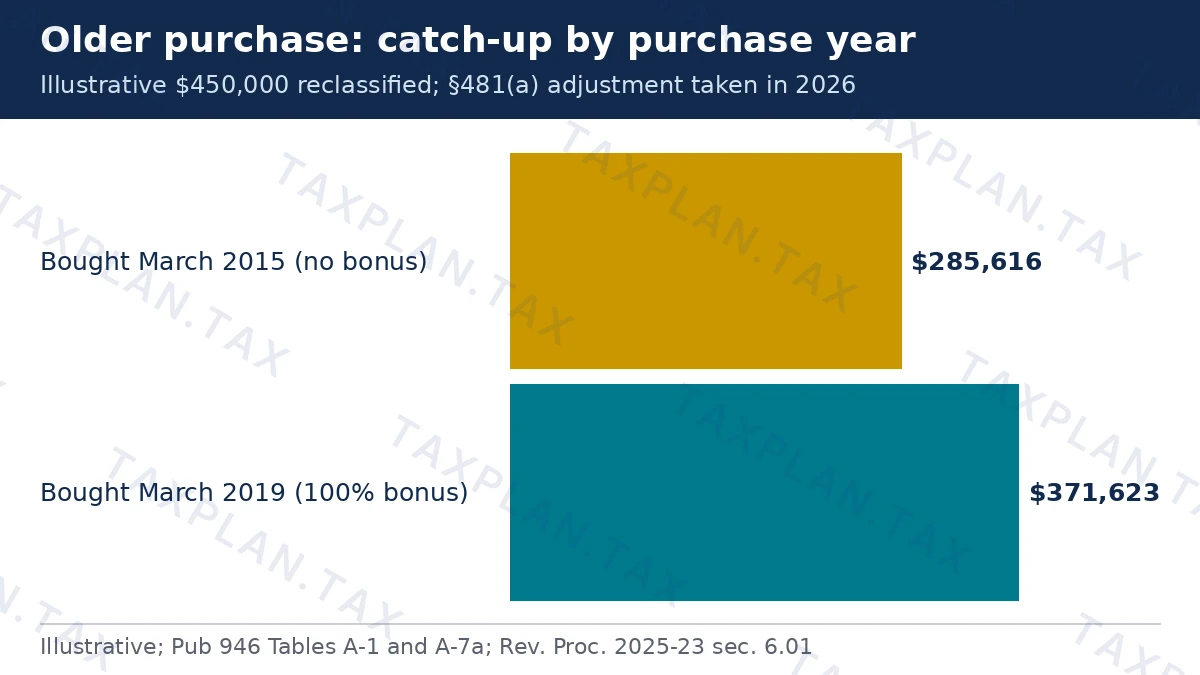
Start with the claimed amount. Under Publication 946 Table A-7a, the rates were 2.033% for 2015 and 2.564% for each of the next ten years. That totals 27.673% of $450,000, or about $124,529. Next, the allowable amount. Because the building was used and bought before September 28, 2017, assume no bonus applied. Under Table A-1, the 5-year property reaches full recovery in 2020, so $300,000 is allowable. Meanwhile, eleven years of 15-year rates total 73.43%, or $110,145. Total allowable is $410,145. Therefore, the negative §481(a) adjustment is about $285,616.
Example 2: The same building bought in March 2019
Now assume the same facts, except the purchase and placed-in-service date was March 2019. Claimed depreciation for 2019 through 2025 totals 17.417%, or about $78,377. Because the investor acquired the building after September 27, 2017, and placed it in service before 2023, the components qualified for 100% bonus. Assume no election out. So the allowable amount is $450,000, and the adjustment is about $371,623.
| Illustrative example | Claimed on components | Allowable on components | §481(a) adjustment in 2026 |
|---|---|---|---|
| Bought March 2015 (no bonus) | $124,529 | $410,145 | $285,616 |
| Bought March 2019 (100% bonus) | $78,377 | $450,000 | $371,623 |
In both cases, however, the remaining $2,550,000 stays 39-year property at $65,382 a year. In Example 1, the 15-year property also continues, with $8,850 for 2026 at the Table A-1 rate of 5.90%.
What Are the Common Mistakes With Properties Purchased Years Ago?
Direct answer: The biggest mistakes involve the wrong vintage rules, weak records, and ignoring an exit plan.
- Assuming bonus always applies. Used property bought before September 28, 2017, generally did not qualify.
- Filing amended returns. After two returns, the ATG says the IRS should generally disallow amended returns based on a later study.
- Missing records. The ATG lists a lack of records to substantiate the adjustment as a common issue.
- Ignoring the contract. An agreed allocation can bind you, as Peco Foods shows.
- Selling soon after. Recapture on a near-term sale can also offset much of the benefit.
- Forgetting the used property tests. Under §1.168(k)-2(b)(3)(iii), used property must meet acquisition requirements. For example, the taxpayer must not have used it before, and the purchase must meet the §179(d) rules, including the related-party limits.
- Overlooking state conformity. Many states do not follow federal bonus rules.
Frequently Asked Questions
Is it too late for cost segregation on properties purchased years ago?
Usually not. The §481(a) adjustment covers open and closed years. However, the benefit shrinks as you recover more of the building’s basis over time.
Do I have to amend my old returns?
Generally, no. After two returns, you file Form 3115 and then claim the catch-up in the year of change.
Does bonus depreciation apply to property bought years ago?
It depends on the dates. For properties purchased years ago, used property acquired after September 27, 2017, can include bonus in the catch-up, unless you elected out.
What records do I need for properties purchased years ago?
Typically the closing statement, purchase agreement, depreciation schedules, prior returns, and any improvement invoices. Drawings and photos help too.
What if I already replaced the roof or HVAC?
The study should account for replacements. Still, you generally cannot make a missed partial disposition election late.
Will the study increase my tax when I sell?
It can, because a taxable sale generally recaptures depreciation on §1245 components as ordinary income.
Can I do the study in any year?
Generally, yes, while you own the property. You make the change for the year of change, with Form 3115 attached to that year’s timely filed return.
Conclusion: Should You Study a Property You Bought Years Ago?
In summary, cost segregation for properties purchased years ago can still produce a meaningful deduction. However, the size depends on the purchase date, remaining basis, prior elections, and your plans for the property. Therefore, the first step is a careful look at your records and the vintage rules.
Emunah Cost Segregation helps owners and CPAs evaluate properties purchased years ago and estimate the catch-up before any study begins. Alan Goldstein, EA, first reviews your records and then tells you plainly whether a study makes sense. Contact Emunah Cost Segregation in Coral Gables, Florida, to request a review.
Cases Cited
- Virginian Hotel Corp. v. Helvering, 319 U.S. 523, 525-526 (1943) (Supreme Court of the United States). Pinpoint verified against the reporter-paginated opinion text. Opinion
- Commissioner v. Brookshire Bros. Holding, Inc., 320 F.3d 507, 513 (5th Cir. 2003). Pinpoint verified against the reporter-paginated opinion text. Opinion
- O’Shaughnessy v. Commissioner, 332 F.3d 1125, 1132 (8th Cir. 2003). Pinpoint verified against the reporter-paginated opinion text. Opinion
- Peco Foods, Inc. v. Commissioner, 522 F. App’x 840, 843-844 (11th Cir. 2013) (unpublished), aff’g T.C. Memo. 2012-18. Pinpoint verified against the reporter-paginated opinion text. Opinion
- Hospital Corp. of America v. Commissioner, 109 T.C. 21, 48-52 (1997) (United States Tax Court). Pinpoint verified against the reporter-paginated opinion text. Opinion
Sources and Authorities
- 26 U.S.C. §481: https://www.law.cornell.edu/uscode/text/26/481
- 26 U.S.C. §1016: https://www.law.cornell.edu/uscode/text/26/1016
- 26 U.S.C. §1245: https://www.law.cornell.edu/uscode/text/26/1245
- 26 U.S.C. §469: https://www.law.cornell.edu/uscode/text/26/469
- Treas. Reg. §1.446-1 (including (e)(2)(ii)(d) and Example 9 of (e)(2)(iii)): https://www.ecfr.gov/current/title-26/section-1.446-1
- Treas. Reg. §1.168(k)-1: https://www.ecfr.gov/current/title-26/section-1.168(k)-1
- Treas. Reg. §1.168(k)-2: https://www.ecfr.gov/current/title-26/section-1.168(k)-2
- Treas. Reg. §1.168(i)-8: https://www.ecfr.gov/current/title-26/section-1.168(i)-8
- T.D. 9105, Changes in Computing Depreciation, 69 FR 5 (Jan. 2, 2004): https://www.federalregister.gov/documents/2004/01/02/03-31820/changes-in-computing-depreciation
- T.D. 9307, Changes in Computing Depreciation, 71 FR 78066 (Dec. 28, 2006): https://www.federalregister.gov/documents/2006/12/28/06-9892/changes-in-computing-depreciation
- Rev. Proc. 2025-23 (List of Automatic Changes), section 6.01 (DCN 7): https://www.irs.gov/pub/irs-drop/rp-25-23.pdf
- Rev. Proc. 2015-13: https://www.irs.gov/pub/irs-drop/rp-15-13.pdf
- About Form 3115: https://www.irs.gov/forms-pubs/about-form-3115
- IRS Notice 2026-11: https://www.irs.gov/pub/irs-drop/n-26-11.pdf
- IRS Publication 946, including Tables A-1, A-6, and A-7a: https://www.irs.gov/pub/irs-pdf/p946.pdf
- IRS Publication 5653 (2-2025), Cost Segregation Audit Techniques Guide: https://www.irs.gov/pub/irs-pdf/p5653.pdf
- Court opinions: see Cases Cited above.
This article is provided for general educational purposes and does not constitute individualized tax, legal, or accounting advice. Tax consequences depend on the taxpayer’s specific facts and applicable law.
