

In cost segregation, 5-year, 7-year, and 15-year property are the shorter MACRS classes that a study carves out of a building’s 27.5- or 39-year cost. Under IRC §168(e)(1), property with a class life of more than 4 but less than 10 years is 5-year property. A class life of 10 to under 16 years makes it 7-year property, and 20 to under 25 years makes it 15-year property. In practice, 5-year property often covers equipment used in retail, restaurants, and rentals. Meanwhile, 7-year property covers office furniture and property with no class life. Finally, 15-year property covers land improvements and qualified improvement property.
All three classes can qualify for bonus depreciation, because they have recovery periods of 20 years or less. For property acquired after January 19, 2025, that bonus is generally 100% under IRS Notice 2026-11. This guide explains how 5-year, 7-year, and 15-year property are defined, depreciated, and recaptured, with worked examples from Publication 946 tables.
Key Takeaways
- Class life, set by Rev. Proc. 87-56, generally decides whether an asset is 5-, 7-, or 15-year property.
- 5-year and 7-year property use the 200% declining balance method; most 15-year property uses 150% declining balance.
- Qualified improvement property is 15-year property but must use the straight-line method.
- The half-year convention usually applies, but the mid-quarter convention applies if more than 40% of the year’s property is placed in service in the last quarter.
- Gain on 5- and 7-year personal property is generally ordinary income under §1245, while some 15-year property is §1250 property.
What Are 5-Year, 7-Year, and 15-Year Property?
Direct answer: They are MACRS recovery classes for tangible property under IRC §168. A cost segregation study assigns building components to these classes when the components are not part of the building’s structure.
What is 5-year property?
By statute, 5-year property includes autos, light general purpose trucks, qualified technological equipment such as computers, and other items listed in §168(e)(3)(B). More importantly for cost segregation, asset class 57.0, Distributive Trades and Services, has a 5-year GDS life. Publication 946, Table B-2 says it covers assets used in wholesale and retail trade and in personal and professional services. Also, the residential rental matrix in the IRS Cost Segregation Audit Techniques Guide applies class 57.0 to most §1245 property used with rental buildings. Common examples include appliances, removable carpet, dedicated electrical, and decorative lighting.
What is 7-year property?
Asset class 00.11, Office Furniture, Fixtures, and Equipment, has a 7-year GDS life. It includes desks, files, safes, and communications equipment that are not structural components. In addition, §168(e)(3)(C)(v) makes property with no class life 7-year property. Many manufacturing classes also fall here. For example, class 34.0, manufacture of fabricated metal products, has a 7-year life.
What is 15-year property?
Asset class 00.3, Land Improvements, has a 15-year GDS life. Publication 946 lists sidewalks, roads, drainage facilities, fences, and landscaping as examples. Moreover, §168(e)(3)(E) lists several statutory 15-year items. These include qualified improvement property and §1250 retail motor fuels outlets. Asset class 57.1 also gives car wash buildings and service station buildings a 15-year life.
How Do 5-Year, 7-Year, and 15-Year Property Depreciate?
Direct answer: Each class has a set method and convention. Most taxpayers use the Publication 946 percentage tables, which build in both.
Which depreciation methods apply?
Under IRC §168(b)(1), the default method is 200% declining balance, switching to straight line when that gives a larger deduction. That method applies to 5-year and 7-year property. Under §168(b)(2), 15-year and 20-year property use 150% declining balance instead. However, §168(b)(3)(G) requires the straight-line method for qualified improvement property. Taxpayers may also elect a slower method for a class.
Which convention applies?
The half-year convention generally applies to these classes. It treats property as placed in service at the midpoint of the year. However, under §168(d)(3), the mid-quarter convention applies if more than 40% of the year’s depreciable basis is placed in service in the last three months. Buildings do not count toward that 40% test, because real property uses the mid-month convention.
How fast does each class recover cost?
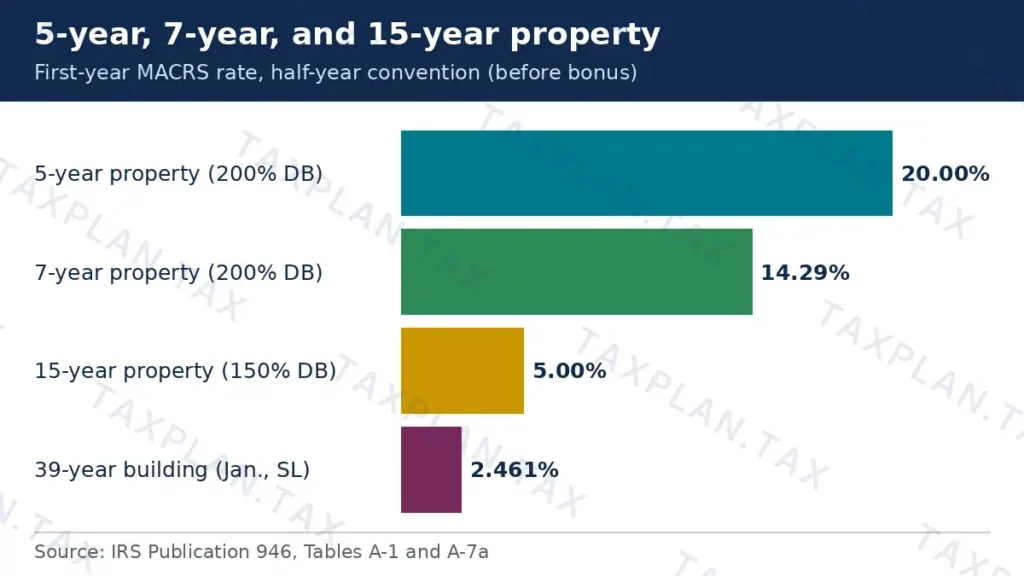
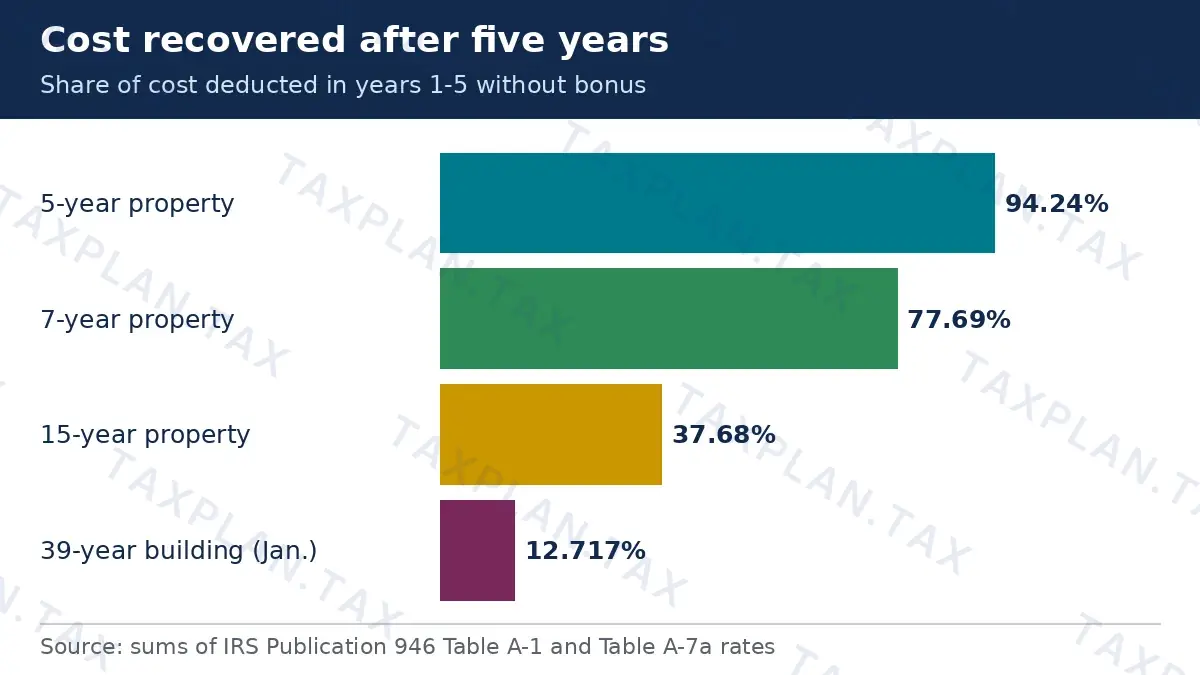
The table below uses Publication 946, Table A-1 (half-year convention) and Table A-7a (39-year property placed in service in January). It shows the share of cost recovered before any bonus depreciation.
| Class | Method | Year 1 rate | Recovered after 5 years |
|---|---|---|---|
| 5-year property | 200% DB, half-year | 20.00% | 94.24% |
| 7-year property | 200% DB, half-year | 14.29% | 77.69% |
| 15-year property | 150% DB, half-year | 5.00% | 37.68% |
| 39-year building (January) | Straight line, mid-month | 2.461% | 12.717% |
What Are the Benefits of 5-Year, 7-Year, and 15-Year Property?
Direct answer: These classes recover cost much faster than a building, and they can qualify for bonus depreciation.
How does bonus depreciation apply?
Public Law 119-21, enacted July 4, 2025, made 100% bonus depreciation permanent for qualified property acquired after January 19, 2025. Under §168(k)(2), qualified property includes property with a recovery period of 20 years or less. So 5-year, 7-year, and 15-year property all qualify if the other rules are met. However, property acquired under a written binding contract signed before January 20, 2025, stays under the old phase-down. That rate is 20% for such property placed in service in 2026. Used property can also qualify under Treas. Reg. §1.168(k)-2 if you did not use it before.
Can you elect out by class?
Yes. Under §168(k)(7), a taxpayer may elect out of bonus depreciation for any class of property for a tax year. The election applies to all qualified property in that class placed in service that year. For example, a taxpayer could claim bonus on 5-year property but elect out for 15-year property. That flexibility can help taxpayers with limited income or passive loss limits.
What Legal Rules Govern 5-Year, 7-Year, and 15-Year Property?
Direct answer: IRC §§167 and 168 set the classes and methods, Rev. Proc. 87-56 sets class lives, and §§1245 and 1250 decide recapture.
- IRC §167: the general depreciation allowance.
- IRC §168: classes, methods, conventions, ADS, and bonus.
- Treas. Reg. §1.48-1: the line between personal property and structural components.
- Rev. Proc. 87-56: class lives, reproduced in Publication 946.
- Publication 5653: examiner guidance and industry matrices.
Two Tax Court cases discussed in the audit guide decide which components are personal property. In Hospital Corporation of America v. Commissioner, 109 T.C. 21 (1997), the court held that the former investment tax credit rules still decide §1245 status. Also, Whiteco Industries, Inc. v. Commissioner, 65 T.C. 664 (1975), set out factors for inherent permanence.
When does the alternative depreciation system apply?
ADS uses longer lives and straight-line depreciation. For example, Publication 946 lists ADS lives of 9 years for class 57.0, 10 years for class 00.11, and 20 years for class 00.3. Under §168(g)(8), an electing real property trade or business must use ADS for its buildings and QIP. Furthermore, §168(k)(2)(D) excludes property that must use ADS from bonus depreciation. However, that rule does not reach the business’s 5-year, 7-year, or land improvement property.
How does recapture differ by class?
Gain on §1245 property is ordinary income up to prior depreciation under IRC §1245. That covers most 5- and 7-year personal property. Class 00.3, however, includes both §1245 and §1250 property. For §1250 property, IRC §1250 recaptures depreciation in excess of straight line as ordinary income. Treas. Reg. §1.168(k)-2(g)(3) states that bonus depreciation is not a straight-line method for §1250(b). In addition, straight-line depreciation on §1250 property creates unrecaptured §1250 gain, taxed at up to 25% under IRC §1(h).
What Do 5-Year, 7-Year, and 15-Year Property Look Like in Practice?
Direct answer: The examples below use Publication 946 table rates on assumed amounts. The dollar amounts are illustrative assumptions.
Example 1: $100,000 in each class, electing out of bonus
Assume a taxpayer places $100,000 of 5-year, $100,000 of 7-year, and $100,000 of 15-year property in service in 2026. It elects out of bonus for all three classes, and the half-year convention applies. First-year depreciation is $20,000, $14,290, and $5,000, respectively. After five years, the totals are $94,240, $77,690, and $37,680. By comparison, $100,000 of 39-year building cost placed in service in January would recover only $12,717 over the same five years.
Example 2: The mid-quarter convention
Next, assume a calendar-year taxpayer places most of its 2026 equipment in service in November. More than 40% of the year’s basis is in the last quarter, so the mid-quarter convention applies. Under Publication 946, Table A-5, fourth-quarter property gets first-year rates of 5.00% for 5-year property, 3.57% for 7-year property, and 1.25% for 15-year property. Without bonus, $100,000 of 5-year property would yield only $5,000 in year one. However, with 100% bonus, the convention does not affect the bonus amount.
Example 3: Choosing which class gets bonus
Finally, assume a cost segregation study on a 2026 acquisition finds $300,000 of 5-year property and $500,000 of 15-year property. The owner expects limited income in 2026. So it claims 100% bonus on the 5-year class and elects out for the 15-year class. The 15-year class then yields $25,000 in year one at the 5.00% Table A-1 rate. For more on weighing timing, see Cost Segregation ROI: How Quickly Do Studies Pay for Themselves?
What Are Common Mistakes With 5-Year, 7-Year, and 15-Year Property?
Direct answer: Most mistakes involve the wrong class, the wrong method, or overlooked conventions and elections.
- Using 7 years for everything. The 7-year default applies only to property with no class life. Many assets have a 5-year class.
- Applying 150% DB to QIP. QIP must use straight-line depreciation.
- Missing the mid-quarter test. Heavy fourth-quarter purchases can change the convention for all non-real property that year.
- Treating structural components as 5-year property. Central HVAC and general wiring usually stay with the building.
- Making an unintended election. An election out of bonus covers the whole class for the year.
- Ignoring §1250 recapture on land improvements. Some 15-year property is §1250 property.
Frequently Asked Questions
Is 15-year property eligible for 100% bonus depreciation?
Yes, generally. Its recovery period is 20 years or less, so it can be qualified property under §168(k), subject to the acquisition date and other rules.
Why are some building components 5-year property?
Because they are not structural components. For example, equipment connections that serve a specific machine are §1245 property. They take the asset class of the business activity, often class 57.0.
What is the difference between 5-year, 7-year, and 15-year property in a study?
The class depends on the asset. Equipment and finishes used in trade and services are often 5-year property. Office furniture is 7-year property, and site improvements are 15-year property.
Does residential rental property have 7-year components?
Sometimes. The residential matrix places most personal property in class 57.0, with a 5-year life. However, rental office furniture can fall in class 00.11, which is 7-year property.
Can I fix a wrong class on prior returns?
Often, yes. A change in depreciation method or life can be made through Form 3115 and a §481(a) adjustment. The automatic change list appears in Rev. Proc. 2025-23.
Where can I see real-world examples?
Our guide Cost Segregation Tax Benefits: Real Numbers and Examples shows full-building examples. Here, the focus is on the classes themselves.
Conclusion: How Should You Use 5-Year, 7-Year, and 15-Year Property?
To sum up, 5-year, 7-year, and 15-year property are the classes that make cost segregation work. Each has its own class life, method, and recapture profile. For property acquired after January 19, 2025, all three can generally get 100% bonus depreciation. However, elections, conventions, and ADS rules can change the result, so each class deserves attention.
Emunah Cost Segregation helps owners and CPAs classify components correctly and document each decision. Alan Goldstein, EA, reviews your property and records before any study begins. Then he tells you plainly whether a study makes sense. Contact Emunah Cost Segregation in Coral Gables, Florida, to request a review. For a broader overview, see What Property Qualifies for a Cost Segregation Study?
Sources and Authorities
- 26 U.S.C. §167: https://www.law.cornell.edu/uscode/text/26/167
- 26 U.S.C. §168 (including §168(b), (d), (e), (g), and (k)): https://www.law.cornell.edu/uscode/text/26/168
- 26 U.S.C. §1245: https://www.law.cornell.edu/uscode/text/26/1245
- 26 U.S.C. §1250: https://www.law.cornell.edu/uscode/text/26/1250
- 26 U.S.C. §1 (including §1(h)): https://www.law.cornell.edu/uscode/text/26/1
- Public Law 119-21 (H.R. 1, 119th Congress), including §70301: https://www.congress.gov/bill/119th-congress/house-bill/1
- IRS Notice 2026-11: https://www.irs.gov/pub/irs-drop/n-26-11.pdf
- Treas. Reg. §1.48-1: https://www.ecfr.gov/current/title-26/section-1.48-1
- Treas. Reg. §1.168(k)-2 (including §1.168(k)-2(g)(3)): https://www.ecfr.gov/current/title-26/section-1.168(k)-2
- IRS Publication 946, including Tables A-1, A-5, A-7a, B-1, and B-2: https://www.irs.gov/pub/irs-pdf/p946.pdf
- IRS Publication 5653, Cost Segregation Audit Techniques Guide: https://www.irs.gov/pub/irs-pdf/p5653.pdf
- About Form 3115: https://www.irs.gov/forms-pubs/about-form-3115
- Rev. Proc. 2025-23: https://www.irs.gov/pub/irs-drop/rp-25-23.pdf
- Hospital Corporation of America v. Commissioner, 109 T.C. 21 (1997), and Whiteco Industries, Inc. v. Commissioner, 65 T.C. 664 (1975), as discussed in IRS Publication 5653.
This article is provided for general educational purposes and does not constitute individualized tax, legal, or accounting advice. Tax consequences depend on the taxpayer’s specific facts and applicable law.
