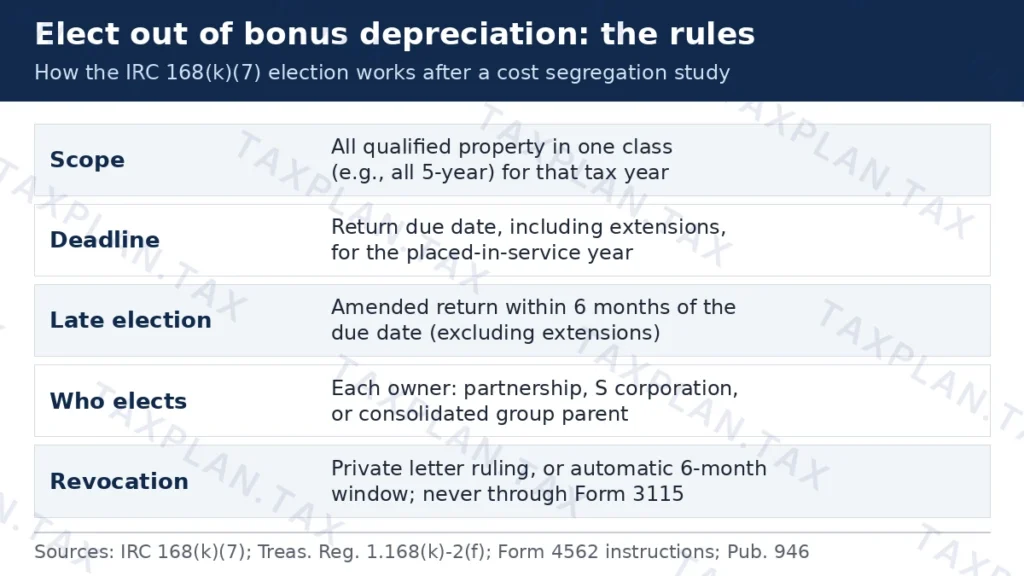


Usually not, if you can use the deduction this year. However, it can make sense to elect out of bonus depreciation after cost segregation when the extra first-year deduction would be suspended, limited, or taxed at a low rate. Under IRC §168(k)(7), you can elect out for any class of property, such as all 5-year property placed in service that year. The election covers every asset in that class for that year, not single items. In addition, you must make it on a timely filed return, including extensions. After that, you can revoke it only with IRS consent, apart from a short automatic window.
Importantly, if you elect out of bonus depreciation, you do not undo the study. Instead, the components still use 5-, 7-, or 15-year recovery instead of 39 years. So the real question is timing: do you want the deduction now or spread over the next few years? Common reasons to elect out include passive loss limits, a low-income year, net operating loss limits, and planned changes in your tax status. This guide explains the rules, the trade-offs, and illustrative numbers.
Key Takeaways
- You elect out of bonus depreciation by class of property (for example, all 15-year property) for a single tax year under §168(k)(7).
- Make the election by attaching a statement to the timely filed return, including extensions, for the placed-in-service year.
- A late election is possible only on an amended return filed within 6 months of the original due date, excluding extensions.
- Revoking the election generally requires a private letter ruling. Moreover, Form 3115 cannot be used to make or revoke it.
- Electing out keeps the cost segregation benefit of 5-, 7-, and 15-year recovery. It only moves deductions to later years.
- The election can help when deductions would be suspended under §469, trapped in a net operating loss, or worth more in later years.
Introduction and Background: What Does It Mean to Elect Out of Bonus Depreciation?
Direct answer: To elect out of bonus depreciation means you choose not to claim the additional first-year deduction for a whole class of property in a given year.
Bonus depreciation, which the Code calls the “additional first year depreciation deduction,” is automatic for qualified property. In other words, you get it unless you elect out. Qualified property generally includes MACRS property with a recovery period of 20 years or less, as §168(k)(2) provides. A cost segregation study matters here because it moves building components into these shorter classes. For example, some carpeting, cabinetry, and dedicated wiring may become 5-year property, while site improvements often become 15-year property.
Under Public Law 119-21, §70301, the bonus rate is 100% for qualified property acquired after January 19, 2025. In contrast, property acquired under an earlier binding contract still follows the old phase-down, which is 20% for property placed in service in 2026. IRS Notice 2026-11 gives interim guidance on these dates. For a full overview of how the two rules fit together, see Bonus Depreciation and Cost Segregation: How They Work Together.
Because 100% bonus is now permanent for these acquisitions, the election out has become a key planning lever. Notably, Notice 2026-11, section 2.05, confirms that the 2025 law did not amend §168(k)(7).
How Does the Election Out of Bonus Depreciation Work?
Direct answer: You pick one or more classes, attach a statement to your timely return, and then depreciate those classes under regular MACRS.
What counts as a “class of property”?
Treas. Reg. §1.168(k)-2(f)(1)(ii) defines the term. Generally, each class in §168(e) is its own class, such as 5-year, 7-year, or 15-year property. Computer software and water utility property are separate classes too. Likewise, each partner’s §743(b) basis adjustment is treated as a separate class.
As a result, you cannot elect out for one asset and keep bonus on another asset in the same class. The regulation says the election applies to all qualified property in the same class placed in service in the same year. That even includes 5-year equipment bought for another activity that year.
How and when do you elect out of bonus depreciation?
The regulation requires the election by the due date, including extensions, of the return for the placed-in-service year. It also requires you to follow the Form 4562 instructions. Those instructions say to attach a statement naming the class and stating that you are not claiming any special depreciation allowance for it.
If you filed on time without the election, there is one fallback. According to the instructions and Publication 946, you can still elect by filing an amended return within 6 months of the original due date, excluding extensions. In that case, write “Filed pursuant to section 301.9100-2” on the amended return.
Who makes the election?
Each owner of the property makes its own election. For example, a partnership or S corporation makes it at the entity level, and the common parent makes it for a consolidated group. Therefore, a partner cannot elect out individually for property held by a partnership.
Can you change your mind later?
Only in limited cases. Under §1.168(k)-2(f)(5)(i), revoking the election generally requires a private letter ruling and the Commissioner’s written consent. However, §1.168(k)-2(f)(5)(ii) grants an automatic 6-month extension to revoke, if you filed on time and file an amended return within that period. Finally, §1.168(k)-2(f)(1)(iv) states that the election cannot be made through a Form 3115 method change.
| Step | Rule | Authority |
|---|---|---|
| Choose classes | All qualified property in a class for the year | §168(k)(7); Reg. §1.168(k)-2(f)(1) |
| Deadline | Return due date, including extensions | Reg. §1.168(k)-2(f)(1)(iii)(A) |
| Manner | Statement attached to the return | Form 4562 instructions |
| Late election | Amended return within 6 months of due date (no extensions) | Pub. 946; Form 4562 instructions |
| Revocation | Private letter ruling, or the automatic 6-month window | Reg. §1.168(k)-2(f)(5) |
What Are the Benefits of Electing Out After Cost Segregation?
Direct answer: The main benefit is control. Specifically, you can place deductions in the years when they save the most tax.
Does electing out waste the study?
First, when you elect out of bonus depreciation, you do not waste the study. The 5-year components still use Table A-1 rates of 20%, 32%, and 19.2% in the first three years under the half-year convention. Similarly, 15-year components start at 5% and 9.5%. By comparison, nonresidential real property placed in service in January recovers only 2.461% in year one under Table A-7a. Our guide to 5-year, 7-year, and 15-year property covers these classes.
How does timing change the value of a deduction?
Second, the election can match deductions to income. Since a deduction is worth your marginal tax rate times its amount, it saves more in a higher-rate year. In Pacific National Co. v. Welch, the Supreme Court noted that a method producing higher tax now “may be preferable because of probable effect on amount of taxes in later years” (304 U.S. at 194).
Which loss limits make the election useful?
Third, the election can reduce waste under loss limits. For example, it may help in these cases:
- Passive loss limits. Under §469(b), a disallowed passive loss carries forward to the next year. However, it remains tied to passive income until you dispose of the activity.
- Future status changes. If a rental later becomes nonpassive, §469(f)(1) applies old suspended losses against income from that same activity, and any remainder stays passive. By contrast, depreciation claimed in the nonpassive years is not limited that way.
- Net operating losses. Under §172(a)(2), losses arising in tax years beginning after 2017 generally offset only 80% of later taxable income. Also, most cannot be carried back.
- Excess business losses. §461(l) disallows excess business losses of noncorporate taxpayers and treats them as a net operating loss carryover. Public Law 119-21, §70601, made this limit permanent for tax years beginning after 2026.
To learn more about suspended losses, read Passive Activity Loss Limitations: Unlocking Suspended Losses.
What Legal Rules Govern the Election Out of Bonus Depreciation?
Direct answer: The statute is §168(k)(7), and the final regulations in §1.168(k)-2(f) set the class, timing, manner, and revocation rules.
The statute is short. It says that if you elect out for any class for any tax year, the bonus rules do not apply to qualified property in that class placed in service that year. It also states that the election “may be revoked only with the consent of the Secretary.” Meanwhile, Notice 2026-11 confirms that taxpayers follow §1.168(k)-2(f)(1) and the Form 4562 instructions for post-January 19, 2025 property.
What does the IRS audit guide say?
Publication 5653, the Cost Segregation Audit Techniques Guide, addresses this point in Chapter 6, sections H.9 and H.10. First, it says a taxpayer that neither elects out nor claims bonus “is using an impermissible method of accounting.” Second, it says components a study later identifies are non-qualifying if you elected out for that class in that year.
How does the election interact with a look-back study?
If you did not elect out, bonus was allowable whether or not you claimed it. Under §1.168(k)-2(f)(1)(iv), depreciation for the placed-in-service year and every later year must then reflect the bonus. Therefore, a look-back study for an earlier year generally picks up the missed bonus through the §481(a) catch-up. You cannot use Form 3115 to elect out after the deadline. For details, see Look-Back Cost Segregation Studies.
Do classification cases still matter?
Yes, because the election works class by class. The class depends on correct classification first. In Hospital Corp. of America, the Tax Court concluded that Congress intended the same tests to decide §1245 versus §1250 class property under ACRS as for the former investment tax credit (109 T.C. at 50-51). Similarly, Whiteco Industries lists factors for deciding whether property is inherently permanent (65 T.C. at 672-673). Full citations appear in the Cases Cited section below.
What about recapture and state law?
On a taxable sale, §1245(a)(2) measures recapture using depreciation “allowed or allowable.” So electing out does not change the character of gain. Instead, it only changes how much depreciation you have taken by the sale date. In addition, some states do not follow federal bonus at all. For example, the California FTB instructions for Form 3885A list IRC §168(k) as a federal and state difference. As a result, a federal election out will not change California’s own rules. For exit planning, see strategies for depreciation recapture.
What Does Electing Out of Bonus Depreciation Look Like in Practice?
Direct answer: The examples below use assumed amounts and Publication 946 table rates. All figures are illustrative only.
Example 1: Four ways to depreciate the same building
Assume an investor signs a contract in March 2025 and places a $2,000,000 commercial building (land excluded) in service in January 2026. A study identifies $300,000 of 5-year property and $150,000 of 15-year property. The remaining $1,550,000 is 39-year property. Because the property was acquired after January 19, 2025, the bonus rate is 100%.
| Scenario (illustrative) | 5-year | 15-year | 39-year | Year-one total |
|---|---|---|---|---|
| A: Full bonus on both classes | $300,000 | $150,000 | $38,146 | $488,146 |
| B: Elect out of 15-year only | $300,000 | $7,500 | $38,146 | $345,646 |
| C: Elect out of both classes | $60,000 | $7,500 | $38,146 | $105,646 |
| D: No study (all 39-year) | n/a | n/a | $49,220 | $49,220 |
Assumptions: placed in service January 2026; half-year convention for 5- and 15-year property; Table A-1 rates of 20% and 5%; Table A-7a rate of 2.461% for month 1; amounts rounded to the nearest dollar.
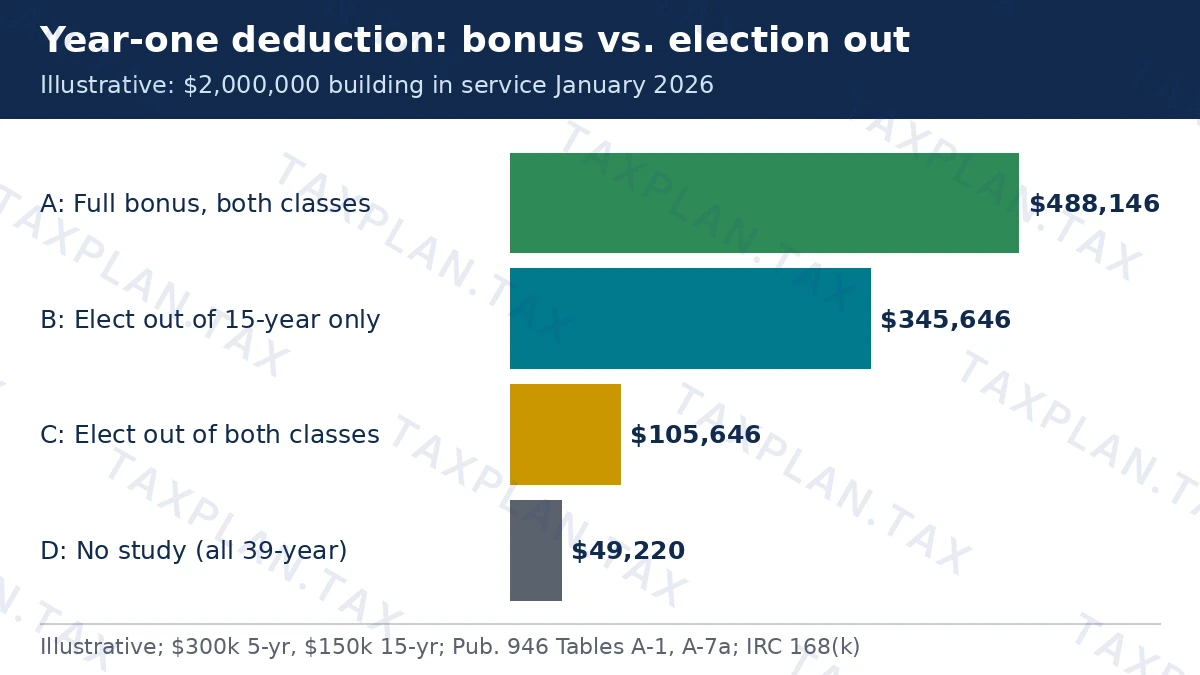
Scenario C still more than doubles the no-study deduction. Then, in year two, Scenario C deducts $96,000 of 5-year property (32%), $14,250 of 15-year property (9.5%), and $39,742 on the building (2.564%). That totals $149,992. By comparison, Scenario A deducts only the $39,742 on the building in year two.
Example 2: A passive investor who expects to qualify later
Now assume the same investor has $120,000 of rental income before depreciation. In 2026, the rental is passive, and there is no other passive income. However, the investor expects to qualify as a real estate professional and materially participate starting in 2027.
| Item (illustrative) | Scenario A: full bonus | Scenario C: elect out |
|---|---|---|
| 2026 depreciation | $488,146 | $105,646 |
| 2026 result | $368,146 loss, suspended | $14,354 taxable income |
| 2027 depreciation | $39,742 | $149,992 |
| 2027 result | $80,258 income, offset by suspended loss | $29,992 nonpassive loss |
| Suspended loss left after 2027 | $287,888 | $0 |
In Scenario A, the leftover $287,888 can offset income from this rental or other passive income. Alternatively, it is released on a fully taxable sale of the entire interest under §469(g). In Scenario C, by contrast, the 2027 loss is nonpassive and may offset other income, subject to other limits such as §461(l). On the other hand, Scenario C pays tax on $14,354 in 2026. So the benefit here is real but modest.
Example 3: A low-income year
Finally, assume an owner expects a 12% marginal rate in 2026 and 35% later (both assumptions). A $100,000 deduction saves $12,000 at 12% but $35,000 at 35%. So electing out for one class may shift deductions into higher-rate years. Still, weigh the delay, because later savings are worth less in today’s dollars.
What Are the Common Mistakes When You Elect Out of Bonus Depreciation?
Direct answer: Most problems come from missed deadlines, misunderstood class rules, and electing out when the loss would not have been wasted.
- Trying to elect out by asset. The election covers the whole class for the year, including assets unrelated to the building.
- Missing the deadline. After the extended due date and the 6-month window pass, bonus is allowable and depreciation must reflect it.
- Using Form 3115 to fix it. The regulation bars making or revoking the election through a §446(e) method change.
- Electing at the wrong level. Partnerships and S corporations make the election, not their owners.
- Assuming suspended losses are lost. Under §469(b) and §469(g), suspended losses carry forward and are generally freed on a fully taxable disposition.
For more on how the 2025 law reshaped these choices, see Permanent 100% Bonus Depreciation and Cost Segregation in 2026.
Frequently Asked Questions
Can I elect out of bonus depreciation for just one asset?
No. The election applies to every qualified asset in the same class placed in service in the same year. However, you can elect out for one class, such as 15-year property, and keep bonus on another class.
What is the deadline to elect out of bonus depreciation?
Generally, the due date, including extensions, of the return for the year the property is placed in service. If you filed on time without it, you can still elect on an amended return within 6 months of the original due date, excluding extensions.
Can I undo a decision to elect out of bonus depreciation?
Generally only with IRS consent through a private letter ruling. However, the regulations allow an automatic 6-month window to revoke on an amended return if you filed on time.
Can I elect out of bonus depreciation in a look-back study?
No. Treas. Reg. §1.168(k)-2(f)(1)(iv) says the election cannot be made through a method change. As a result, a look-back study generally must reflect bonus for years in which you did not elect out.
If I elect out of bonus depreciation, do I lose the study benefit?
No. The reclassified components still use 5-, 7-, or 15-year recovery. As Example 1 shows, year-one depreciation can still be far higher than with no study.
Will I have less recapture if I elect out of bonus depreciation?
Only because you have taken less depreciation by the time of sale. Section 1245 recapture is based on depreciation allowed or allowable, so the election does not change the character of the gain.
Who makes the election for a partnership or S corporation?
The entity does. Under the regulations, each person owning the property makes the election, which means the partnership or S corporation for property it owns.
Can I choose 40% bonus instead of electing out in 2026?
Usually not. Section 168(k)(10) allows a 40% rate only for the first tax year ending after January 19, 2025. For a calendar-year taxpayer, that is 2025.
Conclusion: Should You Elect Out of Bonus Depreciation After Cost Segregation?
In short, the answer depends on whether you can use the deduction now. If you can, full bonus usually wins. However, if passive limits, low rates, or loss limits would blunt it, electing out for one or more classes may be smarter. Either way, decide before filing, because revocation is hard.
Emunah Cost Segregation can help you make that decision with real numbers. Alan Goldstein, MBA, EA, works with owners and CPAs to size each class, test it against your loss limits, and plan the election before the deadline. Contact Emunah Cost Segregation in Coral Gables, Florida, to request a feasibility review.
Cases Cited
- Pacific National Co. v. Welch, 304 U.S. 191, 194-195 (1938) (Supreme Court of the United States). Pinpoint verified against the reporter-paginated opinion text. Opinion
- Hospital Corp. of America v. Commissioner, 109 T.C. 21, 50-51 (1997) (United States Tax Court). Pinpoint verified against the reporter-paginated opinion text. Opinion
- Whiteco Industries, Inc. v. Commissioner, 65 T.C. 664, 672-673 (1975) (United States Tax Court). Pinpoint verified against the reporter-paginated opinion text. Opinion
Sources and Authorities
- 26 U.S.C. §168 (including §168(k)(2), (k)(7), and (k)(10)): https://www.law.cornell.edu/uscode/text/26/168
- Treas. Reg. §1.168(k)-2(f): https://www.ecfr.gov/current/title-26/section-1.168(k)-2
- IRS Notice 2026-11, sections 2.05 and 4.03: https://www.irs.gov/pub/irs-drop/n-26-11.pdf
- Instructions for Form 4562 (2025), Election out: https://www.irs.gov/instructions/i4562
- IRS Publication 946, How To Depreciate Property (Tables A-1 and A-7a): https://www.irs.gov/pub/irs-pdf/p946.pdf
- IRS Publication 5653, Cost Segregation Audit Techniques Guide, Chapter 6, H.9 and H.10: https://www.irs.gov/pub/irs-pdf/p5653.pdf
- Public Law 119-21 (H.R. 1, 119th Congress), §§70301 and 70601: https://www.congress.gov/bill/119th-congress/house-bill/1
- 26 U.S.C. §469: https://www.law.cornell.edu/uscode/text/26/469
- 26 U.S.C. §461: https://www.law.cornell.edu/uscode/text/26/461
- 26 U.S.C. §172: https://www.law.cornell.edu/uscode/text/26/172
- 26 U.S.C. §1245: https://www.law.cornell.edu/uscode/text/26/1245
- California FTB, 2025 Instructions for Form 3885A: https://www.ftb.ca.gov/forms/2025/2025-3885a-instructions.html
- Court opinions: see Cases Cited above.
This article is provided for general educational purposes and does not constitute individualized tax, legal, or accounting advice. Tax consequences depend on the taxpayer’s specific facts and applicable law.
