

New construction cost segregation splits the cost of a newly built property into building, land improvement, and personal property classes from the start, using the project’s own drawings and cost records. Because the records are fresh, new buildings are often the best candidates for the most accurate method. Indeed, the IRS Cost Segregation Audit Techniques Guide (Publication 5653) says the detailed engineering approach from actual cost records generally applies only to new construction.
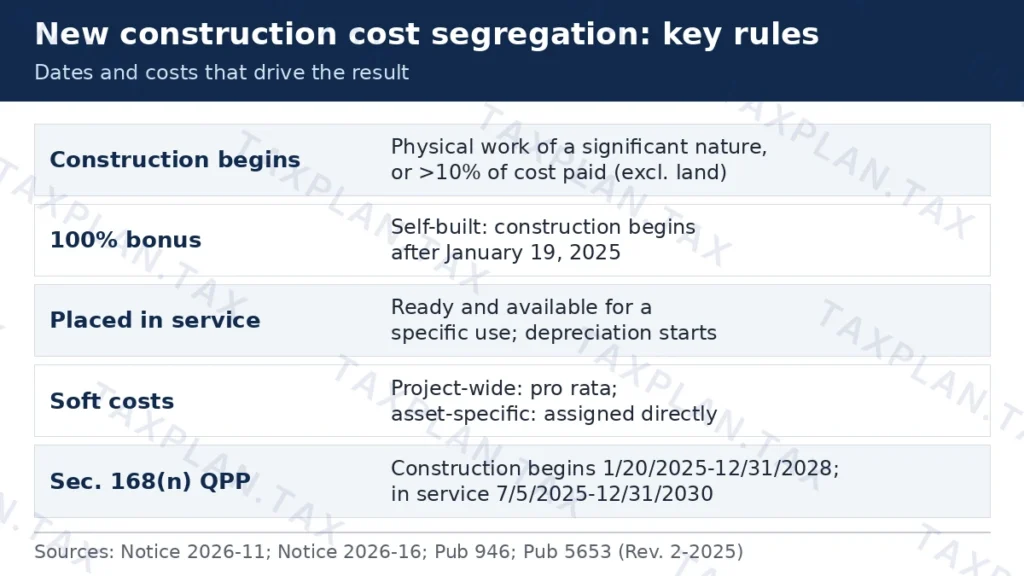
Timing also matters. Under IRC §168(k) as amended by Public Law 119-21, qualified property acquired after January 19, 2025, can receive a permanent 100% first-year deduction. For self-built property, the IRS treats the “acquisition” date as the date construction begins, as explained in Notice 2026-11. This guide covers how new construction cost segregation works, which rules apply, and how to plan before the first shovel hits the ground.
Key Takeaways
- New buildings usually have the records needed for the most accurate study method.
- For self-constructed property, bonus eligibility turns on when physical work of a significant nature begins.
- Depreciation starts when you place the property in service, meaning it is ready and available for its use.
- The study must allocate soft costs and capitalized interest among the asset classes.
- Manufacturing buildings may qualify for the new elective 100% allowance under §168(n).
- Planning the study during design makes record-keeping far easier.
Introduction and Background: What Is New Construction Cost Segregation?
Direct answer: It is a cost segregation study performed on a building you build, rather than one you buy.
A cost segregation study assigns each part of a property to its recovery period. For example, certain equipment and finishes may be 5-year or 7-year property. Similarly, site work such as paving and landscaping is often 15-year land improvements. Meanwhile, the structure is 27.5-year residential rental property or 39-year nonresidential real property under IRS Publication 946. For an overview of the classes, see 5-Year, 7-Year, and 15-Year Property in Cost Segregation.
With an acquisition, the study must estimate costs and allocate a purchase price. By contrast, new construction cost segregation can use what the owner actually paid. That includes contracts, change orders, invoices, and contractor pay applications. As a result, the allocation can rest on real costs rather than estimates.
How Does New Construction Cost Segregation Work?
Direct answer: The preparer reviews the project records and site, prices each asset from actual costs, and reconciles the total to the project cost.
Step 1: Gather the project records
First, collect the drawings, specifications, contracts, change orders, and the general contractor’s pay applications. Publication 5653 lists AIA Forms G-701 through G-704 among the records a quality study reviews. In addition, keep subcontractor pay applications and invoices for work outside the general contract.
Step 2: Inspect the site
Next, the preparer visits the property. The guide says a quality study for new construction includes a site visit. It also says before-and-after photographs help establish land and site preparation costs, such as clearing and grading.
Step 3: Take off quantities and apply unit costs
Then the preparer measures quantities from the drawings and applies unit costs from contractor records. After that, the preparer reconciles the total of all assets to the actual contractor costs. This is the core of the detailed engineering approach.
Step 4: Allocate indirect costs
Soft costs include architect and engineering fees, permits, and certain interest and taxes. According to the guide, preparers normally allocate project-wide indirect costs pro rata. However, they assign costs that relate to specific assets directly to those assets.
Step 5: Report the classes on the return
Finally, the preparer groups the assets by recovery period and placed-in-service date. You then report them on Form 4562 for the year the building goes into service. For more on each stage, see our Cost Segregation Study Process.
Benefits and Opportunities of New Construction Cost Segregation
Direct answer: New construction offers better records, cleaner allocations, and, with 100% bonus, a large first-year deduction.
- Actual cost support: the guide calls the detailed cost approach generally the most methodical and accurate.
- Full first-year write-off of short-life assets: owners can deduct qualified 5-, 7-, and 15-year property in year one.
- Design-stage planning: owners can ask contractors to break out costs by system, which simplifies the study.
- No purchase price allocation: unlike an acquisition, there is no seller agreement to work around.
- Cleaner future records: component-level basis helps with later replacements and dispositions.
For example, land improvements such as parking lots and site lighting are 15-year property. See Land Improvements and Cost Segregation for detail. Also, read Permanent 100% Bonus Depreciation and Cost Segregation in 2026 for the current bonus rules.
Legal and Regulatory Considerations for New Construction Cost Segregation
Direct answer: The key rules cover when construction begins, when service begins, which costs you capitalize, and how to classify assets.
When does construction “begin” for bonus purposes?
Notice 2026-11 applies the self-constructed property rules of Treas. Reg. §1.168(k)-2(b)(5)(iv), with January 19, 2025, substituted as the key date. Under those rules, construction begins when physical work of a significant nature begins. Alternatively, a safe harbor treats work as beginning when more than 10% of the total cost is paid or incurred. That 10% excludes land and preliminary work such as planning, design, and financing.
Importantly, the IRS also treats property that a contractor builds for you as self-constructed, if you signed the written binding contract before construction started. So for most owner-developed projects, the start of physical work drives the answer. In addition, the notice lets taxpayers elect bonus for eligible components acquired or self-constructed after January 19, 2025, even if the larger project began earlier.
When is a new building placed in service?
Depreciation begins when you place property in service. Publication 946 defines that as ready and available for a specific use. In Sears Oil Co. v. Commissioner, 359 F.2d 191 (2d Cir. 1966), the court allowed depreciation on property available for use even though it was not in fact used. Therefore, a certificate of occupancy and readiness for tenants are often key facts. However, the answer always depends on the specific facts.
Which construction costs must be capitalized?
Under IRC §263A, a taxpayer generally capitalizes the direct and indirect costs of producing real property. Notably, §263A(f) requires capitalizing interest during the production period for property with a long useful life, which includes buildings. Likewise, in Commissioner v. Idaho Power Co., 418 U.S. 1 (1974), the Supreme Court held that depreciation on equipment used to build capital facilities must be capitalized. However, §263A(i) exempts taxpayers that meet the §448(c) gross receipts test, other than tax shelters.
How are the components classified?
Classification follows the same law as any study. In Hospital Corp. of America v. Commissioner, 109 T.C. 21 (1997), the Tax Court applied the former investment tax credit tests to separate personal property from structural components. Those tests rely on Treas. Reg. §1.48-1. Also, Whiteco Industries, Inc. v. Commissioner, 65 T.C. 664 (1975), lists factors such as whether an item is designed to remain in place permanently.
Qualified production property under §168(n)
Public Law 119-21 also added §168(n). According to Notice 2026-16, it allows an elective 100% allowance for the portion of nonresidential real property used as an integral part of a qualified production activity. Construction must begin after January 19, 2025, and before January 1, 2029. In addition, the property must be placed in service after July 4, 2025, and before January 1, 2031. The rules exclude office, administrative, parking, and similar space, and lessors do not qualify for property a lessee uses. Moreover, the notice describes §1245 recapture if the use changes within 10 years.
Practical Examples of New Construction Cost Segregation
Direct answer: The example below shows the first-year effect of a study on a new commercial building. All figures are illustrative assumptions.
Example 1: A $3 million office building placed in service in July 2026
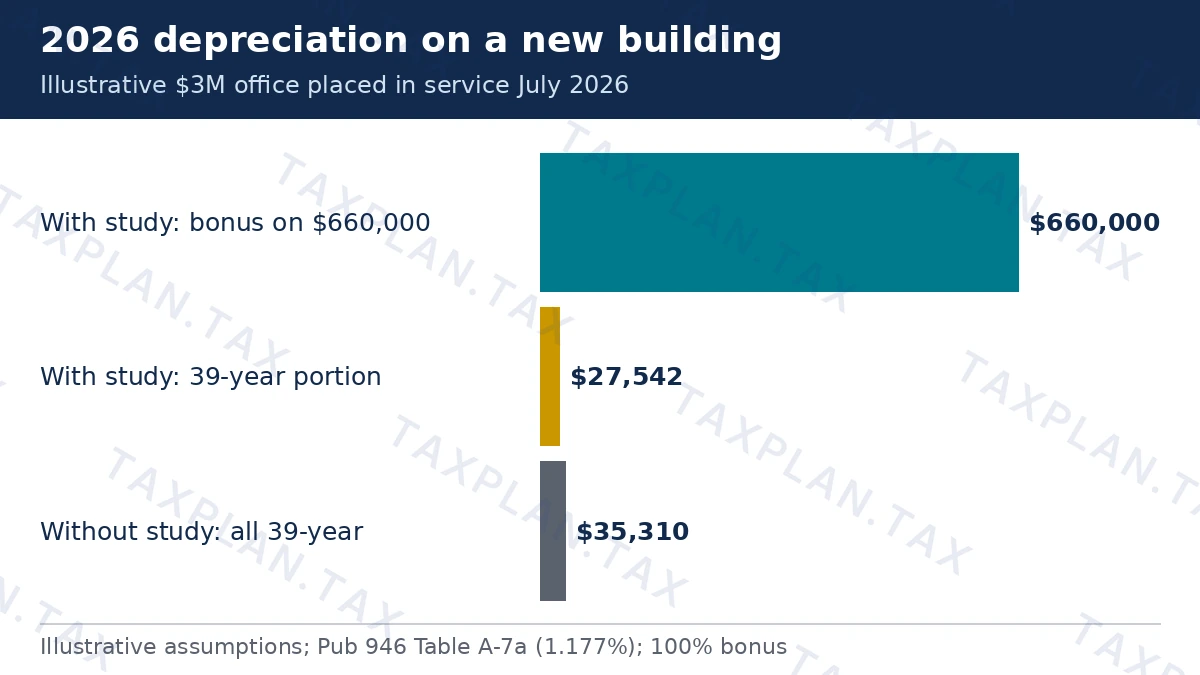
Assume an owner builds an office building with $3,000,000 of depreciable cost, excluding land. Physical work began in 2025, after January 19. Also assume the study supports $300,000 of 5- and 7-year property and $360,000 of 15-year land improvements. The owner places the building in service in July 2026, so the 39-year rate for month 7 is 1.177% under Publication 946, Table A-7a.
| Item (illustrative) | With study | Without study |
|---|---|---|
| 5- and 7-year property (100% bonus) | $300,000 | $0 |
| 15-year land improvements (100% bonus) | $360,000 | $0 |
| 39-year building depreciation | $27,542 | $35,310 |
| Total 2026 depreciation | $687,542 | $35,310 |
| Federal tax deferral at 37% | $241,326 (difference of $652,232 × 37%) | |
Example 2: A project that started before January 20, 2025
Now assume physical work on a larger project began in late 2024. In that case, the project generally does not meet the post-January 19, 2025, acquisition date. However, the component election in Notice 2026-11 may let the owner claim 100% bonus on eligible components acquired or self-constructed after January 19, 2025. Therefore, contract dates and payment records for each component become important.
Example 3: Recapture on a later sale
Finally, suppose the owner sells the building in a few years. Gain on the 5-, 7-, and 15-year property is generally ordinary income under IRC §1245 to the extent of depreciation taken. In contrast, gain on the building may be unrecaptured §1250 gain, taxed at up to 25% under IRC §1(h). As a result, model the exit before relying on the year-one figures.
Common Mistakes and Risks in New Construction Cost Segregation
Direct answer: The biggest risks are poor records, wrong dates, and costs left out of basis.
- Losing the paper trail: pay applications, change orders, and invoices are hard to rebuild later.
- Misdating the start of construction: bonus eligibility can turn on when physical work began.
- Ignoring soft costs: architect fees, permits, and capitalized interest belong in basis, and the study must allocate them.
- Depreciating land costs: the guide generally treats land and land development costs, such as surveys, as nondepreciable land.
- Starting depreciation too early: depreciation waits until the building is ready and available for use.
- Waiting too long: a study done after the return is filed may require an amended return or Form 3115.
Frequently Asked Questions
When should I order a new construction cost segregation study?
Ideally, plan it during design and order it as construction ends. That way, records are complete and the study is ready before you file the return for the placed-in-service year.
Does 100% bonus depreciation apply to new construction?
It applies to qualified property with a recovery period of 20 years or less, such as 5-, 7-, and 15-year assets. For self-constructed property, construction generally must begin after January 19, 2025. However, the 27.5-year and 39-year building portions are not eligible.
What counts as the start of construction?
Generally, it is when physical work of a significant nature begins. Alternatively, a safe harbor uses the date more than 10% of total cost, excluding land and preliminary activities, is paid or incurred.
Is new construction cost segregation more accurate than a study on a purchase?
Usually, yes, because it can rely on actual costs. Publication 5653 notes the detailed engineering approach from actual cost records generally applies only to new construction.
Are architect fees and permits part of the study?
Yes. They are indirect costs. Typically, the preparer spreads project-wide soft costs pro rata and assigns costs tied to specific assets to those assets.
Does new construction cost segregation work for residential rentals?
Yes. A new apartment building can also have 5-, 7-, and 15-year property. The structure itself is 27.5-year residential rental property, however.
What is qualified production property?
It is the portion of a new nonresidential building used as an integral part of manufacturing, production, or refining. Under §168(n), an owner can elect a 100% allowance if strict dates and use rules are met.
Can I still do a study if the building was finished years ago?
Yes. A later study generally uses Form 3115 to catch up missed depreciation. Even so, records are easier to find when you order the study promptly.
Conclusion: Plan New Construction Cost Segregation Early
New construction cost segregation works best when it starts early. Good records support the most accurate method, and the dates of construction and service decide bonus eligibility. In addition, the study must handle soft costs and capitalized interest correctly. With 100% bonus now permanent for qualified property, a careful study can shift large deductions into the first year.
Emunah Cost Segregation helps developers, owners, and CPAs plan studies from design through placed-in-service. Alan Goldstein, MBA, EA, reviews your contracts, timelines, and cost records so nothing slips through. Contact Emunah Cost Segregation in Coral Gables, Florida, to request a feasibility review.
Cases Cited
- Commissioner v. Idaho Power Co., 418 U.S. 1, 13-14, 19 (1974) (Supreme Court of the United States). Pinpoints verified against the reporter-paginated opinion text. Opinion
- Sears Oil Co. v. Commissioner, 359 F.2d 191, 198 (2d Cir. 1966). Pinpoint verified against the reporter-paginated opinion text. Opinion
- Hospital Corp. of America v. Commissioner, 109 T.C. 21, 50-52, 54-55 (1997) (United States Tax Court). Pinpoints verified against the reporter-paginated opinion text. Opinion
- Whiteco Industries, Inc. v. Commissioner, 65 T.C. 664, 672-673 (1975) (United States Tax Court). Pinpoint verified against the reporter-paginated opinion text. Opinion
Sources and Authorities
- IRS Publication 5653 (Rev. 2-2025), Cost Segregation Audit Techniques Guide, Chapters 3 and 4: https://www.irs.gov/pub/irs-pdf/p5653.pdf
- IRS Publication 946 (2025), How To Depreciate Property, Table A-7a and Glossary: https://www.irs.gov/pub/irs-pdf/p946.pdf
- 26 U.S.C. §168: https://www.law.cornell.edu/uscode/text/26/168
- 26 U.S.C. §263A: https://www.law.cornell.edu/uscode/text/26/263A
- 26 U.S.C. §1245: https://www.law.cornell.edu/uscode/text/26/1245
- 26 U.S.C. §1: https://www.law.cornell.edu/uscode/text/26/1
- Public Law 119-21 (H.R. 1, 119th Congress), §§70301 and 70307: https://www.congress.gov/bill/119th-congress/house-bill/1
- IRS Notice 2026-11, sections 2 and 3: https://www.irs.gov/pub/irs-drop/n-26-11.pdf
- IRS Notice 2026-16: https://www.irs.gov/pub/irs-drop/n-26-16.pdf
- Treas. Reg. §1.168(k)-2: https://www.ecfr.gov/current/title-26/section-1.168(k)-2
- Treas. Reg. §1.48-1: https://www.ecfr.gov/current/title-26/section-1.48-1
- Instructions for Form 4562: https://www.irs.gov/instructions/i4562
- About Form 3115: https://www.irs.gov/forms-pubs/about-form-3115
- Court opinions: see Cases Cited above.
This article is provided for general educational purposes and does not constitute individualized tax, legal, or accounting advice. Tax consequences depend on the taxpayer’s specific facts and applicable law.
