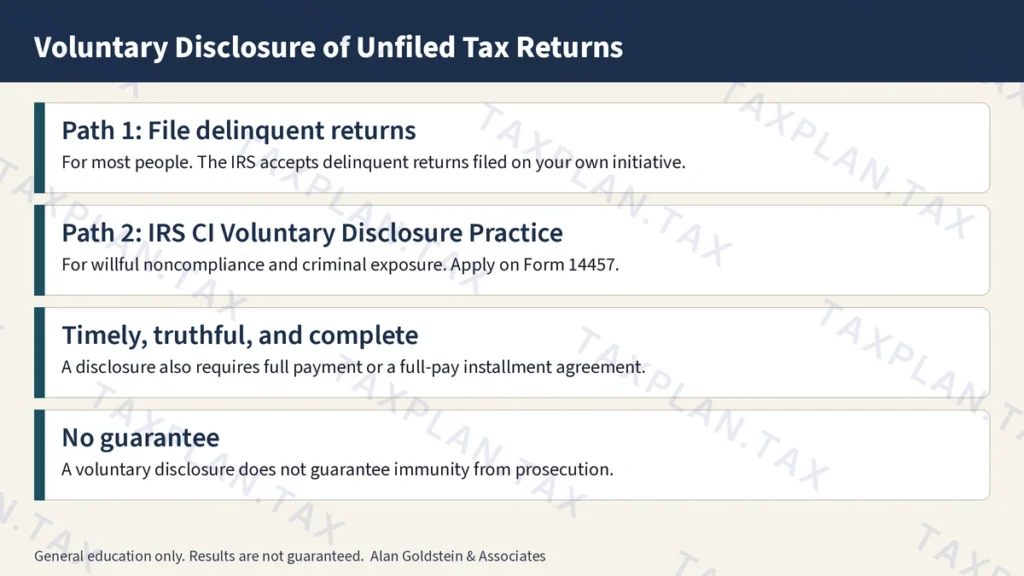


Voluntary disclosure of unfiled tax returns can mean two different things. For most people, it simply means filing the missing returns on your own before the IRS acts. For people whose failure to file was willful, it can mean the IRS Criminal Investigation Voluntary Disclosure Practice (VDP). This guide explains the difference, what the VDP requires, and why no route comes with a guarantee.
Key Takeaways
- Most people with unfiled returns do not need the VDP. They file delinquent returns and resolve any balance.
- The VDP is for willful noncompliance and criminal exposure. It does not guarantee immunity from prosecution.
- A VDP disclosure must be timely, truthful, and complete, and it requires full payment or a full-pay installment agreement.
- The IRS proposed VDP changes in December 2025, but the IRS page still described the current process on November 27, 2026.
- Filing late does not erase penalties, and it does not necessarily cure past fraud.
What does voluntary disclosure of unfiled tax returns mean?
It means coming forward and filing returns you owe before the IRS makes you. The IRS has a general policy of accepting those returns and a separate criminal disclosure program for willful cases.
IRS Policy Statement 5-133 says all delinquent returns submitted by a taxpayer will be accepted, whether on the taxpayer’s own initiative or at the request of an IRS representative. However, it adds that special procedures apply if there are indications of willfulness or fraud. A delinquent return is a required return filed after its due date.
Is filing late the same as a voluntary disclosure?
Not in the formal sense. Filing a late return is the normal civil path. The Voluntary Disclosure Practice is a specific program run by IRS Criminal Investigation (CI).
The IRS VDP page says that if your failure was not willful, you should consider other options, including filing past-due returns. Our guide to filing past-due federal tax returns covers that ordinary path.
What is the IRS Voluntary Disclosure Practice?
It is a long-standing CI practice for taxpayers with criminal exposure from willful violations. A voluntary disclosure may lead CI to not recommend prosecution, but it does not guarantee that result.
According to IRM 9.5.11.9, a voluntary disclosure must be truthful, timely, and complete. The practice also requires you to cooperate, submit all required returns for the disclosure period, and make good-faith arrangements to pay in full. The IRM states that the practice creates no substantive or procedural rights. It also says CI’s determinations are not subject to administrative or judicial review.
The program is not available for illegal-source income. The IRS treats income from activity that is legal under state law but illegal under federal law as illegal-source income for this purpose.
When is a disclosure timely?
A disclosure is timely only if the IRS receives it before certain events. Those events include a civil examination, a criminal investigation, third-party information about your noncompliance, or an enforcement action such as a summons.
The IRS lists these timing rules on its VDP page and in the IRM. CI decides timeliness. If you have received IRS letters or an assigned case, a representative can help you assess whether a disclosure may still qualify. We cannot tell you the answer without the facts.
How does the application work?
You apply on Form 14457 in two parts. Part I is a preclearance request. Part II follows if you are precleared.
The IRS says you must submit Part II within 45 days of the preclearance letter, with one possible 45-day extension. When a representative submits the disclosure, the IRS requires a Form 2848 for each taxpayer and entity. The Form 14457 instructions list the required documents. If CI grants preliminary acceptance, your case goes to a civil examiner. You must provide a statement acknowledging your willful noncompliance.
Is the VDP right for unfiled returns?
Only if your failure to file was willful and you face criminal exposure. If the failure came from a mistake, confusion, or inability to pay, ordinary delinquent filing is usually the better-fitting route.
Willfulness is a legal standard. In Cheek v. United States (1991), the Supreme Court described it as the voluntary, intentional violation of a known legal duty. Under IRC §7203, willful failure to file is a misdemeanor. Many people who simply fell behind did not act willfully. However, the line depends on specific facts, such as prior filing history, what you knew, and whether you took steps to conceal income.
The IRS Manual also tells collection employees not to solicit delinquent returns if a failure to file appears willful or fraud is indicated (IRM 5.1.11.7). For that reason, anyone worried about willfulness should speak with a qualified representative before contacting the IRS.
What did the IRS propose to change in the VDP?
In December 2025, the IRS opened a comment period on proposed updates. The proposal is not final, and eligibility will follow the procedures in effect when changes take effect.
The IRS news release proposed that conditionally approved taxpayers file delinquent returns and pay in full within three months. It proposed a disclosure period generally covering the most recent six years. For delinquent returns, the proposal applies failure-to-file penalties for each year and no failure-to-pay penalties. It also proposed a signed closing agreement waiving statutes of limitations. The IRS announcement said the comment period ended March 22, 2026. It also said final procedures, if adopted, are expected to take effect six months after publication.
As of November 27, 2026, we did not find final procedures on IRS.gov. The VDP page still described the current process. Because that may change, confirm the current rules before relying on any of these details.
How does disclosure affect penalties and time limits?
Disclosure does not erase civil penalties. It also does not turn every old year into a closed year.
The IRS says filing and paying now limits interest and late payment penalties. However, it does not remove penalties already earned. Under IRC §6651, the failure-to-file penalty is 5% of unpaid tax per month, up to 25%. For Form 1040 returns due after December 31, 2025, the minimum for a return more than 60 days late is $525, or 100% of the tax if less (IRS failure to file penalty).
Does filing start the assessment clock?
Generally yes. The IRM says the assessment period for a secured delinquent return is three years from filing, even after a fraudulent failure to file. Other exceptions can still apply, such as the six-year rule for large omissions or the unlimited period for a false or fraudulent return (IRM 4.12.1.5.4).
Fraud on a filed return is different. In Badaracco v. Commissioner (1984), the Court held that a later nonfraudulent amended return did not restart the three-year period after a fraudulent original return. In short, correcting a problem later does not always cure it.
What should you do before disclosing anything?
Learn what the IRS already has, then decide with a representative which path fits. Start with your transcripts, because they show reported income and filed years.
- Order wage and income and account transcripts for each missing year.
- List every missing return, including business and information returns.
- Gather records of income, bank deposits, and expenses.
- Have a representative assess willfulness and any criminal exposure.
- Sign Form 2848 if you want that representative to speak for you.
If your case involves foreign accounts or assets, other IRS programs may apply. Our article on voluntary disclosure versus streamlined filing discusses those options.
Frequently Asked Questions
Do I have to make a voluntary disclosure to file late returns?
No. You can file delinquent returns without applying to the VDP. The IRS says to file them the same way you would file on-time returns, unless a notice directs otherwise.
Does the VDP guarantee I will not be prosecuted?
No. The IRS says a voluntary disclosure does not automatically guarantee immunity. It is one factor CI considers when deciding whether to recommend prosecution.
Can I use the VDP if my failure to file was not willful?
The IRS says the VDP is designed for willful noncompliance. If your error was not willful, it points to other options, such as filing past-due returns.
How far back must I file?
It depends on the path. IRS policy normally enforces filing for no more than six years. The proposed VDP would generally cover the most recent six years. Our guide to how far back the IRS requires unfiled tax returns explains more.
Do I have to pay in full under the VDP?
The IRS requires you to pay in full or secure a full-pay installment agreement. The current IRM also refers to good-faith arrangements to pay in full.
What if I already received an IRS notice?
Read it and respond by its deadline, and consider getting help promptly. A notice may affect whether a VDP disclosure is timely, so a representative should review the facts.
Will the IRS file a substitute return if I wait?
It may. Under §6020(b), the IRS can prepare a return from third-party income data. That return may not include deductions or credits you could claim on your own return.
Is voluntary disclosure the same for businesses?
The IRS says individuals and entities can request the VDP. Entities must also meet the same timing and cooperation rules. Business return penalties differ, so review each return type.
Conclusion
For most people, voluntary disclosure of unfiled tax returns means filing accurate delinquent returns and resolving the balance. For willful cases, the IRS VDP exists, but it is narrow, discretionary, and under proposed revision. Getting the facts reviewed first is usually wise.
Alan Goldstein, MBA, IRS Enrolled Agent, of Alan Goldstein & Associates in Coral Gables, Florida, helps taxpayers evaluate how to come into compliance. We can obtain your transcripts, prepare missing returns, and coordinate with qualified counsel where criminal exposure may be an issue. We cannot guarantee any outcome. To request a confidential review of your unfiled returns and IRS resolution options, visit our Tax Resolution Services page.
Cases Cited
- Cheek v. United States, 498 U.S. 192, 201 (1991)
- Badaracco v. Commissioner, 464 U.S. 386, 393 (1984)
Sources
- IRS: Criminal Investigation Voluntary Disclosure Practice
- IRS: IRM 9.5.11, Voluntary Disclosure Practice (IRM 9.5.11.9)
- IRS: Form 14457, Voluntary Disclosure Practice Preclearance Request and Application
- IRS: IRS seeks public comment on Voluntary Disclosure Practice proposal (Dec. 22, 2025)
- IRS: IRM 1.2.1, Servicewide Policy Statements (Policy Statement 5-133)
- IRS: IRM 5.1.11, Delinquent Return Investigations
- IRS: IRM 4.12.1, Nonfiled Returns
- IRS: Filing past due tax returns
- IRS: Failure to file penalty
- IRC §6651, Failure to file tax return or to pay tax
- IRC §7203, Willful failure to file return, supply information, or pay tax
- IRC §6020, Returns prepared for or executed by Secretary
- Cheek v. United States, 498 U.S. 192, 201 (1991) (official U.S. Reports, Library of Congress)
- Badaracco v. Commissioner, 464 U.S. 386, 393 (1984) (official U.S. Reports, Library of Congress)
This article is provided for general educational purposes and does not constitute individualized tax, legal, or accounting advice. Tax consequences depend on the taxpayer’s specific facts and applicable law.
