

Unfiled partnership tax returns can cost money even when the partnership owes no income tax. A partnership files Form 1065 to report its income and to give each partner a Schedule K-1. If it misses the deadline, the IRS can charge a penalty for every partner, for every month the return is late. This guide explains the Form 1065 filing rules, the penalty math, the relief options, and how to catch up.
Key Takeaways
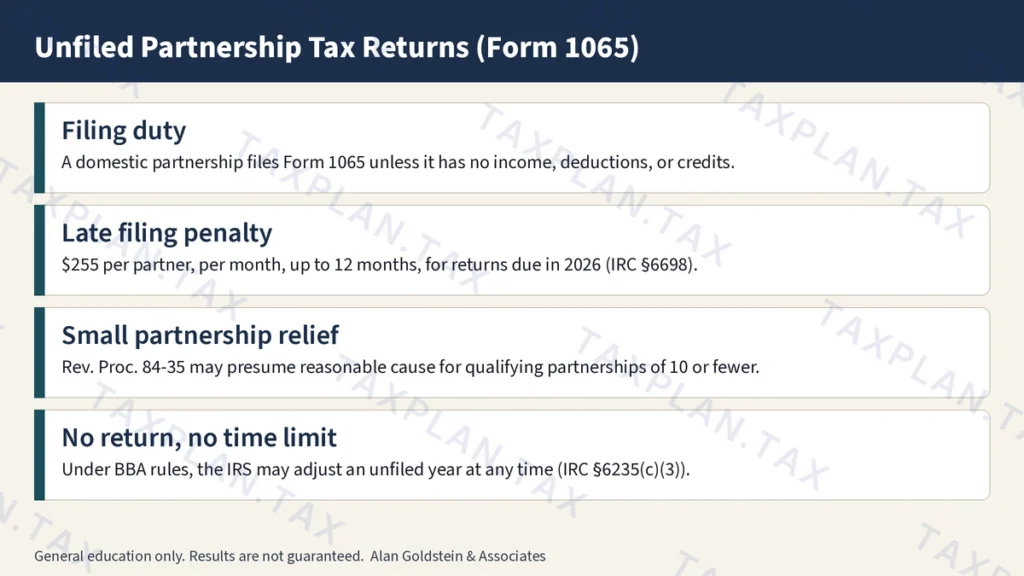
- Every domestic partnership must file Form 1065 unless it had no income, deductions, or credits for the year.
- For returns due in 2026, the late filing penalty is $255 per partner, per month, for up to 12 months.
- The penalty applies even if the partnership owes no tax, because it is based on the number of partners.
- Small partnerships may qualify for relief under Rev. Proc. 84-35 if they meet every condition.
- Under the BBA audit rules, the IRS may make adjustments at any time for a year with no partnership return.
Who must file Form 1065?
Generally, every domestic partnership must file Form 1065. The only general exception is a partnership that neither receives income nor incurs any expenditures treated as deductions or credits (IRS: Instructions for Form 1065).
The duty comes from IRC §6031, which requires every partnership to make a return for each tax year. It also covers most multi-member LLCs. The IRS says an LLC with at least two members is a partnership by default unless it elects corporate treatment (IRS: Limited liability company).
What is a Schedule K-1?
A Schedule K-1 is the form that shows each partner’s share of the partnership’s income, deductions, and credits. The partnership attaches a K-1 for each partner to Form 1065 and gives a copy to each partner. Partners then use it to complete their own returns. So when the partnership does not file, the partners often cannot file correctly either.
When are unfiled partnership tax returns late?
A Form 1065 is late if it is not filed by the due date, including extensions. Generally, the due date is the 15th day of the 3rd month after the tax year ends.
For calendar-year partnerships, that is usually March 15. If the date falls on a weekend or legal holiday, the deadline moves to the next business day. In addition, a partnership can request more time with Form 7004, filed by the regular due date. However, once the extended date passes, the penalty clock starts.
How much is the penalty for unfiled partnership tax returns?
For 2025 returns due in 2026, the IRS lists a penalty of $255 for each month or part of a month the return is late. It then multiplies that amount by the number of partners, for a maximum of 12 months.
The penalty comes from IRC §6698. The statute sets a $195 base amount and adjusts it for inflation, which is why the yearly figure changes. The same penalty applies when a filed return fails to show the required information. Under §6698(c), the IRS assesses the penalty against the partnership itself, not the partners.
What does the penalty look like in practice?
The math is simple, but the total can grow quickly. The following example is illustrative only:
| Illustrative facts (2025 Form 1065, due in 2026) | Amount |
|---|---|
| Monthly amount per partner | $255 |
| Number of partners | 4 |
| Months late (capped at 12) | 12 |
| Maximum penalty for that one return ($255 × 4 × 12) | $12,240 |
Also note that the cap applies per return. Therefore, a partnership with several unfiled years can face a separate penalty for each year. The Form 1065 instructions also describe a separate penalty for failing to furnish information, such as K-1s, on time.
Can the IRS assess this penalty without a notice of deficiency?
Yes. Under §6698(d), the deficiency procedures do not apply to this penalty. In other words, the IRS can assess it directly, without first sending a notice of deficiency. Relief usually comes through an abatement request or an appeal instead.
How long can the IRS adjust an unfiled partnership year?
For partnerships under the centralized audit regime, there is no deadline when no return was filed. IRC §6235(c)(3) says the IRS may make adjustments “at any time” for that year.
The centralized partnership audit regime is often called the BBA regime, after the Bipartisan Budget Act of 2015 (IRS: BBA centralized partnership audit regime). Notably, §6235(c)(4) adds that an IRS-prepared return under IRC §6020(b) does not count as the partnership’s return for this purpose. So a substitute return does not start the clock.
The Supreme Court applied a similar principle long ago. In Commissioner v. Lane-Wells Co. (1944), the Court held that because the required return was never filed, the limitations period did not begin to run (321 U.S. at 224). That case involved a corporation, but the logic is similar: filing the right return is what starts the clock.
Can a partnership get relief from the late filing penalty?
Possibly. The main paths are small partnership relief, First Time Abate, and reasonable cause. Each depends on the facts, and none is guaranteed.
What is Rev. Proc. 84-35 small partnership relief?
Rev. Proc. 84-35 lets the IRS presume reasonable cause for certain small partnerships. According to IRM 20.1.2.4.3.1, the partnership must meet all of these conditions:
- It has 10 or fewer partners. A married couple filing jointly counts as one partner.
- Each partner is an individual (not a nonresident alien) or the estate of a deceased partner.
- Each partner’s share of every item follows the same proportion.
- Each partner reported his or her share of partnership income on a timely filed return.
The IRM also warns that the IRS may reassess the penalty if it later finds that any condition was not met. Because the IRM contains further limits, a professional should confirm eligibility before you rely on this relief.
Do First Time Abate and reasonable cause apply to partnerships?
Yes, both can apply. The IRS lists §6698(a)(1) penalties as eligible for First Time Abate (FTA) and for its new Automatic Exemption from Penalty (AEP), which begins with 2025 tax year returns (IRS: Administrative penalty relief). Both require a clean filing history for the prior three years. That test often rules them out when several years are missing.
Reasonable cause is the other option (IRS: Penalty relief for reasonable cause). But relying on a preparer to file on time is usually not enough. In United States v. Boyle (1985), the Supreme Court held that reliance on an agent “cannot function as a substitute for compliance with an unambiguous statute” (469 U.S. at 251). By contrast, the Court noted that relying on an adviser’s substantive advice, such as advice that no return was required, may be reasonable (id. at 250–251).
How do you file unfiled partnership tax returns?
Confirm the partners and years first, then file Form 1065 with K-1s, and then fix the partners’ returns. The order matters because partner returns depend on partnership figures.
- Confirm the classification. First, check whether the entity was a partnership each year. An LLC may have elected corporate or S corporation status.
- List partners by year. Next, record who was a partner at any time during each year. The penalty counts all of them.
- Rebuild the books. Then reconcile bank records, 1099s, and capital accounts for each year.
- File Form 1065 and K-1s. After that, file the returns and give each partner a K-1.
- Update partner returns. Finally, partners file or amend their own returns, and the partnership requests any penalty relief.
For more on how entity type drives filing duties, see unfiled tax returns for LLC owners. Our guide for small business owners also covers payroll and information returns.
Frequently Asked Questions
Does a partnership with a loss need to file Form 1065?
Yes. A loss usually means the partnership had income or deductions. So it generally must file, and the §6698 penalty can apply even with no tax due.
Who pays the late partnership return penalty?
The partnership does. Section 6698(c) says the IRS assesses the penalty against the partnership.
Is the $255 amount the same every year?
No. The statute sets a $195 base and adjusts it for inflation. The $255 figure applies to 2025 returns filed in 2026, per the IRS instructions.
Can partners file their own returns without a K-1?
They still must file on time. However, without the K-1 they may need to estimate and later amend. A professional can help handle this carefully.
Does Rev. Proc. 84-35 apply to an LLC with a corporate partner?
Generally, no. The IRM requires each partner to be an individual (not a nonresident alien) or a deceased partner’s estate.
Can the IRS adjust a partnership year from 10 years ago?
If no partnership return was filed and the BBA rules apply, §6235(c)(3) allows adjustments at any time. In practice, IRS enforcement priorities vary.
Does an IRS substitute return start the BBA time limit?
No. Section 6235(c)(4) says a §6020(b) return is not treated as the partnership’s return for this purpose.
Conclusion
Unfiled partnership tax returns create a penalty that grows with each month and each partner, even with no tax due. They also leave partners without the K-1s they need, and they can leave the year open indefinitely. Filing complete returns, then seeking relief where the facts support it, is usually the most practical path.
Alan Goldstein, MBA, IRS Enrolled Agent, of Alan Goldstein & Associates in Coral Gables, Florida, helps partnerships and their partners catch up on past-due returns. We can review your filing history, prepare Forms 1065 and K-1s, and evaluate penalty relief. Every case depends on its facts, and we cannot guarantee any outcome. To request a confidential review, visit our Tax Resolution Services page.
Cases Cited
- Commissioner v. Lane-Wells Co., 321 U.S. 219, 224 (1944) (that case involved a corporation, but the logic is similar)
- United States v. Boyle, 469 U.S. 241, 250–251 (1985)
Sources and Authorities
- IRS: Instructions for Form 1065 (2025), Who Must File, When To File, and Penalties
- IRC §6031, Return of partnership income
- IRS: Limited liability company (LLC)
- IRS: About Form 7004
- IRC §6698, Failure to file partnership return
- IRC §6235, Period of limitations on making adjustments
- IRS: BBA centralized partnership audit regime
- IRC §6020, Returns prepared for or executed by Secretary
- Commissioner v. Lane-Wells Co., 321 U.S. 219, 224 (1944) (official U.S. Reports, Library of Congress)
- IRM 20.1.2, Failure To File/Failure To Pay Penalties (20.1.2.4.3.1, Rev. Proc. 84-35)
- IRS: Penalty relief due to First Time Abate or other administrative waiver (including AEP)
- IRS: Penalty relief for reasonable cause
- United States v. Boyle, 469 U.S. 241, 250–251 (1985) (official U.S. Reports, Library of Congress)
This article is provided for general educational purposes and does not constitute individualized tax, legal, or accounting advice. Tax consequences depend on the taxpayer’s specific facts and applicable law.
