
How long a cost segregation study takes depends mostly on the property, the records you can supply, and the approach the provider uses, so there is no single standard cost segregation study timeline. The IRS has not set any time requirement for studies. Instead, its Cost Segregation Audit Techniques Guide (Publication 5653) describes the work: document review, a site visit, quantity take-offs, cost allocation, reconciliation, and a written report. Naturally, each step takes longer when drawings or cost records are missing.
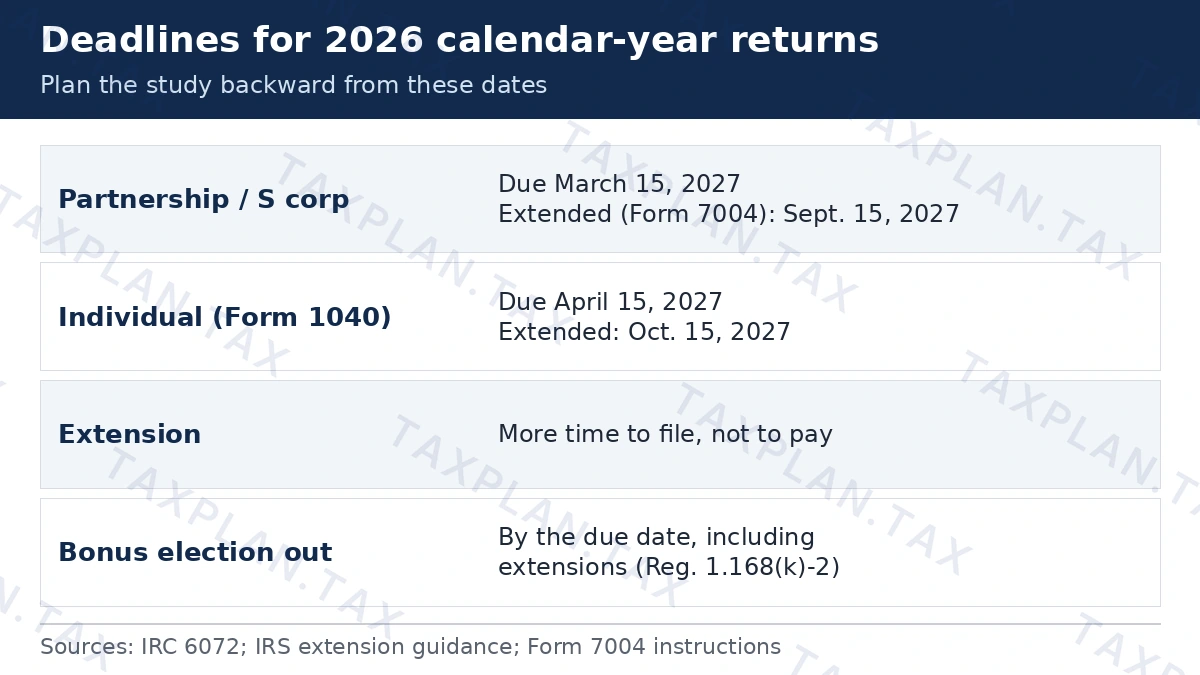
However, the date that truly matters is your tax return deadline. Indeed, the guide says a study done in the placed-in-service year should allow enough time before the return is filed to compute bonus and regular depreciation. For calendar-year 2026 returns, partnerships and S corporations generally file by March 15, 2027, and individuals by April 15, 2027, with six-month extensions available. If you miss that window, an amended return or a later Form 3115 can often still capture the deductions.
Key Takeaways
- No IRS rule sets how long a study must take; scope, records, and approach drive the schedule.
- Plan backward from your return due date, including any extension.
- An extension gives more time to file, not more time to pay.
- Records such as drawings, pay applications, and closing documents shorten the work.
- Missing the first return is usually fixable through an amended return or Form 3115.
- Start before you sign the purchase contract if price allocation is in play.
Introduction and Background: What Is a Cost Segregation Study Timeline?
Direct answer: It is the sequence of steps from engagement to a finished report, set against your filing deadline.
A cost segregation study allocates a building’s cost among recovery classes under IRC §168. For example, some components are 5-, 7-, or 15-year property, while the structure stays 27.5-year or 39-year property. The recovery periods appear in IRS Publication 946.
Publication 5653 states that the IRS has not established any requirements or standards for preparing studies. As a result, providers set their own schedules. That is why a cost segregation study timeline should be agreed in writing at engagement. For a full walk-through of each stage, see our Cost Segregation Study Process: Step-by-Step Breakdown.
How Does the Cost Segregation Study Timeline Unfold?
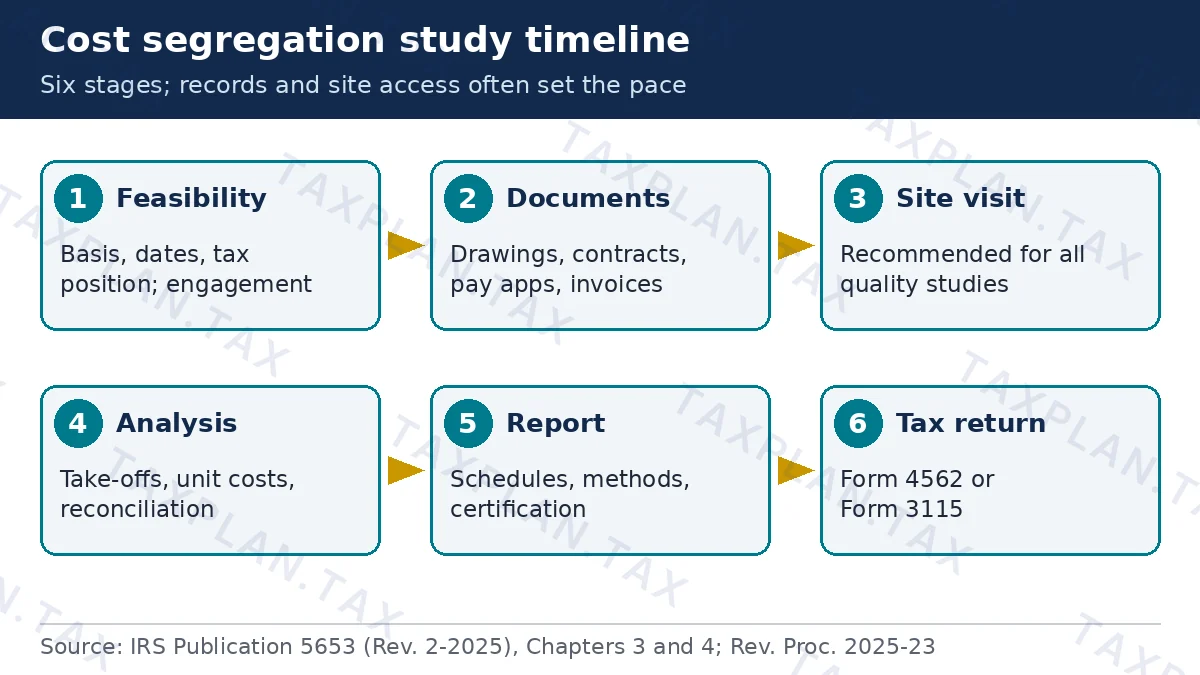
Direct answer: Most studies move through six stages, and the document stage often decides the pace.
1. Feasibility and engagement
First, the provider reviews the purchase price, placed-in-service date, and your tax position. Then you sign an engagement letter that defines scope, fee, and deliverables.
2. Document collection
Next, you gather records, and this stage often sets the cost segregation study timeline. For new construction, Publication 5653 points to drawings, specifications, contracts, pay requests, change orders, and invoices. For acquired buildings, records may range from full construction files to nothing more than the purchase price. In that case, the provider must estimate costs, which takes more work.
3. Site visit
Specifically, the guide recommends a field inspection for all quality studies. Moreover, when drawings are limited, it calls the inspection a critical step. So scheduling access to the property is part of the timeline.
4. Engineering analysis and costing
Then the provider identifies components, prepares quantity take-offs, and applies unit costs. It also allocates indirect costs and reconciles allocated costs to the actual total. Notably, the guide lists that reconciliation among its 13 principal elements of a quality study.
5. Report
After that, the provider issues a report. Specifically, the guide lists a summary, a narrative, asset schedules, cost schedules, engineering procedures, assumptions, and a certification.
6. Implementation on the return
Finally, your preparer reports the results. For instance, current-year property goes on Form 4562. Property placed in service in earlier years often needs Form 3115 under Rev. Proc. 2025-23, section 6.01.
What Makes a Cost Segregation Study Timeline Longer?
Direct answer: Missing records, complex buildings, multiple sites, and look-back calculations add the most time.
- Acquired versus new property. New projects usually have cost records, whereas acquisitions often require estimates and depreciation adjustments.
- Approach. The guide calls the residual estimation approach simpler and less time consuming than engineering approaches, but it can also be less accurate.
- Complexity. More systems, finishes, and site work mean more components to identify.
- Several similar properties. Sampling can minimize resources for nearly identical sites, although the guide notes accuracy limits.
- Look-back studies. Prior-year property adds a §481(a) adjustment and Form 3115 work.
- Your response time. Slow answers to document requests delay every later step.
Benefits of Starting Your Cost Segregation Study Timeline Early
Direct answer: An early start protects your deadline, improves documentation, and lets you plan elections.
Above all, starting early gives the provider time for a complete study rather than a rushed one. In addition, Publication 5653 notes that contemporaneous documentation is the most reliable and trustworthy. An early study also supports estimated tax planning, since 100% bonus may apply. For qualified property acquired after January 19, 2025, Public Law 119-21 set the §168(k) rate at 100%. IRS Notice 2026-11 gives interim guidance on that change.
Similarly, early results help you decide whether to elect out of bonus for any class. For more on that choice, see Bonus Depreciation and Cost Segregation: How They Work Together.
Legal and Regulatory Considerations for the Cost Segregation Study Timeline
Direct answer: Return due dates, election deadlines, and method-change rules set the real limits on timing.
Return due dates and extensions
Under IRC §6072(b), calendar-year partnership and S corporation returns are due by March 15. Meanwhile, individual returns for calendar-year taxpayers are due April 15 under §6072(a). The IRS says an individual extension runs to October 15, but tax owed is still due by the April date. Likewise, the Form 7004 instructions say the automatic business extension is generally six months.
Bonus elections follow the return
Under Treas. Reg. §1.168(k)-2(f)(1)(iii), an election out of bonus must be made by the due date, including extensions, of the return for the placed-in-service year. Moreover, Treas. Reg. §301.9100-2(b) grants an automatic six-month extension for certain elections if you timely filed the return and take corrective action.
If the study finishes after you file
Publication 5653, Chapter 6, section H.9, explains the fallback. Generally, you can amend the placed-in-service year return before you file the next year’s return. Otherwise, you have adopted an impermissible method and generally need Form 3115. Under Rev. Proc. 2015-13, section 6.03(1)(a), the original Form 3115 goes with the timely filed return, including extensions. A signed copy goes to the IRS no earlier than the first day of the year of change and no later than the date you file the original.
Court cases that affect timing
For example, in Peco Foods, Inc. v. Commissioner, 522 F. App’x 840 (11th Cir. 2013), the buyer was bound by allocation schedules in its purchase agreements and could not use a later study to change them. Therefore, timing a study before you sign can matter. In Hospital Corp. of America v. Commissioner, 109 T.C. 21 (1997), the Tax Court applied the former investment tax credit rules of Treas. Reg. §1.48-1 to classify components. Consequently, a rushed study that skips that analysis invites problems. Finally, AmeriSouth XXXII, Ltd. v. Commissioner, T.C. Memo. 2012-67, shows how weak evidence on specific items can lose on audit. Additionally, full case citations appear in the Cases Cited section below.
Practical Examples: Planning a Cost Segregation Study Timeline
Direct answer: Work backward from the return deadline and leave a buffer. Also, the turnaround figures below are assumptions for illustration, not typical or guaranteed times.
Example 1: Partnership with an extension
Assume a calendar-year LLC taxed as a partnership buys an office building in February 2026. Its 2026 return, in turn, is due March 15, 2027, or September 15, 2027, with a Form 7004 extension. Assume the provider quotes eight weeks after receiving complete documents, and the preparer wants the report a month before filing.
| Illustrative milestone | Without extension | With extension |
|---|---|---|
| Return due date (calendar-year partnership) | March 15, 2027 | September 15, 2027 |
| Report needed by (one-month buffer, assumed) | Mid-February 2027 | Mid-August 2027 |
| Complete documents delivered by (eight weeks, assumed) | Mid-December 2026 | Mid-June 2027 |
In this example, the extension adds six months of room to the cost segregation study timeline. Still, the partners’ own returns depend on the partnership’s Schedules K-1. So a late study can delay everyone.
Example 2: Individual who filed before the study
Now assume an individual places a rental building in service in 2026 and files the 2026 return in April 2027 without a study. However, the study finishes in June 2027. Under the guide, the owner can generally amend the 2026 return before filing the 2027 return. Alternatively, Rev. Proc. 2025-23, section 6.01(1)(b), allows a Form 3115 for property placed in service in the year before the year of change.
Example 3: Study started before closing
Finally, assume a buyer engages a provider during due diligence. Then the provider reviews the draft purchase agreement and flags any allocation clause. As a result, the buyer avoids a Peco Foods-type allocation problem, and the study can start as soon as the closing documents arrive.
Common Cost Segregation Study Timeline Mistakes and Risks
Direct answer: Most timing problems come from late starts, missing records, and confusion about extensions.
- Starting after the deadline is near. A rushed study is more likely to cut corners.
- Assuming an extension delays payment. It does not; tax owed is still due by the original date.
- Sending records piecemeal. Gaps force estimates and repeated requests.
- Ignoring the purchase agreement. A binding allocation can limit the study.
- Making an unintended election out. The election covers a whole class for the year.
- Forgetting the Form 3115 copy. The signed duplicate has its own filing window.
Frequently Asked Questions
How long does a cost segregation study take?
It varies, because property size, records, approach, site access, and your response time all matter, and no IRS rule sets a duration. So ask the provider for a written schedule.
Can I finish a cost segregation study after my return is due?
Yes. If you extend, you can file later. If you already filed, an amended return or Form 3115 can often capture the deductions.
Does an extension give me more time to pay?
No. According to the IRS, the extension is only for filing, so pay any tax owed by the original due date.
What records speed up a study?
In general, drawings, specifications, contracts, pay applications, invoices, and closing documents are most helpful. Photos of the property can also help.
Is a site visit required for a cost segregation study?
No rule requires one. However, Publication 5653 recommends a field inspection for all quality studies.
Can I do a study years after buying the property?
Often, yes. In that case, a look-back study generally uses Form 3115 and a §481(a) adjustment under Rev. Proc. 2025-23.
Should I order the study before closing?
It can help, especially if the contract may allocate the price. For example, early review can prevent a Peco Foods-type problem.
Conclusion: How Should You Plan Your Cost Segregation Study Timeline?
In short, the right cost segregation study timeline starts with your filing deadline and works backward. Next, gather records early, book the site visit, and agree on a written schedule. If time runs short, file an extension, but pay any tax by the original date. If you have already filed, remember that an amended return or Form 3115 may still work.
Emunah Cost Segregation helps owners and CPAs plan studies around real deadlines. Alan Goldstein, MBA, EA, reviews your dates, documents, and contracts at the start. Then he helps you set a realistic schedule. Contact Emunah Cost Segregation in Coral Gables, Florida, to request a feasibility review.
Cases Cited
- Peco Foods, Inc. v. Commissioner, 522 F. App’x 840, 843-844 (11th Cir. 2013) (unpublished), aff’g T.C. Memo. 2012-18. Pinpoint verified against the reporter-paginated opinion text. Opinion
- Hospital Corp. of America v. Commissioner, 109 T.C. 21, 48-52 (1997) (United States Tax Court). Pinpoint verified against the reporter-paginated opinion text. Opinion
- AmeriSouth XXXII, Ltd. v. Commissioner, T.C. Memo. 2012-67, 103 T.C.M. (CCH) 1324 (2012) (United States Tax Court, memorandum opinion). Pinpoint uncertainty: T.C. Memos have no volume or reporter page of their own, and we could not confirm the T.C.M. (CCH) page numbers for the specific holdings. In the CourtListener text, the utility-line holdings appear at star pages *44-*46 and the “inadequate record” statement at *53; we believe those star pages track the Lexis version, but we could not confirm that. Opinion
Sources and Authorities
- IRS Publication 5653 (Rev. 2-2025), Cost Segregation Audit Techniques Guide, Chapters 3, 4, and 6.H: https://www.irs.gov/pub/irs-pdf/p5653.pdf
- IRS Publication 946, How To Depreciate Property: https://www.irs.gov/pub/irs-pdf/p946.pdf
- 26 U.S.C. §168: https://www.law.cornell.edu/uscode/text/26/168
- 26 U.S.C. §6072: https://www.law.cornell.edu/uscode/text/26/6072
- Public Law 119-21 (H.R. 1, 119th Congress), §70301: https://www.congress.gov/bill/119th-congress/house-bill/1
- IRS Notice 2026-11: https://www.irs.gov/pub/irs-drop/n-26-11.pdf
- Treas. Reg. §1.168(k)-2: https://www.ecfr.gov/current/title-26/section-1.168(k)-2
- Treas. Reg. §301.9100-2: https://www.ecfr.gov/current/title-26/section-301.9100-2
- Treas. Reg. §1.48-1: https://www.ecfr.gov/current/title-26/section-1.48-1
- IRS, Get an extension to file your tax return: https://www.irs.gov/filing/get-an-extension-to-file-your-tax-return
- Instructions for Form 7004 (Rev. 12/2025): https://www.irs.gov/instructions/i7004
- About Form 3115: https://www.irs.gov/forms-pubs/about-form-3115
- Rev. Proc. 2025-23, section 6.01: https://www.irs.gov/pub/irs-drop/rp-25-23.pdf
- Rev. Proc. 2015-13, section 6.03: https://www.irs.gov/pub/irs-drop/rp-15-13.pdf
- Court opinions: see Cases Cited above.
This article is provided for general educational purposes and does not constitute individualized tax, legal, or accounting advice. Tax consequences depend on the taxpayer’s specific facts and applicable law.
