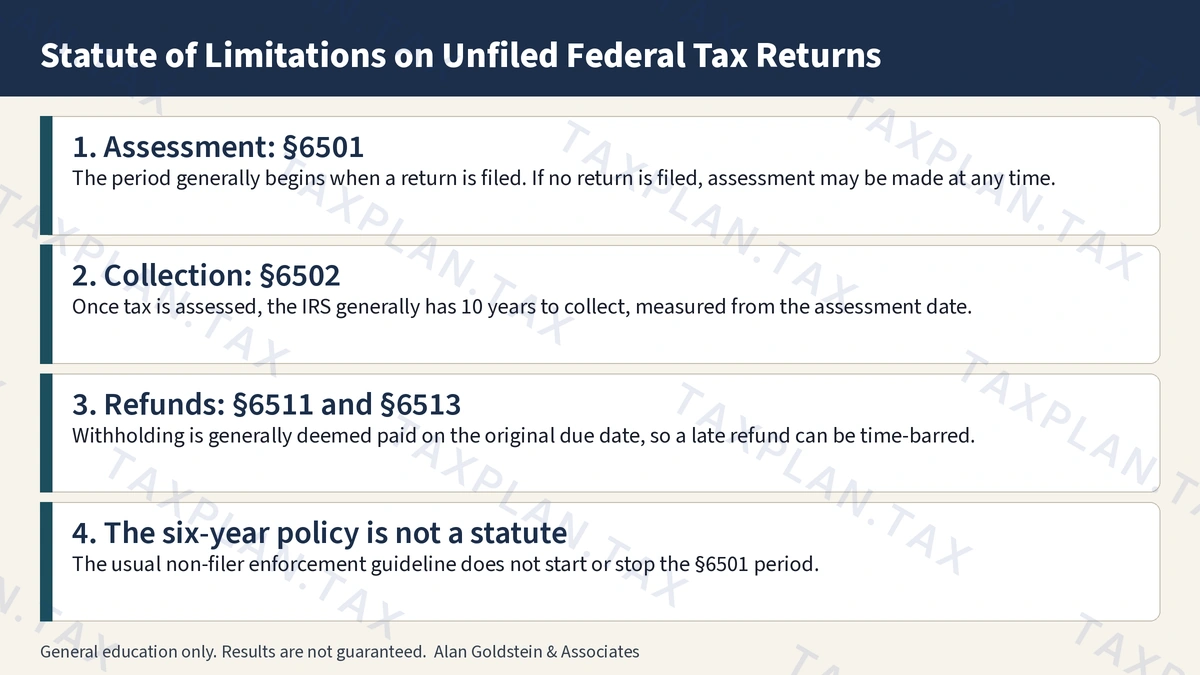

On an unfiled federal tax return, the ordinary three-year assessment statute of limitations generally has not started. Internal Revenue Code (IRC) §6501 usually gives the IRS three years after a return is filed to assess additional tax. If no return is filed, §6501(c)(3) allows the tax to be assessed, or a court proceeding for collection to be begun without assessment, at any time. That is the central limitations rule for non-filers, and it is often confused with three other clocks: the IRS’s normal six-year delinquency-enforcement policy, the 10-year collection period that begins only after assessment under §6502, and the taxpayer’s time to claim a refund under §6511. Filing a valid, nonfraudulent return is what starts the ordinary assessment period. Until then, waiting does not close the year. A refund, by contrast, can expire even though the year remains open for assessment, because withholding and estimated tax are generally deemed paid on the original due date.
Key Takeaways
- The assessment limitation period in §6501 generally begins when a return is filed, not on the original due date. If no return is filed, assessment may be made at any time.
- The IRS’s usual six-year non-filer enforcement policy is not a statute of limitations and does not start or stop the §6501 period.
- Once tax is assessed—either from your return or from a substitute for return—the IRS generally has 10 years to collect under §6502, measured from the assessment date.
- A refund claim is subject to §6511. Withholding and estimated tax are generally deemed paid on the original due date under §6513, so a late-filed refund year can be time-barred.
- After a valid return is filed, a substantial omission of more than 25% of gross income can extend the assessment period to six years under §6501(e). Fraud or a willful attempt to evade tax can leave it open under §6501(c).
- Filing is what starts the ordinary assessment clock. Simply remaining a non-filer does not cause these limitation periods to run in the taxpayer’s favor.
Introduction and Background
Limitation periods in tax law are specific. There is no single “statute of limitations on unfiled returns” that quietly closes a missing year after three or six or ten years. Each period has a starting event, a length, and exceptions. For a year that was never filed, the starting event for assessment usually has not occurred.
That fact surprises people who remember that the IRS generally has three years to audit a filed return, or 10 years to collect a balance. Both of those statements can be true in the right setting, and both are incomplete when no return has been filed. The six-year figure that appears in IRS enforcement manuals is a policy about how far back the agency will normally go to secure returns. It is not the assessment statute, and it is not the collection statute.
Understanding the clocks is practical. It tells you why filing a late return can be in your interest even if you cannot pay, why a substitute for return can start collection, and why a refund year should not be left sitting on the shelf.
How It Works
The assessment period: §6501
Section 6501(a) generally requires that tax be assessed within three years after the return is filed, whether or not the return was filed on the due date specified in the Code. For this purpose, the filing date of a late return is the date it is filed, not the original due date. If no return is filed, §6501(c)(3) provides that the tax may be assessed at any time, or that a court proceeding for collection may be begun without assessment at any time.
Other exceptions can apply after a return is filed. Under §6501(c), a false or fraudulent return filed with intent to evade tax, or a willful attempt to evade tax, leaves the assessment period open. Under §6501(e), if the taxpayer omits from gross income an amount exceeding 25% of the gross income stated on the return, the period is generally six years from the date the return was filed. Those extensions matter once you have filed. They are not a substitute for the rule that an unfiled year has no ordinary starting date.
The collection period: §6502
Section 6502 generally limits collection, by levy or by a court proceeding, to 10 years after the assessment of the tax. The collection statute expiration date, often called the CSED, is measured from assessment, not from the original return due date and not from the date the IRS first sent a delinquency notice. On an unfiled year there is typically no CSED until the IRS assesses tax, which can happen when you file or when it assesses a substitute for return under §6020(b) after deficiency procedures. Events such as a collection due process hearing, an offer in compromise, or a bankruptcy can suspend or extend the collection period in ways this article does not attempt to catalog; the point for non-filers is that the 10-year clock does not start before assessment.
The refund period: §6511 and §6513
A claim for credit or refund generally must be filed within three years from the time the return was filed or two years from the time the tax was paid, whichever is later. The amount that can be refunded is limited by the lookback rules in §6511(b). Under §6513, amounts withheld as tax and estimated tax payments are generally deemed paid on the due date of the return, determined without regard to any extension of time for filing. The IRS summarizes the practical result on its past-due returns page: if you are due a refund for withholding or estimated taxes, you must file your return to claim it within three years of the return due date. The same timing concern applies to refundable credits such as the earned income credit. In other words, the taxpayer’s refund clock can run out while the IRS’s assessment clock on an unfiled year has not even started.
Benefits and Opportunities
- Filing starts the ordinary assessment period. A valid, nonfraudulent late return generally gives the IRS three years from the filing date to assess additional tax, rather than leaving the year open indefinitely.
- You may still be in time for a refund. If the §6511 period has not expired, filing is how you claim withholding or credits. That deadline is independent of whether the IRS has asked for the year.
- You can replace an SFR assessment posture with your own figures. If the IRS has proposed or assessed tax on a substitute for return, filing your own return is the way to put deductions and credits into the computation, which can change both the tax and the later collection period that rests on the assessment.
- Clear clocks support a payment plan. Once tax is assessed, you and the IRS can see a collection horizon under §6502, and collection alternatives such as an installment agreement generally require required returns to be filed.
Legal and Regulatory Considerations
The assessment and collection periods are statutory. Policy Statement 5-133, as applied in IRM 4.12.1 and IRM 5.1.11, does not amend §6501 or §6502. The IRM states that the IRS will normally enforce delinquency procedures for not more than six years, with managerial approval to go shorter or longer, and that the taxpayer may file older years. That guidance allocates enforcement resources. It does not close an unfiled year for assessment.
A substitute for return under §6020(b), once processed through deficiency procedures and assessed, is an assessment for §6502 purposes. The IRS states that a Notice of Deficiency CP3219N gives you 90 days (150 days if the notice is addressed to a person outside the United States) to file your own return or petition the Tax Court, and that you cannot request an extension to file after that notice. If you do neither, the IRS may assess the proposed tax and begin collection. The collection period then generally runs from that assessment.
Interest under §§6621 and 6622, and civil penalties under §6651, are not limitation periods, but they continue to accrue on unpaid amounts until paid, subject to the penalty caps and to any available relief. For income tax returns more than 60 days late, the minimum failure-to-file penalty is the lesser of the IRS-published amount or 100% of the tax required to be shown; for due dates after December 31, 2025, that amount is $525. For October 1 through December 31, 2026, the underpayment interest rate for individuals is 7% per year, compounded daily. Willful failure to file can also be a misdemeanor under §7203.
Practical Examples
The examples below are illustrative. They apply the statutory starting dates and published IRS figures. They do not compute interest to the penny, because quarterly rates change and compounding is daily.
| Clock | Ordinary starting event | Ordinary length | If the return was never filed |
|---|---|---|---|
| Assessment (§6501) | Filing of the return | Generally three years from filing (six years if §6501(e) applies; open indefinitely if §6501(c) fraud rules apply) | Assessment may be made at any time under §6501(c)(3) |
| Collection (§6502) | Assessment of the tax | Generally 10 years from assessment, subject to suspensions and extensions | No ordinary CSED until there is an assessment, including an SFR assessment |
| Refund (§6511 / §6513) | Filing of the claim, with lookback to amounts paid in the relevant period | Generally three years from filing the return or two years from payment, whichever is later; withholding often deemed paid on the original due date | Waiting too long after the original due date can bar a refund of withholding even though assessment remains open |
| Six-year enforcement policy | IRS resource decision under Policy Statement 5-133 | Normally six years, with approval to do more or less | Does not start or stop §6501 |
Example A (illustrative). A 2018 Form 1040 was never filed and has a balance due. In 2026 the ordinary three-year assessment period has not begun, because no return has been filed. The year is also older than the IRS’s normal six-year enforcement window, but that fact alone does not bar assessment. If the taxpayer files in 2026, the ordinary assessment period generally begins on the 2026 filing date, and any resulting assessment would then start a new 10-year collection period.
Example B (illustrative). The same taxpayer had a 2023 overpayment from withholding and still has not filed. Withholding is generally deemed paid on the original 2023 due date. If the taxpayer files more than three years after that due date, applying the §6511 lookback (including any filing-extension period that is part of it), the refund can be time-barred even though the IRS could still have assessed tax had the year been a balance-due year that was never filed.
Example C (illustrative). The IRS prepares an SFR for 2024, issues a CP3219N, and later assesses the proposed tax. The collection period under §6502 generally begins at that assessment, not in April 2025. Filing a signed original return can change the tax and penalties that sit on the account; it does not erase the fact that an assessment, once made, has a collection clock.
Common Mistakes and Risks
- Assuming that an unfiled year “expires” after three years. The three-year period generally starts at filing.
- Confusing the six-year enforcement policy with §6501 or with the six-year substantial-omission rule in §6501(e). Those are different legal concepts.
- Counting 10 years from the original due date and concluding that collection is barred. The 10-year period generally runs from assessment.
- Leaving a refund year unfiled because the IRS has not asked for it. The refund period can expire first.
- Ignoring a CP3219N on the theory that the year is old. The notice starts a short period to file a return or petition the Tax Court, after which an assessment can start collection.
- Filing an incomplete or false return in an effort to start the clock. A return that is false or fraudulent with intent to evade tax does not start the ordinary three-year period.
Frequently Asked Questions
Is there a statute of limitations if I never filed?
For assessment, §6501(c)(3) allows the IRS to assess the tax at any time if no return is filed. Other limitation periods, including refunds and collection after assessment, still have their own rules.
If I file a return this year for a year that is 10 years old, can the IRS still assess more tax later?
Generally yes, for a limited time. A valid, nonfraudulent return ordinarily starts a three-year assessment period beginning on the filing date. Exceptions can extend or keep open that period, including a substantial omission of gross income or fraud.
Does filing a late return also start the 10-year collection period?
The collection period starts at assessment. Filing often leads to an assessment of the tax shown, or of a corrected amount, and the 10-year period is then measured from that assessment.
How does an SFR affect the statute of limitations?
An SFR assessment, after deficiency procedures, is an assessment. The collection period generally runs from that assessment. Filing your own return can change the figures but should be done with the notice deadlines in mind.
Can I still get a refund on an old unfiled return?
Only if the claim is timely under §6511. Because withholding is generally deemed paid on the original due date, many refunds are lost if the return is filed more than three years after that date. Check the dates before you assume a refund is still available.
Does the six-year IRS policy close the statute?
No. It is an enforcement guideline. It does not amend §6501, and it does not start the assessment period on an unfiled year.
What if my return was filed late but I paid the tax on time through withholding?
The assessment period still generally starts when the return is filed. The failure-to-file percentage penalty may have little or no unpaid-tax base, but a minimum penalty can apply if the return is more than 60 days late and tax was required to be shown. A refund, if any, remains subject to §6511.
Do state statutes of limitations work the same way?
Not necessarily. States have their own assessment, collection, and refund rules. A year that is still open federally may be treated differently by a state, and the reverse can also be true.
Conclusion
The statute of limitations on an unfiled federal return is not a single deadline. Assessment generally remains open until a return is filed. Collection generally begins only after assessment and then lasts 10 years, subject to suspensions and extensions. Refunds can expire on a much shorter schedule measured from the original due date of withheld tax. The IRS’s six-year enforcement policy sits beside those rules and does not replace them. Filing the required returns is what brings the ordinary limitation periods into operation and what preserves any refund that is still timely.
If you need help applying the assessment, collection, and refund limitation periods to unfiled federal years, Alan Goldstein & Associates can help. Alan Goldstein, MBA, IRS Enrolled Agent, works with individuals, business owners, and their tax advisors to file delinquent returns and evaluate what remains open, expired, or at risk. Contact Alan Goldstein & Associates in Coral Gables, Florida, for a confidential review.
Sources and Authorities
- 26 U.S.C. §6501: https://www.law.cornell.edu/uscode/text/26/6501
- 26 U.S.C. §6502: https://www.law.cornell.edu/uscode/text/26/6502
- 26 U.S.C. §§6511 and 6513: https://www.law.cornell.edu/uscode/text/26/6511
- 26 U.S.C. §6020: https://www.law.cornell.edu/uscode/text/26/6020
- 26 U.S.C. §6651: https://www.law.cornell.edu/uscode/text/26/6651
- IRM 4.12.1, Nonfiled Returns: https://www.irs.gov/irm/part4/irm_04-012-001
- IRM 5.1.11, Delinquent Return Investigations: https://www.irs.gov/irm/part5/irm_05-001-011r
- IRS, Filing past due tax returns: https://www.irs.gov/businesses/small-businesses-self-employed/filing-past-due-tax-returns
- IRS, Failure to file penalty: https://www.irs.gov/payments/failure-to-file-penalty
- IRS, Quarterly interest rates: https://www.irs.gov/payments/quarterly-interest-rates
This article is provided for general educational purposes and does not constitute individualized tax, legal, or accounting advice. Tax consequences depend on the taxpayer’s specific facts and applicable law.
