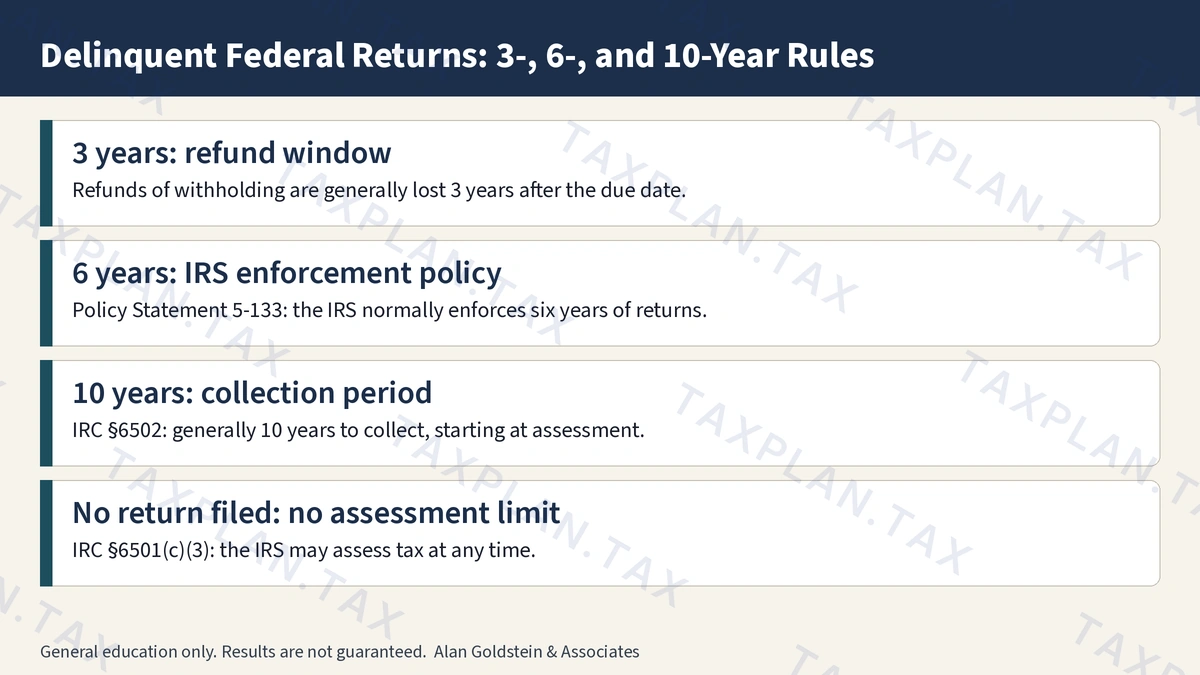

Delinquent federal returns are not governed by a choice between filing 3, 6, or 10 years. Those numbers come from three different rules. Three years is the general window to claim a refund. Six years is the IRS’s normal policy for enforcing unfiled returns. Ten years is the general period the IRS has to collect tax after it assesses it. This article explains what each number means for delinquent federal returns and how to decide which years to file.
Key Takeaways
- No law lets you choose to file only 3, 6, or 10 years of unfiled returns.
- 3 years is the general deadline to claim a refund, measured from the return due date for withholding and estimated tax.
- 6 years is the IRS’s normal enforcement period for unfiled returns under Policy Statement 5-133.
- 10 years is the general collection period, and it starts only after the IRS assesses the tax.
- If you never file, the IRS may assess tax for that year at any time.
Why is the “3, 6, or 10 years” framing misleading for delinquent federal returns?
It is misleading because it treats three unrelated time limits as filing options. In fact, the law requires every required return, and none of these rules cancels that duty.
The key statute is IRC §6501(c)(3). It says that if no return is filed, the IRS may assess the tax at any time. So an unfiled year never “ages out” for assessment purposes. Meanwhile, the IRS itself says to file all tax returns that are due, whether or not you can pay (IRS: Filing past due tax returns).
Still, each number matters. Together, they explain which years carry the most risk and which years can still help you.
What does the 3-year rule cover?
The 3-year rule mainly limits refunds. If you are due a refund of withholding or estimated tax, you generally must file within 3 years of the return due date to claim it.
The IRS states this rule directly: you risk losing your refund if you do not file, and you must file within 3 years of the return due date to claim a refund of withholding or estimated taxes. The same rule applies to credits such as the Earned Income Credit (IRS).
Why is it measured from the due date?
The statute treats withholding and estimated tax as paid on the return due date. Under IRC §6513(b), those amounts are deemed paid on the fifteenth day of the fourth month after the tax year ends. Then IRC §6511 limits a refund to tax paid within a look-back period before the claim.
For example, the IRS warned that unclaimed 2022 refunds faced an April 15, 2026 deadline. It said that after three years, the money becomes the property of the U.S. Treasury (IRS: IR-2026-37). The IRS page on time you can claim a credit or refund lists exceptions, such as certain disaster and combat zone extensions.
Is there another 3-year rule?
Yes. Once you file, the IRS generally has 3 years to assess additional tax. IRC §6501(a) sets that period, and it applies whether the return was filed on time or late.
That period can be longer in some cases. For instance, §6501(e) generally allows 6 years if you omit gross income that exceeds 25 percent of the gross income stated on the return. Fraud also removes the time limit. Even so, filing usually starts a clock that never runs for an unfiled year.
What does the 6-year rule cover?
The 6-year rule is an IRS enforcement policy, not a statute. Under Policy Statement 5-133, the IRS normally pursues unfiled returns for the most recent six years.
The IRS examination manual says the enforcement period is not to be more than six years, but the facts of each case control (IRM 4.12.1). Longer or shorter periods may apply after considering factors such as:
- Your prior history of noncompliance.
- Income from illegal sources.
- The effect on voluntary compliance.
- The expected revenue compared with the effort needed.
- Special circumstances for a taxpayer, class of taxpayer, or industry.
In addition, the collection manual says IRS employees should always request all non-fraudulent unfiled returns. It also says the taxpayer may file for all open periods regardless of age, and that enforcing more or less than six years requires managerial approval (IRM 5.1.11).
Which six years does the IRS count?
The IRS counts back six years from the return that is currently due. The manual’s examples show the method.
According to IRM 5.1.11, on July 31, 2024, the previous six years were 2023 back through 2018. On January 15, 2024, before the 2023 return was due, they were 2022 back through 2017. Applying the same method on today’s date in late 2026 would point to tax years 2025 back through 2020. This is an illustration only. The IRS may set a different range in your case.
Is there a 6-year criminal limit?
Generally, yes. IRC §6531(4) sets a 6-year limitations period for prosecuting willful failure to file a return. The underlying offense appears in IRC §7203, which makes willful failure to file a misdemeanor. Most delinquent filers resolve matters civilly, but this limit partly explains why the IRS focuses on six years.
What does the 10-year rule cover?
The 10-year rule limits collection, not filing. The IRS generally has 10 years after it assesses a tax to collect it by levy or court proceeding.
The statute is IRC §6502. The end of this period is often called the Collection Statute Expiration Date (CSED). Certain events can suspend or extend it, as other Code sections provide.
When does the 10-year clock start for an unfiled year?
It starts only when the IRS assesses the tax. If you have not filed and the IRS has not assessed anything, there is no collection clock running for that year.
An assessment can follow your own late return. It can also follow a substitute for return (SFR), which is a return the IRS prepares under IRC §6020(b). So waiting does not start the 10-year clock. Instead, waiting usually lets penalties and interest grow.
Why do people connect ten years with filing?
Partly because of IRS records. The IRS says wage and income transcripts are available for the current and nine prior tax years (IRS: Transcript types). That is about ten years of reported income. However, that is a records window, not a filing limit.
So how many years of delinquent federal returns should you file?
For many people, the starting point is the six years the IRS normally enforces. Then you adjust for refund deadlines, IRS notices, substitute returns, and your own facts.
A practical way to sort the years:
| Situation | Why it matters |
|---|---|
| Years within the normal six-year window | The IRS normally enforces these years under Policy Statement 5-133. |
| Years where a refund may still be claimed | Refunds of withholding and estimated tax are generally lost after 3 years from the due date. |
| Years with an SFR assessment | Your own return may reduce the assessed balance. |
| Years named in an IRS notice | The IRS asked for them, often with a deadline. |
| Older years with special facts | The IRS may enforce beyond six years, for example with prior noncompliance. |
For deeper detail on the six-year policy, see our article on how far back the IRS requires unfiled tax returns. For the statutes, see our guide to the statute of limitations on unfiled federal tax returns.
What happens to the refund years inside the six?
Some of them may have expired. For example, a 2022 refund of withholding was generally lost after April 15, 2026, according to the IRS. Even so, the IRS may still want that return, and a late return may offset other balances or confirm that no tax is owed.
What steps help you catch up on delinquent federal returns?
Start by learning what the IRS already has. Then prepare the years in order and file them with a plan for any balance.
- Order wage and income transcripts through Get Transcript.
- Check whether you had a filing requirement each year using the IRS filing tool.
- Prepare each return on that year’s forms.
- File each return, using the address on any IRS notice.
- Address any balance through payment or a resolution option.
Our step-by-step guide to filing past-due federal tax returns covers each stage.
Frequently Asked Questions
Is it true I only need to file the last six years?
Not exactly. Six years is the IRS’s normal enforcement policy, not a legal limit. The IRS asks for all unfiled returns and may enforce a longer period based on your facts.
Does the IRS forgive tax after 10 years?
Only after assessment. The 10-year collection period under IRC §6502 runs from assessment. If you never filed and no assessment exists, that clock has not started.
Can I still get a refund for a year more than three years old?
Generally, no, for refunds of withholding or estimated tax. Exceptions exist, such as certain disaster or combat zone extensions, so check the IRS rules for your situation.
Is there a statute of limitations if I never filed?
Not for assessment. Under IRC §6501(c)(3), the IRS may assess tax at any time for a year with no return.
Why would I file a year that is outside the six-year window?
The IRS may ask for it, an SFR may have created a balance, or your facts may call for it. A representative can help you weigh those reasons.
Does filing a late return start any deadlines?
Yes. Filing generally starts the 3-year assessment period. If the return shows tax due, the IRS generally assesses that tax, and the assessment starts the 10-year collection period.
Who decides how many years I must file?
The law requires every required return. In practice, the IRS decides how far back to enforce, using Policy Statement 5-133 and the facts of your case.
Conclusion
The numbers 3, 6, and 10 are useful, but they are not filing choices. Three years mainly limits refunds and, after filing, IRS assessments. Six years is the IRS’s normal enforcement policy for unfiled returns. Ten years limits collection after assessment. Because an unfiled year has no assessment deadline, filing is usually the step that brings these limits into play.
Alan Goldstein, MBA, IRS Enrolled Agent, of Alan Goldstein & Associates in Coral Gables, Florida, helps taxpayers decide which delinquent years to file and in what order. We review your transcripts, notices, and refund deadlines, then explain your options for any balance. Every case is different, and we do not guarantee outcomes. To request a confidential review, visit our Tax Resolution Services page.
Sources and Authorities
- IRC §6501, Limitations on assessment and collection
- IRS: Filing past due tax returns
- IRC §6513, Time return deemed filed and tax considered paid
- IRC §6511, Limitations on credit or refund
- IRS: IR-2026-37, Unclaimed refunds for tax year 2022
- IRS: Time you can claim a credit or refund
- IRM 4.12.1, Nonfiled Returns (Policy Statement 5-133)
- IRM 5.1.11, Delinquent Return Investigations
- IRC §6531, Periods of limitation on criminal prosecutions
- IRC §7203, Willful failure to file
- IRC §6502, Collection after assessment
- IRC §6020, Returns prepared by the Secretary
- IRS: Transcript types for individuals
- IRS: Get Transcript
- IRS Interactive Tax Assistant: Do I need to file a tax return?
This article is provided for general educational purposes and does not constitute individualized tax, legal, or accounting advice. Tax consequences depend on the taxpayer’s specific facts and applicable law.
