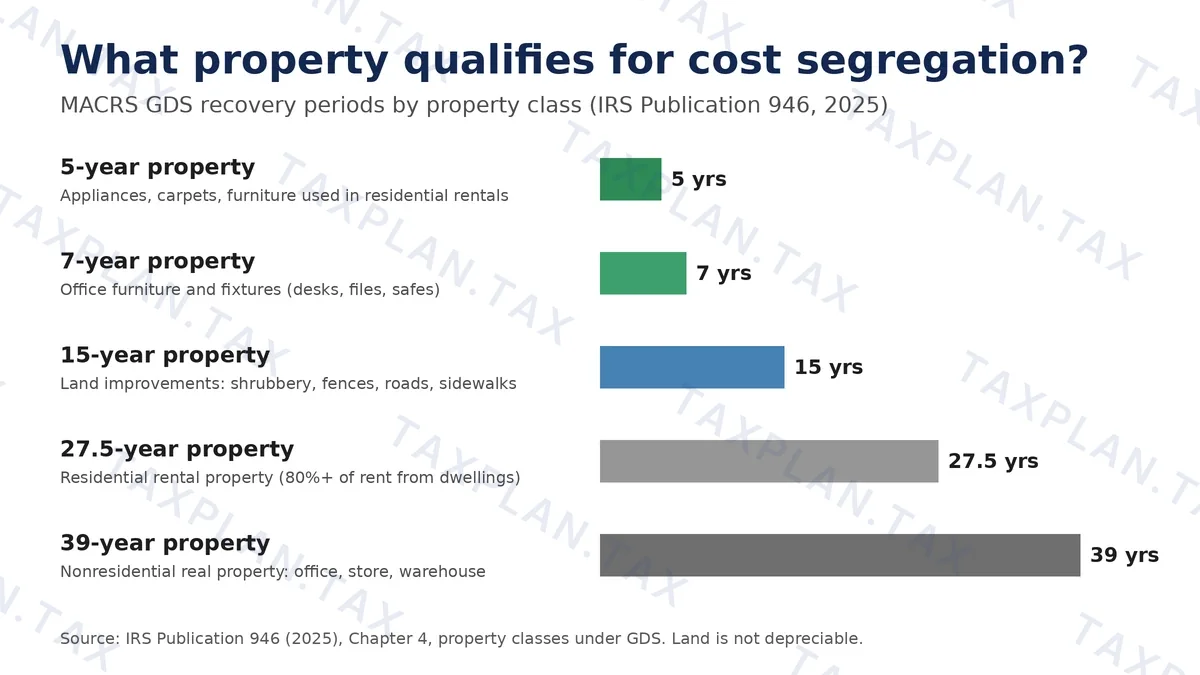

What property qualifies for cost segregation? In short, any building you own and use in a business or rental can qualify if it holds shorter-lived parts. That covers purchases, new construction, and renovations. It also covers commercial and residential rentals. However, land never qualifies. Likewise, your personal home and property you hold for sale to customers do not qualify.
The study itself sorts a building’s cost into three groups. First, it finds personal property, which often has a 5- or 7-year life. Next, it finds land improvements, which have a 15-year life. Finally, the rest stays as a 27.5-year or 39-year building. In 2026, this sorting matters more. Under IRS Notice 2026-11, qualified property acquired after January 19, 2025 can get a permanent 100% bonus deduction.
Key Takeaways
- Property qualifies for cost segregation if you own it and use it in a business or rental activity (IRS Publication 946).
- Land, personal homes, and inventory do not qualify.
- Personal property inside a building often has a 5- or 7-year life.
- Land improvements, such as paving and fences, usually have a 15-year life.
- Walls, roofs, central HVAC, and general plumbing stay with the building.
- Qualified property acquired after January 19, 2025 can get 100% bonus depreciation.
What Property Qualifies for Cost Segregation, and Why Does It Matter?
Direct answer: Property qualifies when it is depreciable real estate that contains shorter-lived parts. The study then finds those parts and moves them into faster tax classes.
In general, depreciation lets owners recover the cost of property over time. According to IRS Publication 946, property must meet four tests to be depreciable. You must own it. You must use it in a business or income-producing activity. It must have a determinable useful life. Finally, it must have an expected life of more than one year.
So, whether property qualifies for cost segregation starts with those tests. Also, a study does not create new deductions. Instead, it changes when you take them. For a plain-language overview, see What Is a Cost Segregation Study and How Does It Work?
What does “qualify” mean in this context?
Here, “qualify” has two layers, so the answer to what property qualifies for cost segregation has two parts. First, the building must be depreciable at all. Second, it must contain parts that the law assigns shorter lives. A building with almost no such parts technically qualifies. Even so, a study may not pay off for it.
How Does Cost Segregation Decide What Property Qualifies?
Direct answer: The study splits building cost into personal property, land improvements, and building property. Each group has its own recovery period under IRC §168.
For example, under MACRS, residential rental buildings use a 27.5-year life. In contrast, nonresidential buildings use 39 years. Many items of personal property use 5 or 7 years. Meanwhile, land improvements use 15 years. You can find these periods in Publication 946, Appendix B.
Which building parts count as personal property?
Direct answer: Parts that serve the business, rather than the building, often count as personal property.
In fact, the regulations define “tangible personal property” broadly. For example, Treas. Reg. §1.48-1(c) lists production machinery, refrigerators, grocery counters, display racks, shelves, and signs. Importantly, it says local law does not control. So a “fixture” under state law can still be personal property for tax purposes.
Common examples in a study include the following:
- Removable carpet and some floor coverings
- Cabinets, millwork, and decorative finishes
- Electrical lines that serve specific equipment
- Plumbing that serves specific equipment, such as kitchen gear
- Signs and display fixtures
However, each item still needs facts to support it. Also, the right life depends on the business activity. For instance, asset class 57.0 (Distributive Trades and Services) gives a 5-year life to assets used in retail, wholesale, and professional services. Similarly, Publication 946 lists appliances, carpets, and furniture used in residential rentals as 5-year property.
Which site improvements are 15-year property?
Direct answer: Depreciable improvements to the land itself, such as sidewalks, roads, fences, and landscaping, are usually 15-year property.
Asset class 00.3, shown in Publication 946, Table B-1, covers land improvements. For instance, its examples include sidewalks, roads, drainage, sewers, docks, bridges, fences, and shrubbery. Notably, it excludes buildings and their structural components. So site work outside the building often qualifies, while the building shell does not.
What stays in the building class?
Direct answer: Structural components stay with the building and keep its 27.5- or 39-year life.
The regulations list them in Treas. Reg. §1.48-1(e)(2). They include walls, floors, ceilings, windows, and doors. In addition, they include central heating and air conditioning, plumbing fixtures, wiring, lighting, stairs, elevators, and sprinklers. In other words, parts that run or maintain the building stay in the building class.
However, there is one notable exception. Machinery that exists only to meet temperature or humidity needs of other machinery is not a structural component. For example, the regulation cites a textile plant’s humidity system.
How do courts decide close cases?
Direct answer: Courts generally ask whether an item is inherently permanent, using factors from the Whiteco case.
The key case is Hospital Corporation of America v. Commissioner, 109 T.C. 21 (1997). There, the Tax Court held that the old investment tax credit rules still decide what counts as personal property. Later, the IRS accepted that point in an action on decision. Meanwhile, Whiteco Industries, Inc. v. Commissioner, 65 T.C. 664 (1975), set out six questions about movability and attachment. The IRS Cost Segregation Audit Techniques Guide discusses both cases.
What Property Qualifies for Cost Segregation by Property Type?
Direct answer: Most income-producing building types qualify. Still, results vary with each building’s design and use.
| Property type | Qualifies? | Building life |
|---|---|---|
| Office, retail, or warehouse | Yes, if used in business or rented | 39 years |
| Apartment or other residential rental | Yes | 27.5 years |
| Owner-occupied business building | Yes | 39 years |
| Tenant-paid improvements to leased space | Yes, for the tenant who paid | Depends on the item |
| Your personal home | No | Not depreciable |
| Fix-and-flip inventory | No | Not depreciable |
| Land | No | Not depreciable |
A few notes help explain which property qualifies for cost segregation in the table. First, a residential building uses 27.5 years only if dwelling units produce at least 80% of its gross rent, under IRC §168(e)(2). Second, tenants can depreciate capital improvements they make, according to Publication 946. Third, inventory is not depreciable because you hold it for sale to customers. Finally, a home office or a rented part of a home may be depreciable, but only for that part.
Why Does Qualifying Matter More in 2026?
Direct answer: Qualifying parts can now get 100% bonus depreciation if acquired after January 19, 2025.
Public Law 119-21, enacted July 4, 2025, made that rate permanent. As a result, a study can move much of a building’s cost into the first year. The IRS explained the rules in Notice 2026-11, released January 14, 2026.
However, the building itself does not get bonus depreciation. Bonus applies to property with a recovery period of 20 years or less. Therefore, the value of a study comes from finding 5-, 7-, and 15-year parts. In addition, used property can qualify for bonus if you did not use it before, under Treas. Reg. §1.168(k)-2.
Similarly, renovations offer another path. Qualified improvement property, defined in IRC §168(e)(6), is 15-year property. Specifically, it covers interior improvements to nonresidential buildings made after the building was first placed in service. Still, it excludes enlargements, elevators, escalators, and the internal structural framework.
To estimate the dollar effect, see How Much Can You Save with a Cost Segregation Study?
What Rules Decide Whether Property Qualifies for Cost Segregation?
Direct answer: The tax code, Treasury regulations, IRS asset classes, and two key court cases decide the result.
- IRC §167: allows depreciation for property used in a business or held for income.
- IRC §168: sets MACRS lives, methods, and bonus depreciation.
- Treas. Reg. §1.48-1: defines personal property and structural components.
- Rev. Proc. 87-56: sets asset classes and lives, as reproduced in Publication 946, Appendix B.
- Notice 2026-11: gives interim rules for bonus depreciation after P.L. 119-21.
- Publication 5653: explains how IRS examiners review studies.
Timing rules matter too, even after you confirm the property qualifies for cost segregation. For a past year, owners usually claim missed depreciation on Form 3115. Rev. Proc. 2025-23, section 6.01, lists this automatic change. Notably, it bars reclassifying §1250 property into a class, such as 57.0, that does not expressly include §1250 property.
What Do Qualifying Components Look Like in Practice?
Direct answer: The examples below show how a study sorts real parts. All dollar amounts are illustrative assumptions, not typical results.
Example 1: Why a dental office qualifies for cost segregation
For example, assume a dentist buys an office building for her own practice. The building basis is $1,200,000 after removing land. A study might sort the parts like this:
| Component | Likely class | Illustrative cost |
|---|---|---|
| Cabinets and casework in operatories | 5-year (class 57.0) | $70,000 |
| Electrical and plumbing serving dental chairs | 5-year (class 57.0) | $55,000 |
| Carpet and decorative finishes | 5-year (class 57.0) | $35,000 |
| Parking lot, curbs, and landscaping | 15-year (class 00.3) | $95,000 |
| Shell, roof, central HVAC, restrooms | 39-year building | $945,000 |
| Total | $1,200,000 |
As a result, $255,000 moves out of the 39-year class. That is about 21% of the building basis. Because a dental practice is a professional service, class 57.0 supplies the 5-year life for its personal property.
Example 2: Why an apartment building qualifies
Next, consider a 12-unit apartment building held as a rental. Dwelling units produce all of its rent. So the building uses a 27.5-year life. Also, its appliances and carpets are 5-year property under Publication 946. Likewise, its parking area, fencing, and site lighting are usually 15-year land improvements.
Example 3: Two properties that do not qualify
Finally, consider two cases where no property qualifies for cost segregation. A family’s own home does not qualify, because they do not use it in a business. Similarly, a house an investor renovates for quick resale does not qualify. The investor holds it for sale, so it is inventory rather than depreciable property.
What Mistakes Cause Property to Fail Cost Segregation?
Direct answer: Even when property qualifies for cost segregation, studies fail from weak facts or wrong classes. Others fail because the property was never depreciable.
- Treating structural parts as personal property. Central HVAC and general wiring stay with the building.
- Using rules of thumb. The Audit Techniques Guide flags thin studies that rely on flat percentages.
- Ignoring the business activity. The same item can have different lives in different activities.
- Overstating building value. An inflated building share at the expense of land invites adjustment.
- Studying non-depreciable property. Homes and flips do not qualify.
- Missing the contract date. A binding contract signed before January 20, 2025 limits 2026 bonus to 20%.
Moreover, a study should support each line item with drawings, cost data, or a site visit. In fact, the guide lists 13 principal elements of a quality study.
Frequently Asked Questions
What property qualifies for cost segregation most often?
Commercial buildings and residential rentals qualify most often. In other words, most rented or business-use property qualifies for cost segregation. Owner-occupied business buildings also qualify. Ultimately, the payoff depends on how many short-lived parts the building has.
Does a single-family rental qualify?
Yes. A rental home is depreciable, and its appliances and carpets are 5-year property, so that property qualifies for cost segregation. However, the smaller dollar amounts can make the study fee harder to justify.
What land-related property qualifies for cost segregation?
Land itself never qualifies, because it is not depreciable. Still, depreciable improvements to land, such as paving and fences, usually qualify as 15-year property.
What tenant property qualifies for cost segregation?
Improvements the tenant paid for can qualify. In that case, the tenant’s property qualifies for cost segregation, not the landlord’s. Publication 946 confirms that tenants can depreciate the improvements they make.
What property qualifies for cost segregation if I bought it years ago?
The same property qualifies for cost segregation. However, you generally claim the missed depreciation through Form 3115 and a §481(a) adjustment under Rev. Proc. 2025-23.
Does used property qualify for 100% bonus depreciation?
Often, yes. Used property can qualify if you did not use it before and you meet the acquisition rules in Treas. Reg. §1.168(k)-2.
What home office property qualifies for cost segregation?
Only the business part of a home may be depreciable. Therefore, a full study rarely makes sense for a home office.
Conclusion: Does Your Property Qualify for Cost Segregation?
To sum up, a building generally qualifies when you own it, use it for business or rent, and it has shorter-lived parts. Then, personal property and land improvements are the parts that move. Meanwhile, structural components stay with the building. In 2026, qualified parts acquired after January 19, 2025 can get 100% bonus depreciation. That makes the classification work more valuable than before.
If you are unsure what property qualifies for cost segregation in your portfolio, Emunah Cost Segregation can help. Alan Goldstein, EA, reviews your property and documents before any study begins. Then he tells you plainly whether a study makes sense. Contact Emunah Cost Segregation in Coral Gables, Florida, to request a review. For a deeper look at timing, read When Is a Cost Segregation Study Worth It?
Sources and Authorities
- 26 U.S.C. §167: https://www.law.cornell.edu/uscode/text/26/167
- 26 U.S.C. §168: https://www.law.cornell.edu/uscode/text/26/168
- Public Law 119-21 (H.R. 1, 119th Congress): https://www.congress.gov/bill/119th-congress/house-bill/1
- IRS Notice 2026-11: https://www.irs.gov/pub/irs-drop/n-26-11.pdf
- Treas. Reg. §1.48-1: https://www.ecfr.gov/current/title-26/section-1.48-1
- Treas. Reg. §1.168(k)-2: https://www.ecfr.gov/current/title-26/section-1.168(k)-2
- IRS Publication 946, including Appendix B (Rev. Proc. 87-56 asset classes): https://www.irs.gov/pub/irs-pdf/p946.pdf
- IRS Publication 5653, Cost Segregation Audit Techniques Guide: https://www.irs.gov/pub/irs-pdf/p5653.pdf
- Rev. Proc. 2025-23: https://www.irs.gov/pub/irs-drop/rp-25-23.pdf
- Hospital Corporation of America v. Commissioner, 109 T.C. 21 (1997), and Whiteco Industries, Inc. v. Commissioner, 65 T.C. 664 (1975), as discussed in IRS Publication 5653.
This article is provided for general educational purposes and does not constitute individualized tax, legal, or accounting advice. Tax consequences depend on the taxpayer’s specific facts and applicable law.
