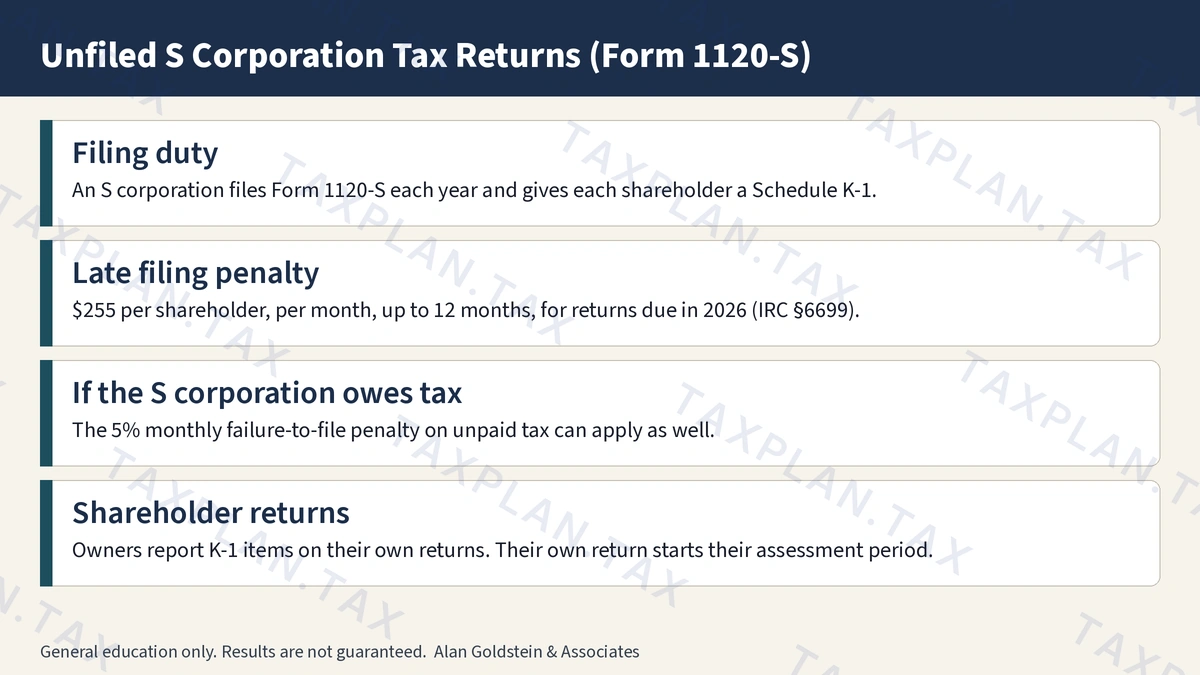

Unfiled S corporation tax returns affect both the company and every shareholder. An S corporation usually pays no federal income tax itself. Even so, it must file Form 1120-S each year and issue a Schedule K-1 to each shareholder. If it does not, the IRS can charge a penalty for every shareholder, for each month the return is late. This guide covers the Form 1120-S rules, the penalties, the effect on shareholders, and how to catch up.
Key Takeaways
- A corporation must file Form 1120-S for each year its accepted S election remains in effect.
- For returns due in 2026, the late filing penalty is $255 per shareholder, per month, for up to 12 months.
- If the S corporation also owes tax, the 5% monthly failure-to-file penalty on unpaid tax can apply too.
- Shareholders report K-1 items on their own returns. Their own return starts their assessment period.
- Relief may be available through First Time Abate or reasonable cause, but it is never guaranteed.
Who must file Form 1120-S?
A corporation or other entity must file Form 1120-S if it elected S status on Form 2553, the IRS accepted the election, and the election remains in effect (IRS: Instructions for Form 1120-S).
The filing rule appears in IRC §6037, which requires an S corporation return for each tax year. Owners sometimes assume that a company with no profit has nothing to file. However, the duty depends on the election, not on profit. An LLC that elected S status on Form 2553 has the same duty.
What is an S corporation?
An S corporation is a corporation that elected to pass its income, losses, deductions, and credits through to its shareholders. Under IRC §1366, each shareholder takes a pro rata share of those items into account on his or her own return. The Supreme Court described Subchapter S as a pass-through system in Bufferd v. Commissioner (1993) (506 U.S. at 525).
Does not filing end the S election?
Not by itself, under the statute’s list of termination events. IRC §1362(d) lists revocation, ceasing to qualify as a small business corporation, and certain passive income situations. A missed return is not on that list. So the filing duty generally continues each year until the election ends.
When are unfiled S corporation tax returns late?
A Form 1120-S is late if it is not filed by the due date, including extensions. Generally, that is the 15th day of the 3rd month after the tax year ends.
For a calendar-year S corporation, the 2025 return was due March 16, 2026, because March 15 fell on a Sunday. A corporation can request more time on Form 7004 by the regular due date. Also, a dissolved S corporation generally must file by the 15th day of the 3rd month after it dissolved.
What penalties apply to unfiled S corporation tax returns?
The main penalty is a per-shareholder, per-month charge. For 2025 returns due in 2026, the IRS lists $255 for each month or part of a month, up to 12 months, times the number of shareholders.
That penalty comes from IRC §6699. The statute sets a $195 base amount and adjusts it for inflation. It also applies when a filed return omits the required information. Under §6699(c), the IRS assesses the penalty against the S corporation. Further, §6699(d) says the deficiency procedures do not apply, so the IRS can assess it without a notice of deficiency.
How fast can the S corporation penalty grow?
The following example is illustrative only. It uses the $255 amount for a 2025 return due in 2026:
| Illustrative facts (2025 Form 1120-S, due in 2026) | Amount |
|---|---|
| Monthly amount per shareholder | $255 |
| Number of shareholders | 3 |
| Months late (capped at 12) | 12 |
| Maximum penalty for that one return ($255 × 3 × 12) | $9,180 |
Because the cap applies to each return, several unfiled years can each carry a separate penalty.
Can an S corporation owe its own tax?
Yes, in some cases. For example, the built-in gains tax under IRC §1374 can apply at the corporate level. If tax is due, the Form 1120-S instructions say the penalty is the per-shareholder amount plus 5% of the unpaid tax per month, up to 25%. The same instructions note the $525 minimum for returns required to be filed in 2026 that are more than 60 days late. Interest also runs on unpaid tax at the IRS underpayment rate, which is 7% for late 2026 and 8% for the quarter beginning January 1, 2027 (IR-2026-144).
How do unfiled S corporation returns affect shareholders?
Shareholders still must file their own returns on time and report their share of S corporation items. Without K-1s, that becomes much harder.
Under §1366, shareholders report their shares whether or not the company distributed any cash. So a shareholder may owe tax on income that the company kept. In addition, the IRS Business Tax Account lets S corporation shareholders view details for years with a Schedule K-1 on file (IRS: Business tax account). That access only helps if the company filed K-1s.
Whose return starts the clock for shareholder tax?
The shareholder’s own return does. In Bufferd, the Supreme Court held that the period to assess an S corporation shareholder’s income tax runs from the date the shareholder’s return is filed (506 U.S. at 533). The Court said the Commissioner’s time ran “from the filing date of petitioner’s return” under the plain language of IRC §6501(a) (id. at 527).
So each shareholder’s open years depend on his or her own filing history. If a shareholder never filed, §6501(c)(3) allows assessment at any time for that year.
Can an S corporation get penalty relief?
Possibly. The IRS may grant relief under First Time Abate or for reasonable cause. The result depends on the facts.
The IRS lists §6699(a)(1) penalties as eligible for First Time Abate (FTA) relief (IRS: Administrative penalty relief). FTA requires timely compliance for the prior three years. The same page describes a new Automatic Exemption from Penalty (AEP) starting in 2026. Its list of eligible return series names Forms 1040, 1065, and 1120, so confirm with the IRS how AEP applies to Form 1120-S.
Reasonable cause is the other path (IRS: Penalty relief for reasonable cause). However, the Supreme Court held in United States v. Boyle (1985) that reliance on an agent to meet a deadline “cannot function as a substitute for compliance with an unambiguous statute” (469 U.S. at 251).
How do you file unfiled S corporation tax returns?
Confirm the election and shareholders first, then file Forms 1120-S with K-1s, then update shareholder returns.
- Confirm the S election. First, find the IRS acceptance letter for Form 2553. If the election was never accepted, the company may have had to file Form 1120 instead.
- List shareholders by year. Next, record everyone who held shares at any time during each year.
- Rebuild the books. Then reconcile bank records, payroll filings, and shareholder loans and distributions.
- File Forms 1120-S and K-1s. After that, file each missing year and give each shareholder a K-1.
- Fix shareholder returns. Finally, shareholders file or amend their own returns, and the company requests penalty relief where the facts support it.
For related guidance, see unfiled tax returns for LLC owners and unfiled federal tax returns for small business owners.
Frequently Asked Questions
Does an S corporation with no income need to file Form 1120-S?
Generally, yes. The duty depends on the election being in effect, not on income. The per-shareholder penalty can apply even with no tax due.
Who pays the S corporation late filing penalty?
The S corporation does. Section 6699(c) says the IRS assesses the penalty against the S corporation.
Is the $255 penalty amount fixed?
No. It starts from a $195 statutory base and adjusts for inflation. The $255 figure applies to returns required to be filed in 2026.
Do shareholders owe tax if the S corporation never filed?
Generally, yes. Shareholders must report their pro rata shares under §1366, whether or not the company filed or paid them anything.
Can the IRS assess a shareholder after the S corporation’s return is filed late?
The shareholder’s own return controls the general assessment period, as Bufferd held. Late corporate filing does not shorten that period.
What if the S election was never accepted?
Then the company may have been a C corporation required to file Form 1120. A professional should review the election history before filing.
Can the penalty be removed?
Possibly, through First Time Abate or reasonable cause. The IRS decides each request on its own facts.
Conclusion
Unfiled S corporation tax returns create a penalty that grows with every month and every shareholder. They also leave owners without the K-1s they need for their own returns. Filing complete Forms 1120-S, issuing K-1s, and then fixing shareholder returns is usually the clearest path back to compliance.
Alan Goldstein, MBA, IRS Enrolled Agent, of Alan Goldstein & Associates in Coral Gables, Florida, helps S corporations and their shareholders resolve unfiled returns. We can review your election and filing history, prepare past-due returns, and evaluate penalty relief. Every case depends on its facts, and we cannot guarantee any outcome. To request a confidential review, visit our Tax Resolution Services page.
Cases Cited
- Bufferd v. Commissioner, 506 U.S. 523, 525, 527, 533 (1993)
- United States v. Boyle, 469 U.S. 241, 251 (1985)
Sources and Authorities
- IRS: Instructions for Form 1120-S (2025), Who Must File, When To File, and Interest and Penalties
- IRC §6037, Return of S corporation
- IRS: About Form 2553, Election by a Small Business Corporation
- IRC §1366, Pass-thru of items to shareholders
- Bufferd v. Commissioner, 506 U.S. 523, 525, 527, 533 (1993) (official U.S. Reports, Library of Congress)
- IRC §1362, Election; revocation; termination
- IRS: About Form 7004
- IRC §6699, Failure to file S corporation return
- IRC §1374, Tax imposed on certain built-in gains
- IRS: IR-2026-144, Interest rates increase for the first quarter of 2027
- IRS: Business tax account
- IRC §6501, Limitations on assessment and collection
- IRS: Penalty relief due to First Time Abate or other administrative waiver (including AEP)
- IRS: Penalty relief for reasonable cause
- United States v. Boyle, 469 U.S. 241, 251 (1985) (official U.S. Reports, Library of Congress)
This article is provided for general educational purposes and does not constitute individualized tax, legal, or accounting advice. Tax consequences depend on the taxpayer’s specific facts and applicable law.
