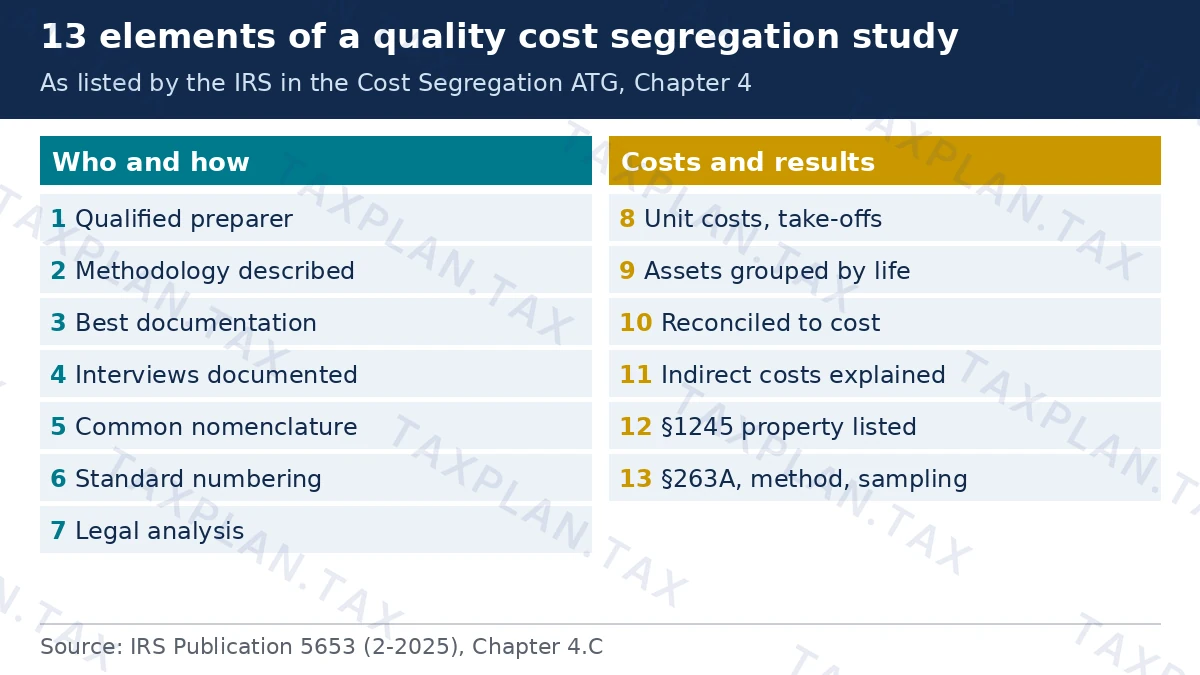

A quality cost segregation study is one that is both accurate and well documented, according to the IRS. In Publication 5653, the Cost Segregation Audit Techniques Guide, the IRS lists 13 principal elements of a quality study. For example, they start with a preparer who has real expertise and a clearly described method. They also include the best available documentation, interviews, plain asset names, a standard numbering system, and a legal analysis. On the cost side, a quality study shows unit costs and take-offs, groups assets by recovery period, and reconciles total allocated cost to total actual cost. Moreover, it explains indirect costs, lists §1245 property, and addresses §263A, accounting method changes, and sampling.
In practice, three things matter most. First, every asset is classified with a stated reason, every dollar traces to a document, and the totals tie to the price or project cost. As a result, a study that meets those tests is easier to defend. Just as important, the guide also says a quality study speeds up the IRS review.
Key Takeaways
- The IRS defines a “quality” study as one that is both accurate and well documented.
- Chapter 4 of IRS Publication 5653 lists 13 principal elements of a quality study and 9 elements of a quality report.
- The IRS does not require a specific method, but it favors actual-cost and well-supported estimate approaches.
- Reconciliation is central: allocated costs should tie to actual cost or to purchase price less land value.
- By contrast, rule-of-thumb percentages and pro-rata “step-up” factors are red flags.
- Quality also depends on correct law, such as the §1245 tests and any binding §1060 allocation.
What Does “Quality” Mean for a Cost Segregation Study?
Direct answer: In short, the IRS says a quality study is accurate and well documented on three core points: classification, rationale, and cost support.
Notably, Chapter 4 of the guide says every study, whatever its length, should do three things. First, it should classify assets into property classes, such as land, land improvements, building, and equipment. Second, it should explain the rationale, including legal citations, for treating assets as §1245 or §1250 property. Third, it should substantiate the cost of each asset and reconcile total allocated cost to total actual cost.
Why does this matter? Simply put, under IRC §168, recovery periods range from 5 or 7 years for many personal property items to 39 years for commercial buildings. So each classification in a quality cost segregation study changes the timing of deductions. For a primer on how a study is built, see also our step-by-step guide to the cost segregation study process.
Is there an official standard?
No. In fact, the guide says the IRS “has not established any requirements or standards” for preparing studies. It also says there are no prescribed qualifications for preparers. Even so, taxpayers must substantiate their deductions. Therefore, the guide’s quality elements work as the practical benchmark.
What Are the 13 Elements of a Quality Cost Segregation Study?
Direct answer: In sum, the guide lists 13 elements that cover who prepared the study, how it was done, and how costs were supported.
| # | Element (IRS Pub. 5653, Ch. 4.C) | What it looks like in practice |
|---|---|---|
| 1 | Preparer with expertise and experience | Report names the preparer and states credentials |
| 2 | Detailed description of methodology | Steps taken to classify assets and find costs |
| 3 | Appropriate documentation | Drawings, pay applications, purchase documents, site visit |
| 4 | Interviews with appropriate parties | Documented talks with contractors and property staff |
| 5 | Common nomenclature | Asset names match the blueprints and contracts |
| 6 | Standard numbering system | For example, CSI MasterFormat divisions |
| 7 | Explanation of legal analysis | Regulations, rulings, and cases for §1245 calls |
| 8 | Unit costs and engineering take-offs | Documented quantities and derived unit costs |
| 9 | Assets organized into lists or groups | Grouped by recovery period; ties to the fixed asset ledger |
| 10 | Reconciliation of allocated to actual cost | Totals tie; separately bought items listed |
| 11 | Treatment of indirect costs | Each indirect cost explained and allocated |
| 12 | Identification of §1245 property | Amounts shown, including reclassified items |
| 13 | Related issues | §263A, accounting method change, sampling |
Why documentation and site visits matter
The guide says contemporaneous documentation is “the most reliable and trustworthy.” For new construction, a quality cost segregation study reviews drawings, specifications, change orders, and contractor pay applications, such as AIA G702 and G703 forms. For acquired property, by contrast, it reviews the purchase agreement first, then any lease and appraisals. In both cases, moreover, the guide calls for a site visit and photographs.
Why names and numbers matter
Likewise, asset names should match the project documents. The guide gives examples of “creative” names, such as calling building sewer or water piping “process piping.” Similarly, it mentions an emergency exit sign called a “decorative placard.” As a result, such labels hurt a study’s credibility.
How Does a Quality Cost Segregation Study Handle Costs?
Direct answer: In general, it uses actual costs when they exist, documents any estimates, and reconciles everything to the real total.
Specifically, Chapter 3 of the guide describes six approaches. Of these, the detailed engineering approach from actual cost records is called, in general, “the most methodical and accurate.” Meanwhile, the detailed cost estimate approach can work for acquired property when sources are cited by volume, page, and item number. By contrast, the residual approach costs out only short-life assets and assigns the rest to the building. Indeed, the guide notes it “generally does not reconcile project costs.” Finally, the guide says to view rule-of-thumb percentages “with caution.”
Land value comes first
For acquired property, the guide specifically says land value is always determined first, based on highest and best use. After that, the rest of the price is allocated by value at purchase. This approach follows Treas. Reg. §1.167(a)-5, which apportions a lump-sum price by relative value. Notably, Chapter 5 warns that backing into land value by subtracting improvements from the price can understate land.
Indirect costs and separately bought items
Next, indirect costs include items such as permits, general conditions, and contractor overhead and profit. According to the guide, many are allocated pro rata, but some belong only to land. Also, a quality study lists furniture and equipment bought outside the project, so nothing is counted twice.
What Should a Quality Cost Segregation Study Report Include?
Direct answer: Specifically, the guide lists nine report elements, from an executive summary to exhibits.
- Summary letter or executive summary naming the preparer, date, client, property, and results by class.
- Narrative report describing the property and the regulations, rulings, and cases relied on.
- Schedule of assets that ties to depreciation records, with before-and-after detail for reallocations.
- Schedule of direct and indirect costs, including §263A items.
- A schedule of property units and costs, the final basis for depreciation.
- Engineering procedures, including records reviewed and inspections made.
- Assumptions and limiting conditions.
- Certification that the signer developed the analysis and conclusions.
- Exhibits, such as cost sources, a cost reconciliation, and photographs.
What Are the Benefits of a Quality Cost Segregation Study?
Direct answer: Above all, a quality study supports the deductions you claim and makes any IRS review shorter and less costly.
- Defensible deductions. Each class has a reason as well as a document behind it.
- Faster exams. The guide says a quality study will “expedite the exam process.”
- Penalty protection. Reliance on a competent adviser with full facts can support a reasonable cause defense under §6664(c).
- Cleaner later years. Later, asset-level detail helps with partial dispositions and with §1245 recapture on sale.
What Legal Standards Shape Study Quality?
Direct answer: In short, a quality study applies the §1245 and §1250 tests correctly and respects any binding allocation.
In Hospital Corp. of America, the Tax Court held that the former investment tax credit rules apply in deciding whether property is §1245 or §1250 property under the depreciation rules (109 T.C. 21, 48-52). Importantly, those rules include Treas. Reg. §1.48-1. In addition, Whiteco Industries lists questions courts ask, such as whether property can be moved and whether it was designed to stay in place (65 T.C. 664, 672-673). Accordingly, a quality cost segregation study cites these authorities and applies them to the facts.
A quality study also checks the purchase documents. Under §1060(a), a written allocation in an applicable asset acquisition binds both parties. In Peco Foods, that kind of allocation defeated a later study-based change (522 F. App’x 840, 843-844).
Finally, AmeriSouth XXXII shows what happens when support is thin. There, a firm “mentally deconstructed” an apartment complex into over 1,000 parts. Later, the taxpayer’s expert report on the study was limited to a description of the assets and legal conclusions. However, on the site-preparation issue, the IRS expert relied on the study firm’s own workpapers, and the court found the IRS expert more reliable. Additionally, full case citations appear in the Cases Cited section below.
What Does a Quality Cost Segregation Study Look Like in Practice?
Direct answer: Both examples below come from the IRS guide or are labeled illustrative.
Example 1: the IRS step-up example
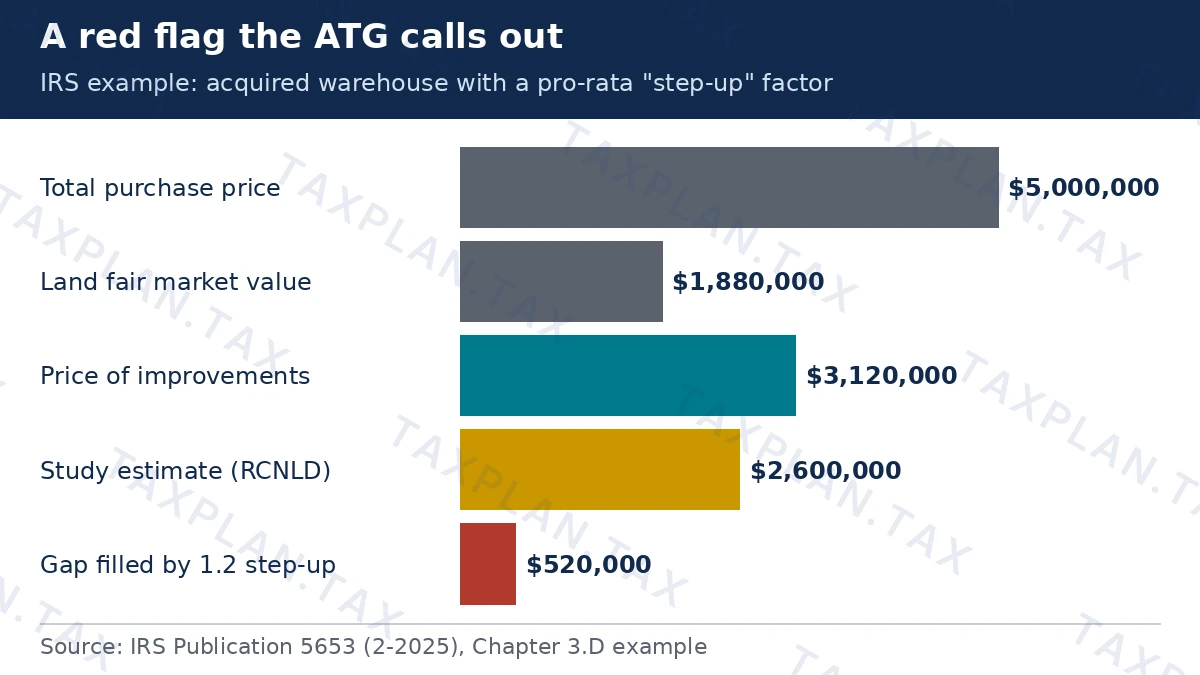
To illustrate, the guide describes an acquired warehouse bought for $5 million. Here, the land was worth $1.88 million, so $3.12 million remained for improvements and personal property. However, the study’s estimates totaled only $2.6 million. So the preparer multiplied every estimate by 1.2, adding $520,000. Yet the guide states that a pro-rata step-up “is not an acceptable method.” Instead, a quality study would find the cause of the gap, such as missed assets or a wrong land value.
Example 2: a reconciliation check (illustrative)
Now assume a quality study on a $3 million acquisition. The table below shows how its totals should tie out. All amounts are illustrative assumptions.
| Illustrative class | Allocated amount |
|---|---|
| Land (appraised first) | $600,000 |
| Land improvements (15-year) | $240,000 |
| Personal property (5- and 7-year) | $360,000 |
| Building (39-year) | $1,800,000 |
| Total, equal to purchase price | $3,000,000 |
In this case, the four classes add to exactly $3 million. In addition, the building, land improvements, and personal property total $2.4 million, which equals the price less land. If the estimates had totaled $2.1 million instead, a quality study would explain the $300,000 difference rather than scale everything up.
What Are the Common Signs of a Low-Quality Study?
Direct answer: In particular, watch for missing support, inflated short-life classes, and totals that do not tie.
- No named preparer or credentials. Instead, the guide says a quality study always identifies them.
- A fixed percentage of cost. Such rule-of-thumb results lack documentation.
- Little or no cost to land. In fact, the guide treats this as an audit red flag.
- Creative asset names. Instead, names should match the drawings and contracts.
- Unexplained indirect costs. Each should, therefore, be described and allocated.
- Weak sampling. The guide notes that populations under 50 can limit sampling accuracy unless sampling error is considered.
- Ignoring the method change rules. Generally, a study after filing needs Form 3115.
Also, to see which items are commonly moved into shorter classes, read what assets can be reclassified in a cost segregation study. For the records that support these elements, see our article on documentation for avoiding IRS challenges to cost segregation studies.
Frequently Asked Questions
Who should prepare a quality cost segregation study?
The IRS has no prescribed qualifications. However, the guide says a study by a construction engineer is generally more reliable, and tax law knowledge also matters. For used property, it also says studies should be performed by qualified appraisers.
Should a quality cost segregation study tie to my fixed asset ledger?
Generally, yes. The guide says a quality study should list assets and generally tie to the taxpayer’s fixed asset ledger. As a result, the IRS can trace each class to the return.
Is a desktop study ever acceptable?
The guide recommends a field inspection for all quality studies. In addition, it calls inspection critical when drawings are limited, as is common for acquired property.
Are contingency fees a quality concern?
Yes. The guide tells examiners to closely scrutinize contingency-fee studies, because such fees can reward aggressive allocations.
How many pages should a quality report have?
There is no set length. In fact, the guide says some studies are brief and others are long. Instead, what matters is that the required elements are present.
Can a quality cost segregation study still be challenged?
Yes. Indeed, the guide notes that classification issues can arise even with the most accurate methods. Still, a quality cost segregation study narrows the dispute.
Should a study cite court cases?
Yes. Specifically, the guide says a quality study contains a thorough legal analysis with citations, and it recognizes conflicting decisions.
Conclusion: How Do You Get a Quality Cost Segregation Study?
In the end, a quality cost segregation study is accurate, documented, and reconciled. Fortunately, the IRS guide’s 13 elements give you a clear checklist. So ask any provider how its study meets each one, who prepares it, and how totals tie to your price or project cost.
Emunah Cost Segregation, led by Alan Goldstein, MBA, EA, builds studies around the standards in IRS Publication 5653 and current law. Contact Alan Goldstein & Associates in Coral Gables to review a proposal, a property, or an existing study.
Cases Cited
- AmeriSouth XXXII, Ltd. v. Commissioner, T.C. Memo. 2012-67, 103 T.C.M. (CCH) 1324 (2012) (United States Tax Court, memorandum opinion). Pinpoint uncertainty: T.C. Memos have no volume or reporter page of their own, and we could not confirm the T.C.M. (CCH) page numbers for the specific holdings. In the CourtListener text, the description of the study appears at star page *6, and the discussion of the expert reports and workpapers at star pages *23-*24; we believe those star pages track the Lexis version, but we could not confirm that. Opinion
- Hospital Corp. of America v. Commissioner, 109 T.C. 21, 48-52 (1997) (United States Tax Court). Pinpoint verified against the reporter-paginated opinion text. Opinion
- Peco Foods, Inc. v. Commissioner, 522 F. App’x 840, 843-844 (11th Cir. 2013) (unpublished), aff’g T.C. Memo. 2012-18. Pinpoint verified against the reporter-paginated opinion text. Opinion
- Whiteco Industries, Inc. v. Commissioner, 65 T.C. 664, 672-673 (1975) (United States Tax Court). Pinpoint verified against the reporter-paginated opinion text. Opinion
Sources and Authorities
- IRS Publication 5653, Cost Segregation Audit Techniques Guide (rev. 2-6-2025), Chapters 3, 4, and 5: https://www.irs.gov/pub/irs-pdf/p5653.pdf
- 26 U.S.C. §168: https://www.law.cornell.edu/uscode/text/26/168
- 26 U.S.C. §1245: https://www.law.cornell.edu/uscode/text/26/1245
- 26 U.S.C. §1060: https://www.law.cornell.edu/uscode/text/26/1060
- 26 U.S.C. §6664: https://www.law.cornell.edu/uscode/text/26/6664
- Treas. Reg. §1.48-1: https://www.ecfr.gov/current/title-26/section-1.48-1
- Treas. Reg. §1.167(a)-5: https://www.ecfr.gov/current/title-26/section-1.167(a)-5
- IRS Publication 946: https://www.irs.gov/pub/irs-pdf/p946.pdf
- About Form 3115: https://www.irs.gov/forms-pubs/about-form-3115
- Court opinions: see Cases Cited above.
This article is provided for general educational purposes and does not constitute individualized tax, legal, or accounting advice. Tax consequences depend on the taxpayer’s specific facts and applicable law.
