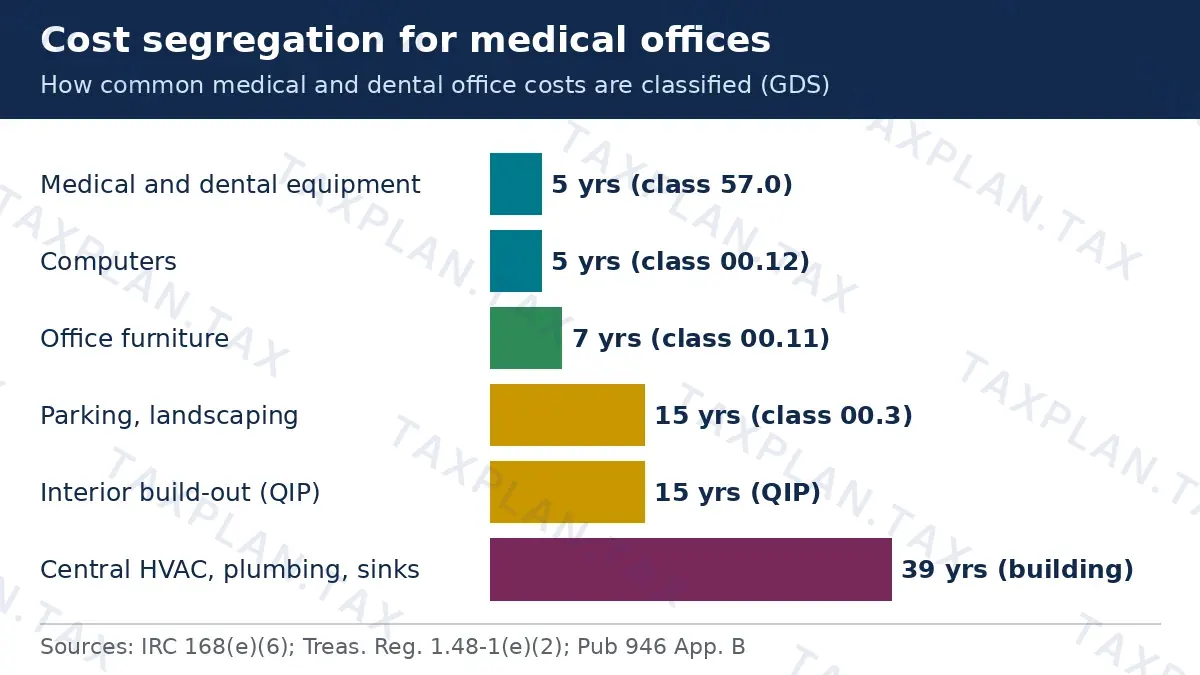

Cost segregation for medical offices separates a medical or dental office property into building, personal property, and site improvement components, so part of the cost is deducted years sooner. A medical office building is nonresidential real property, so its shell and building systems are depreciated over 39 years. However, medical and dental spaces often contain shorter-lived assets. Examples include equipment, wiring and plumbing dedicated to that equipment, removable floor coverings, casework tied to equipment, signage, and parking areas. In addition, assets used in professional services fall in asset class 57.0, which has a 5-year life under Publication 946. Interior build-outs can also be qualified improvement property under IRC §168(e)(6).
For property acquired after January 19, 2025, those 5-, 7-, and 15-year parts can generally get 100% bonus depreciation, as IRS Notice 2026-11 explains. This guide covers cost segregation for medical offices and dental offices, tenant build-outs, and two worked examples.
Key Takeaways
- Medical and dental office buildings are 39-year nonresidential real property under IRC §168(c).
- Asset class 57.0 covers assets used in personal and professional services, with a 5-year GDS life.
- The IRS audit guide has no medical office industry matrix, so studies rely on general rules.
- Wiring and plumbing dedicated to specific equipment may be personal property, while general building systems are not.
- Interior build-outs can be 15-year qualified improvement property, except enlargements, elevators, escalators, and internal structural framework.
- Office space is excluded from the new §168(n) production property allowance.
What Is Cost Segregation for Medical Offices?
Direct answer: Cost segregation for medical offices is an engineering-based study that assigns each part of a medical or dental property’s cost to its correct depreciation class. It finds personal property and land improvements that do not belong in the 39-year class.
This includes physician-owned buildings, multi-tenant medical office buildings, dental offices, and outpatient clinics. Under IRC §168(e)(2)(B), these are nonresidential real property. Therefore, the building and its structural components use a 39-year straight-line method with a mid-month convention. Without cost segregation for medical offices, owners often leave everything in that class.
However, tax law treats some items inside a building as personal property. Treas. Reg. §1.48-1(c) says local law does not control. So an item that is a fixture under state law can still be personal property for depreciation. For the general concept, see What Is a Cost Segregation Study and How Does It Work?
Which asset class applies to medical and dental personal property?
Asset class 57.0, Distributive Trades and Services, includes assets used in personal and professional services. Publication 946 assigns this class a 5-year GDS life. A footnote to that table also says high technology medical equipment described in class 57.0 has a 5-year ADS period. IRC §168(i)(2)(C) defines that equipment as electronic, electromechanical, or computer-based equipment used to screen, monitor, diagnose, or treat patients.
Ownership matters too. When a landlord leases space to a practice, the asset class is determined as if the tenant owned the property. The audit guide explains this rule and cites Treas. Reg. §1.167(a)-11(e)(3)(iii).
How Does Cost Segregation for Medical Offices Work?
Direct answer: A study team reviews cost records and drawings, inspects the space, removes land value, and classifies each component. Then it documents the support for every line item.
Medical construction records are usually detailed, which helps. Mechanical, electrical, and plumbing drawings show which circuits and lines serve specific equipment. For an acquisition, the team starts with the purchase price, removes land, and prices each component with cost estimating. The IRS Cost Segregation Audit Techniques Guide explains how examiners judge these methods. To see each step, read Cost Segregation Study Process: Step-by-Step Breakdown.
Which medical office components often move to shorter lives?
Every building differs, but studies commonly review these items:
- Equipment-specific electrical: dedicated circuits and connections that serve imaging, sterilization, laboratory, or dental equipment.
- Equipment-specific plumbing: water, gas, vacuum, or air lines that connect directly to specific equipment, rather than serving the building.
- Removable finishes: carpet or vinyl installed with strippable adhesive and strippable wallcovering.
- Furniture and technology: office furniture in class 00.11 (7 years) and computers in class 00.12 (5 years).
- Land improvements: parking, sidewalks, site lighting, and landscaping in class 00.3 (15 years).
In cost segregation for medical offices, medical equipment itself, such as exam tables, dental chairs, and imaging units, is usually tracked separately from the building. Even so, a study confirms its class and catches items that were capitalized with construction costs.
What stays in the 39-year class?
Structural components stay with the building. Treas. Reg. §1.48-1(e)(2) lists walls, partitions, ceilings, doors, central heating and air conditioning, plumbing and plumbing fixtures such as sinks, wiring, lighting fixtures, elevators, and sprinkler systems. So exam room sinks, general lighting, and central HVAC usually remain 39-year property in cost segregation for medical offices.
The same regulation has a narrow exception. Machinery installed solely to meet temperature or humidity needs that are essential for other machinery or for processing materials is not a structural component. However, that exception is fact-specific. Comfort cooling for patients and staff does not meet it.
What Are the Benefits of Cost Segregation for Medical Offices?
Direct answer: The main benefits are earlier deductions on purchase or construction, faster recovery of build-outs, and better records for later changes.
How does bonus depreciation apply?
Public Law 119-21, enacted July 4, 2025, made 100% bonus depreciation permanent for qualified property acquired after January 19, 2025. Bonus applies to property with a recovery period of 20 years or less. So the 5-, 7-, and 15-year parts found through cost segregation for medical offices can qualify. However, property acquired under a written binding contract signed before January 20, 2025 stays under the old phase-down, which is 20% for property placed in service in 2026. Used property can also qualify under Treas. Reg. §1.168(k)-2 if you did not use it before.
Why do build-outs matter so much?
Practices often build out leased suites with many small rooms and specialized systems. Under IRC §168(e)(6), an improvement to an interior portion of a nonresidential building is qualified improvement property if it is placed in service after the building was first placed in service. QIP is 15-year property, so it can qualify for bonus. However, QIP excludes enlargements, elevators and escalators, and the internal structural framework.
In addition, IRC §179(f) allows expensing of QIP and certain roofs, HVAC, fire protection, alarm, and security systems on nonresidential buildings. The §179 dollar and business-income limits apply. Also, improvements on leased property use normal MACRS lives, not the lease term, under IRC §168(i)(8)(A).
What Legal Rules Govern Cost Segregation for Medical Offices?
Direct answer: The key authorities are IRC §168, IRC §179, the structural component regulations, Rev. Proc. 87-56 asset classes, and the IRS audit guide.
- IRC §168: recovery periods, QIP, leasehold improvements, and bonus under §168(k).
- IRC §179: expensing for equipment and qualified real property.
- Treas. Reg. §1.48-1: personal property versus structural components.
- Rev. Proc. 87-56: asset classes 00.11, 00.12, 00.3, and 57.0, as reproduced in Publication 946.
- Publication 5653: IRS examination guidance and court case summaries.
Two Tax Court cases discussed in the audit guide are central. Hospital Corporation of America v. Commissioner, 109 T.C. 21 (1997), involved a hospital company. There, the court held that the former investment tax credit rules still decide §1245 status for cost recovery. Also, Whiteco Industries, Inc. v. Commissioner, 65 T.C. 664 (1975), set out factors for inherent permanence.
Is there an IRS matrix for medical offices?
No. Chapter 7 of the audit guide covers retail, restaurants, biotech and pharmaceuticals, casinos, auto dealerships, auto manufacturing, and residential rental property. The retail matrix lists plumbing hook-ups that connect directly to equipment as 5-year property, using special salon sinks as an example. That is a useful analogy for dental and medical equipment lines. However, it addresses another industry, so a study should explain any analogy.
Does the production property allowance help?
No. IRC §168(n) excludes space used for offices and administrative services. It also excludes property a lessor leases to others.
What about recapture?
Gain on §1245 property is ordinary income up to prior depreciation under IRC §1245. Meanwhile, straight-line building depreciation creates unrecaptured §1250 gain, taxed at up to 25% under IRC §1(h). So plan an eventual sale when you plan cost segregation for medical offices.
What Does Cost Segregation for Medical Offices Look Like in Practice?
Direct answer: The examples below show a building purchase and a dental suite build-out. All amounts are illustrative assumptions, not typical or guaranteed results.
Example 1: A physician group buys its building
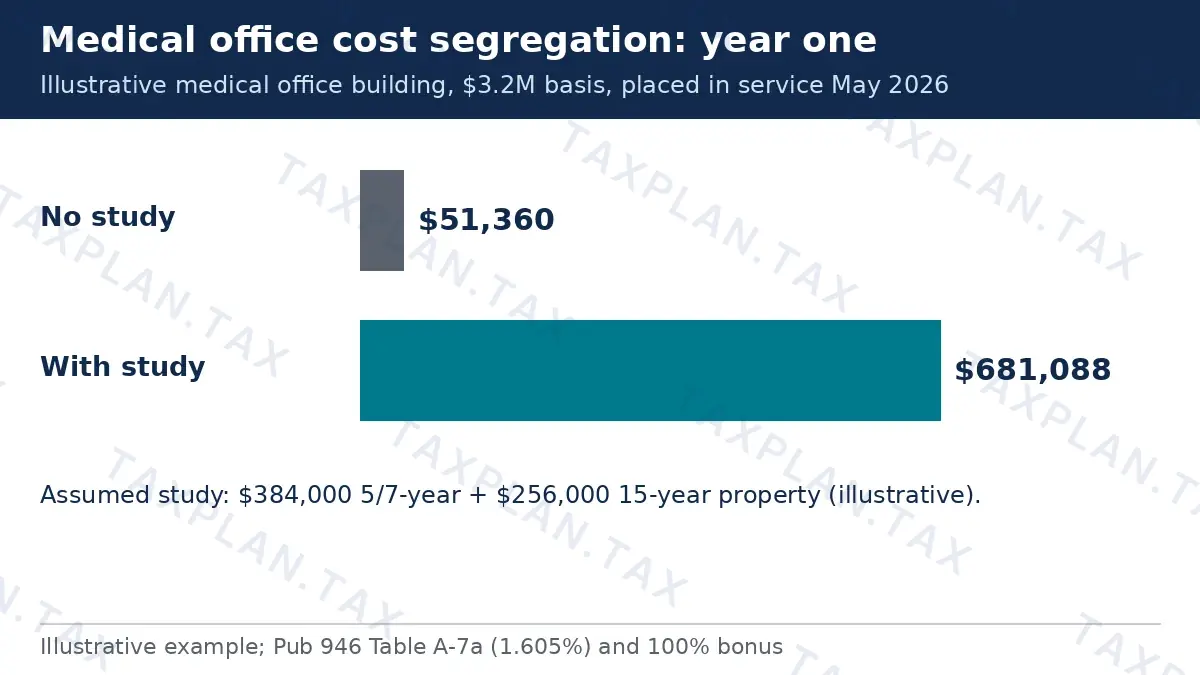
Assume a physician group buys a two-story medical office building for $4,000,000 under a 2026 contract. The land is worth $800,000, so the building basis is $3,200,000. The building is placed in service in May 2026.
| Class (illustrative study) | Basis | Year-one depreciation |
|---|---|---|
| 5- and 7-year personal property | $384,000 | $384,000 (100% bonus) |
| 15-year parking, lighting, landscaping (class 00.3) | $256,000 | $256,000 (100% bonus) |
| 39-year building | $2,560,000 | $41,088 |
| Total | $3,200,000 | $681,088 |
The 39-year figure uses the May rate of 1.605% from Publication 946, Table A-7a. Without a study, $3,200,000 at 1.605% gives $51,360. Therefore, in this example cost segregation for medical offices adds about $629,728 of first-year depreciation.
Example 2: A dental suite build-out
Next, assume a dental practice leases a suite in a building first placed in service in 2015. In 2026, the practice spends $400,000 on its own build-out. The work includes $330,000 of partitions, ceilings, lighting, and finishes. It also includes $70,000 of dedicated electrical, water, air, and vacuum lines for dental chairs and equipment.
The $330,000 of interior work can be QIP, so it is 15-year property eligible for bonus. Meanwhile, the dedicated equipment lines may be 5-year property in class 57.0, if the facts show they serve only the equipment. Separately, the practice’s dental chairs and imaging units are equipment, not building costs.
What Are Common Mistakes With Cost Segregation for Medical Offices?
Direct answer: Most errors involve overreaching on building systems, weak equipment documentation, or mishandling build-outs.
- Calling exam room sinks or general plumbing personal property. Plumbing fixtures such as sinks are listed structural components.
- Treating comfort HVAC as equipment. Central heating and air conditioning stay with the building.
- Claiming dedicated lines without drawings. Support should show each line serves specific equipment.
- Calling elevator work QIP. The statute excludes elevators and escalators.
- Using the lease term for build-outs. MACRS lives apply instead.
- Ignoring state law. Some states do not follow federal bonus depreciation.
Frequently Asked Questions
Is cost segregation for medical offices worth it?
It can be, especially for specialized practices and recent purchases. However, the answer depends on basis, income, and holding period. Our guide When Is a Cost Segregation Study Worth It? explains the analysis.
Are dental and medical offices treated the same way?
Generally, yes. Cost segregation for medical offices and dental offices follows the same rules. Both are nonresidential real property, and assets used in professional services fall in class 57.0. The differences come from each practice’s equipment and systems.
Is medical equipment 5-year or 7-year property?
Assets used in professional services fall in class 57.0, with a 5-year GDS life. However, office furniture falls in class 00.11, with a 7-year life.
Can I use cost segregation for medical offices I bought years ago?
Yes. A look-back study claims missed depreciation through Form 3115 and a §481(a) adjustment, under Rev. Proc. 2025-23.
Who depreciates a tenant’s medical build-out?
Generally, the party that pays for and owns the improvement depreciates it. So a practice that funds its own build-out depreciates that work.
Can a practice that owns its building use cost segregation?
Yes. Cost segregation for medical offices works for owner-users too. Many doctors hold the building in a separate entity and lease it to the practice. In that case, the asset class is determined as if the practice owned the property.
Conclusion: Is Cost Segregation for Medical Offices Right for You?
To sum up, cost segregation for medical offices can move equipment-related systems, removable finishes, and site work out of the 39-year class. For property acquired after January 19, 2025, those parts can generally get 100% bonus depreciation. In addition, QIP rules can speed up the recovery of build-outs. However, general building systems stay in the 39-year class, so careful documentation matters.
Emunah Cost Segregation works with physicians, dentists, and their CPAs. Alan Goldstein, EA, reviews your building, lease, and build-out costs before any study begins. Then he tells you plainly whether a study makes sense. Contact Emunah Cost Segregation in Coral Gables, Florida, to request a review. For related reading, see Cost Segregation for Office Buildings.
Sources and Authorities
- 26 U.S.C. §168 (including §168(c), §168(e), §168(i), §168(k), and §168(n)): https://www.law.cornell.edu/uscode/text/26/168
- 26 U.S.C. §179 (including §179(f)): https://www.law.cornell.edu/uscode/text/26/179
- 26 U.S.C. §1245: https://www.law.cornell.edu/uscode/text/26/1245
- 26 U.S.C. §1 (including §1(h)): https://www.law.cornell.edu/uscode/text/26/1
- Public Law 119-21 (H.R. 1, 119th Congress): https://www.congress.gov/bill/119th-congress/house-bill/1
- IRS Notice 2026-11: https://www.irs.gov/pub/irs-drop/n-26-11.pdf
- Treas. Reg. §1.48-1: https://www.ecfr.gov/current/title-26/section-1.48-1
- Treas. Reg. §1.167(a)-11: https://www.ecfr.gov/current/title-26/section-1.167(a)-11
- Treas. Reg. §1.168(k)-2: https://www.ecfr.gov/current/title-26/section-1.168(k)-2
- IRS Publication 946, including Table A-7a and Table B-1: https://www.irs.gov/pub/irs-pdf/p946.pdf
- IRS Publication 5653, Cost Segregation Audit Techniques Guide: https://www.irs.gov/pub/irs-pdf/p5653.pdf
- About Form 3115: https://www.irs.gov/forms-pubs/about-form-3115
- Rev. Proc. 2025-23: https://www.irs.gov/pub/irs-drop/rp-25-23.pdf
- Hospital Corporation of America v. Commissioner, 109 T.C. 21 (1997), and Whiteco Industries, Inc. v. Commissioner, 65 T.C. 664 (1975), as discussed in IRS Publication 5653.
This article is provided for general educational purposes and does not constitute individualized tax, legal, or accounting advice. Tax consequences depend on the taxpayer’s specific facts and applicable law.
