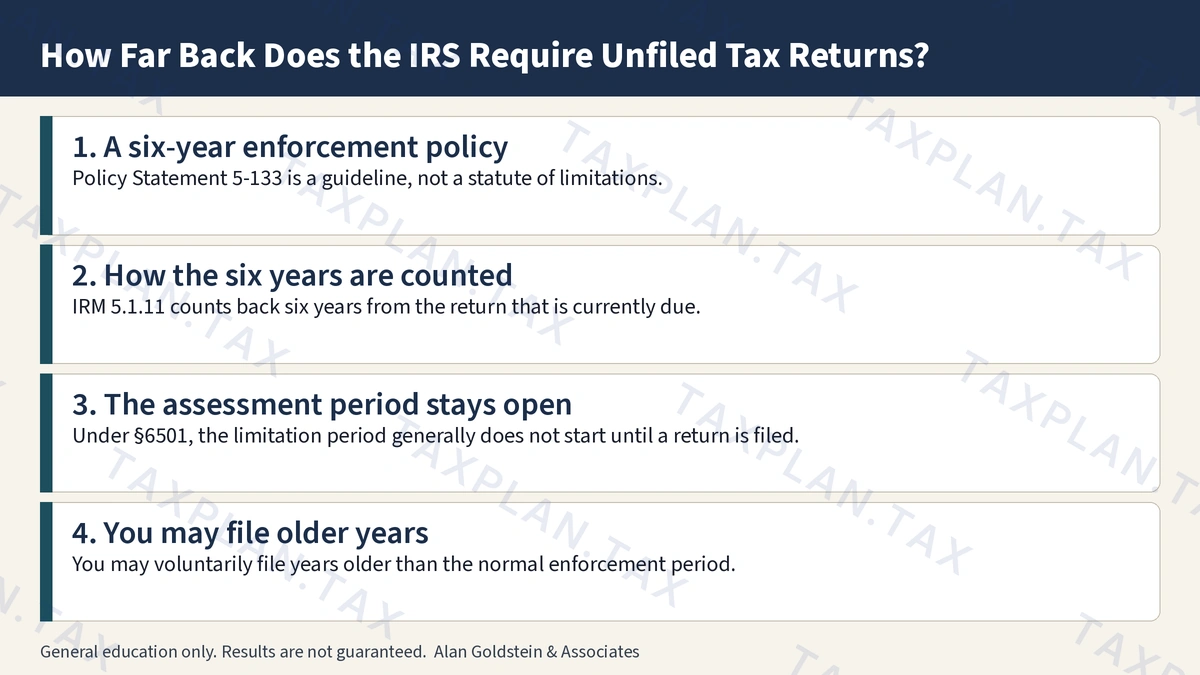

The IRS does not have a statute that limits the filing duty to the last six years. As a matter of enforcement policy, Policy Statement 5-133, applied in Internal Revenue Manual (IRM) 4.12.1 and IRM 5.1.11, provides that the IRS will normally enforce delinquency procedures for not more than six years, and that managerial approval is required to go shorter or longer. The legal duty to file a required return is not confined to that period. Under Internal Revenue Code (IRC) §6501, the time for the IRS to assess tax generally does not begin until a valid return is filed, so an unfiled year can remain open for assessment long after six years have passed. You may also file older years on your own. Older years can still matter for refunds, which can expire under §6511, for state compliance, and in cases involving willfulness or fraud. The practical answer to “how far back” is therefore two-layered: the years the IRS will normally pursue, and the years the law still allows it to assess if no return has been filed.
Key Takeaways
- Policy Statement 5-133 is an enforcement guideline, not a statute of limitations. The IRS normally pursues about six unfiled years, with manager approval required to do more or less.
- IRM 5.1.11 explains how that six-year period is counted, starting from the return that is currently due and going back six years. The exact years shift depending on whether the determination is made before or after the April filing deadline.
- The assessment limitation period in §6501 generally does not start until a return is filed. An unfiled year is not automatically closed after three, six, or ten years.
- A refund of withholding, estimated tax, or refundable credits can be lost if you wait too long under §6511, even if the IRS is not asking you to file that year.
- You may voluntarily file years older than the normal enforcement period. IRM 5.1.11 states that the taxpayer may file for all open periods regardless of the age of the delinquency.
- Willful failure to file, fraud, illegal-source income, and similar facts are among the reasons the IRS may seek to enforce more than six years.
Introduction and Background
People who have missed several federal returns often hear a short answer: “The IRS only makes you file six years.” That statement is incomplete. It describes, in rough terms, how the IRS usually uses its enforcement resources. It does not describe the filing duty, and it does not describe the assessment statute of limitations.
The Code requires a return from a person who is liable for the tax and required to file. Nothing in that duty expires merely because six calendar years have passed. What can expire, on different clocks, are the IRS’s time to assess tax after a return is filed, the time to collect after assessment, and the taxpayer’s time to claim a refund. Those clocks are the subject of a companion article on the statute of limitations. This article focuses on how far back the IRS will ordinarily require unfiled returns, and how that policy relates to the law.
The distinction matters in both directions. A taxpayer who files only the six years an examiner or collection officer has listed may leave older required returns unfiled, with the assessment period still open. Waiting to reconstruct a full decade before filing can also delay refund years close to the §6511 deadline. The better starting point is a year-by-year inventory: which years were required, which the IRS is pursuing, and which still have a refund that can be lost.
How It Works
The normal six-year enforcement period
IRM 4.12.1, discussing Policy Statement 5-133, states that the enforcement period is not to be more than six years, but that the extent to which delinquency procedures will be enforced depends on the facts and circumstances of each case and on factors that support even-handed use of IRS resources. Those factors include the taxpayer’s prior history of noncompliance, the existence of income from illegal sources, the effect upon voluntary compliance, the anticipated revenue in relation to the time and effort required to determine the tax due, and any special circumstances of the taxpayer, class of taxpayer, industry, or class of tax. Management approval is required if enforcement will be for less than, or more than, the six-year period. Group manager approval is not needed if the taxpayer voluntarily files returns beyond the established enforcement period.
IRM 5.1.11, which covers delinquent return investigations in Collection, repeats the same core rule: enforcement of filing requirements will normally be pursued for a six-year period; the employee should always request all non-fraudulent unfiled returns; and the taxpayer may file for all open periods regardless of the age of the delinquency. If the employee determines that more or less than six years will be enforced, managerial approval is required. The IRM also lists factors for that determination, including the degree of flagrancy, the history of noncompliance, the impact on future voluntary compliance, whether trust fund taxes are involved, special circumstances, illegal-source income, minimal or no tax due, the cost to the IRS relative to anticipated revenue, and bankruptcy.
How the six years are counted
IRM 5.1.11 instructs employees to calculate the six-year period by starting with the tax year that is currently due and going back six years. The IRM’s examples turn on the calendar date of the determination:
| If the determination is made | How the IRM counts the six years | IRM example |
|---|---|---|
| On or after January 1 and on or before April 14 | The “current” return is the prior tax year, because the most recent calendar-year return is not yet due | On January 15, 2024, the previous six years would be 2022, 2021, 2020, 2019, 2018, and 2017 |
| On or after April 15 and on or before December 31 | The “current” return is the tax year whose return has just come due | On July 31, 2024, the previous six years are 2023, 2022, 2021, 2020, 2019, and 2018 |
Applying that same method, illustratively, to a determination made after April 15, 2026, and before the end of 2026, the six years would typically be tax years 2025 through 2020. That is an illustration of the IRM counting method, not a prediction of what the IRS will request in any particular case. The IRM itself notes that the start of the calendar year initiates the six-year rule, but the specific month determines which prior returns must be addressed, and that facts can support a shorter or longer period with approval.
What the six-year policy does not do
The policy does not start the §6501 assessment period. It does not cancel tax, penalties, or interest on an older unfiled year. It does not prevent you from filing that year, and it does not prevent the IRS from later assessing tax on that year if no return has been filed, particularly if new facts appear or if the case is not an ordinary civil delinquency. It also does not extend the time to claim a refund. A year the IRS is not currently asking for can still be the year you need to file first, if a refund is about to expire.
Benefits and Opportunities
- A realistic work plan. Knowing the normal enforcement window helps you prioritize records, transcripts, and return preparation without treating six years as a legal cutoff.
- Room to file older years voluntarily. If an older year has a refund that is still timely, or if you want a complete filing history for a loan, a license, or peace of mind, you can file it. Manager approval is not required for a voluntary filing beyond the enforcement period.
- A chance to document years with no filing requirement. If a year in the six-year window had gross income below the filing threshold, the right response may be an explanation, with facts, rather than a return that was not required.
- Better sequencing of refund years and balance-due years. Filing the years the IRS is pursuing, and any refund year near the §6511 deadline, is usually more urgent than reconstructing a long-closed refund year that can no longer be claimed.
Legal and Regulatory Considerations
Policy Statement 5-133 and the IRM provisions that apply it are internal enforcement guidance. They do not repeal the statutory filing requirement, and they are not a substitute for the limitation periods in the Code. Section 6501 generally allows assessment within three years after a return is filed. If no return is filed, §6501(c)(3) provides that the tax may be assessed, or a court proceeding for collection may be begun without assessment, at any time. Section 6501(c) also leaves the period open for a false or fraudulent return filed with intent to evade tax, and for a willful attempt to evade tax. After a valid, nonfraudulent return is filed, a substantial omission of more than 25% of gross income can extend the assessment period to six years under §6501(e). Those rules are statutes. The six-year non-filer policy is not.
Collection after assessment is generally limited to 10 years from the assessment date under §6502. That collection period does not begin on an unfiled year until there is an assessment, which may occur when you file or when the IRS assesses tax on a substitute for return under §6020(b). Filing therefore has a limitations consequence that simply waiting does not.
Refunds are governed by §6511 and by the deemed-paid rule in §6513 for withholding and estimated tax. The IRS’s past-due returns page summarizes a practical result: if you are due a refund for withholding or estimated taxes, you must file your return to claim it within three years of the return due date, and the same concern applies to credits such as the earned income credit. A year the IRS is not currently enforcing can still be lost as a refund year if you wait.
Civil penalties under §6651, and interest under §§6621 and 6622, are computed on each late year that has unpaid tax. They are not limited to the six-year enforcement window. For income tax returns more than 60 days late, a minimum failure-to-file penalty can apply: the lesser of the IRS-published amount or 100% of the tax required to be shown. For return due dates after December 31, 2025, that amount is $525. Interest on underpayments for October 1 through December 31, 2026, is 7% per year, compounded daily, for individuals and for ordinary corporate underpayments. Willful failure to file a required return can also be a misdemeanor under §7203, which is a separate inquiry from how many years Collection or Examination decides to pursue.
Practical Examples
The following examples are illustrative. They apply the IRM counting method and published statutory rules. They are not a determination of any taxpayer’s filing requirement or of what the IRS will request.
| Situation | What “how far back” usually means | What can still be at stake |
|---|---|---|
| Individual, determination made in November 2026, ordinary civil case | Under the IRM method, the normal six years would typically be 2025 through 2020 | Older unfiled years can remain open for assessment; a 2019 refund year may already be time-barred under §6511 |
| Same taxpayer has a likely refund on the 2023 year and balances due on 2024 and 2025 | File all required years in the window, and do not delay the refund year | The IRS may also hold a refund if other years remain unfiled |
| Taxpayer has 10 unfiled years and wants to file all of them | The IRM states that the taxpayer may file for all open periods; manager approval is not needed for voluntary filings beyond six years | Older balance-due years can still produce assessments, penalties, and interest once filed or once an SFR is assessed |
| Indicators of fraud or illegal-source income | The policy factors expressly include those facts, and enforcement beyond six years requires managerial approval, not a legal bar | Assessment may remain open under §6501(c); professional advice is important before any filing or interview |
Illustrative penalty point, not a six-year computation. The enforcement window does not cap the §6651 penalty on a year that is late. If a 2025 return due after December 31, 2025, is more than 60 days late and shows net unpaid tax, the failure-to-file penalty can reach 25% (22.5% when the failure-to-pay offset applies) plus a continuing failure-to-pay penalty and daily interest. If the unpaid tax is small, the minimum failure-to-file penalty can be the lesser of $525 or 100% of the tax required to be shown. Those amounts accrue on the late year itself, whether or not it is on a six-year list.
Common Mistakes and Risks
- Treating six years as a legal discharge. It is an IRS resource guideline. The assessment period on an unfiled year generally remains open.
- Ignoring years older than six years that still have a refund. The refund clock is separate and can expire while the IRS is focused on other years.
- Filing only the years named in a notice and assuming the rest are closed. A notice may not list every required year, and an unlisted unfiled year is not thereby barred.
- Waiting to reconstruct ten or fifteen years before filing the years that are due now. Delay can add failure-to-file penalty up to the cap, add interest, and forfeit refunds.
- Assuming a year with no tax due can be skipped without checking the filing threshold. The question is whether a return was required, not only whether a balance was due.
- Discussing older years casually in a case that may involve fraud or a criminal investigation. Get professional advice first.
Frequently Asked Questions
Does the IRS only require six years of unfiled returns?
Normally, yes, as a matter of enforcement policy under Policy Statement 5-133. The IRS can seek more or fewer years with managerial approval, and you can file older years yourself. The legal duty to file a required return is not limited to six years.
If the IRS asks for only four years, are the other years closed?
Not necessarily. A shorter enforcement period requires managerial approval under the IRM, and it still does not start the §6501 period on a year that was never filed. You may still need or want to file other required years, especially refund years.
Can the IRS go back 10 years or more?
It can assess tax on an unfiled year at any time under §6501(c)(3). Whether it will enforce delinquency procedures beyond six years is a policy decision that requires managerial approval and depends on the facts, including flagrancy, illegal-source income, and similar factors listed in the IRM.
Should I file years older than six years?
Often yes, if a return was required and especially if a refund is still timely, or if you need a complete filing record. The IRM states that you may file for all open periods regardless of the age of the delinquency. Balance-due years will still produce tax, penalties, and interest once filed.
How do I know which six years apply right now?
Follow the IRM method described above, and confirm it against any IRS notice you have received. The list on a notice is the list you must answer, even if you think the counting should be different. Transcripts help you see which years are missing.
Does the six-year policy apply to employment or information returns?
Policy Statement 5-133 is a general delinquency-enforcement policy and is applied in both income-tax and other delinquent-return procedures, with facts and the class of tax taken into account. Employment and information returns also have their own penalty regimes. Do not assume a Form 1040 analysis automatically covers Forms 941, 940, 1099, 1065, or 1120-S.
If I file a late return, how far back can the IRS audit it?
Once a valid, nonfraudulent return is filed, the ordinary assessment period is generally three years from filing. A substantial omission of gross income can extend that period to six years, and fraud or a willful attempt to evade tax can leave it open. Filing is what starts the ordinary clock.
What if I truly had no filing requirement in some of those years?
Then the correct response may be to explain that, with supporting facts, rather than to file an unnecessary return. IRS delinquency notices often include Form 15103 for that explanation. Keep the records that show income was below the filing threshold.
Conclusion
The IRS will normally ask a non-filer to become current for about six years. That is a policy of enforcement, documented in Policy Statement 5-133 and the Internal Revenue Manual, not a legal expiration of the duty to file or of the IRS’s power to assess tax on a year that was never filed. The years that matter in a real case include the years the IRS is pursuing, any older year you should file voluntarily, and any refund year that is close to the claim deadline. Mapping those years and filing the required returns replaces assumptions with a plan.
If you are unsure how far back your unfiled federal returns go, or which years to file first, Alan Goldstein & Associates can help. Alan Goldstein, MBA, IRS Enrolled Agent, works with individuals, business owners, and their tax advisors to inventory missing years, prepare delinquent returns, and respond to IRS notices. Contact Alan Goldstein & Associates in Coral Gables, Florida, for a confidential review.
Sources and Authorities
- IRM 4.12.1, Nonfiled Returns (Policy Statement 5-133 six-year enforcement period): https://www.irs.gov/irm/part4/irm_04-012-001
- IRM 5.1.11, Delinquent Return Investigations: https://www.irs.gov/irm/part5/irm_05-001-011r
- 26 U.S.C. §6501 (limitations on assessment and collection): https://www.law.cornell.edu/uscode/text/26/6501
- 26 U.S.C. §6502 (collection after assessment): https://www.law.cornell.edu/uscode/text/26/6502
- 26 U.S.C. §§6511 and 6513 (refund limitations and timing of payments): https://www.law.cornell.edu/uscode/text/26/6511
- 26 U.S.C. §6651 (failure to file or to pay): https://www.law.cornell.edu/uscode/text/26/6651
- IRS, Filing past due tax returns: https://www.irs.gov/businesses/small-businesses-self-employed/filing-past-due-tax-returns
- IRS, Failure to file penalty: https://www.irs.gov/payments/failure-to-file-penalty
- IRS, Quarterly interest rates (7% underpayment rate for the quarter beginning October 1, 2026): https://www.irs.gov/payments/quarterly-interest-rates
This article is provided for general educational purposes and does not constitute individualized tax, legal, or accounting advice. Tax consequences depend on the taxpayer’s specific facts and applicable law.
