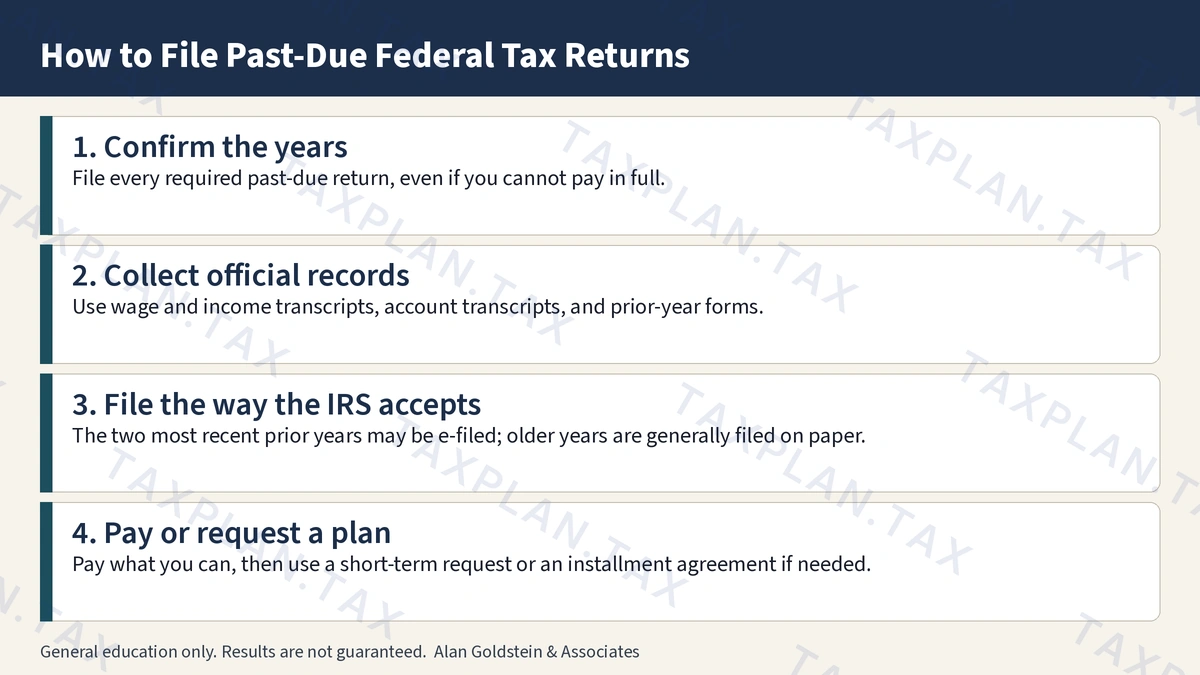

Filing a past-due federal tax return is a defined process: confirm that a return is required, gather wage and income information, complete the prior-year form, file it in the manner the IRS will accept, and then pay or arrange to pay. The IRS instructs taxpayers to file all returns that are due, whether or not they can pay in full, and to file a past-due return the same way and to the same location as an on-time return, unless a notice gives a different address. You can obtain much of the income information the IRS already has through Get Transcript or Form 4506-T. Recent prior-year returns may be eligible for electronic filing; older years are generally paper-filed on the prior-year form. If the IRS has already prepared a substitute for return, you should still file your own signed return so that deductions and credits can be considered. This article walks through those steps in order, including what to do when records are incomplete and what to expect after the return is submitted.
Key Takeaways
- File every required past-due return, even if you cannot pay in full. Use the address on any IRS notice you have received.
- Start with official records: wage and income transcripts, account transcripts, and prior-year forms from IRS.gov or 800-TAX-FORM (800-829-3676).
- The IRS has stated that it accepts returns electronically for the two most recent prior years, through an e-file provider that offers that service. Older years are generally filed on paper.
- If you received a delinquency notice, return Form 15103 with the tax return or with an explanation of why you are not required to file, using the notice address or fax number.
- The IRS estimates about six weeks to process an accurately completed past-due return. A Notice of Deficiency (CP3219N) has a 90-day response period, and no filing extension is available after that notice.
- Pay what you can with the return, then use a short-term payment request or an installment agreement if you need more time.
Introduction and Background
A past-due federal return is the same legal return you would have filed on time, prepared under the law in effect for that tax year, and signed under penalty of perjury. The difference is timing, and timing is what triggers the failure-to-file penalty under IRC §6651(a)(1), the failure-to-pay penalty if tax remains unpaid, and daily interest. The IRS’s filing-past-due-returns page is the operational guide: file now, file completely, and do not wait until you can pay the balance in full.
The mechanics matter because a sloppy late return can create a second problem: an underreported year, a missing form, or a return sent to the wrong place while a notice is pending. The steps below are designed to reduce those errors and to use the IRS’s own transcripts so that the income you report is reconciled to what the agency already has.
How It Works
Step 1. Confirm the years and the filing requirement
List each tax year at issue. For each year, determine whether you were required to file, based on filing status, age, gross income, and other facts such as self-employment earnings. If a year was not required, assemble the facts that support that conclusion. If you have a delinquency notice, Form 15103 is the IRS form used to explain a late filing or to state that you already filed or were not required to file.
Step 2. Collect transcripts and missing statements
Use IRS Get Transcript to request a wage and income transcript and an account transcript for each year. If you cannot use the online tool, complete Form 4506-T, Request for Transcript of Tax Return, and check the box for wage and income information (line 8 on the current form). You can also contact the employer or payer. If a Form W-2 or 1099 is wrong, the IRS says to contact the payer for a correction and to attach the corrected form when you file. Account transcripts will also show whether a substitute for return has already posted.
Step 3. Reconstruct records the transcripts do not show
Transcripts usually capture third-party reported income. They may not capture all deductible expenses, basis, filing-status facts, or dependent information. Use bank and credit-card records, books and ledgers, prior-year state filings, and closing statements to reconstruct what you can. If you must estimate an expense, keep a record of the method and the documents you used. Do not invent deductions, and do not omit reported income without a documented reason.
Step 4. Complete the correct prior-year form
Download the prior-year Form 1040 (or 1120, 1120-S, 1065, or other required form) and its instructions from IRS.gov, or order them by calling 800-TAX-FORM. Use the form and the tax law for that year, not the current-year form, unless official instructions say otherwise. Compute the tax, apply timely withholding and estimated payments, and attach the schedules and forms required for that year, including any digital-asset, foreign-account, or self-employment schedules that apply.
Step 5. File the return the IRS will accept
The IRS says to file a past-due return the same way and to the same location as an on-time return, unless a notice provides a different address. On the CP515 notice page, the IRS has stated that it accepts returns electronically for the two most recent prior years, but you must locate an e-file provider who offers this service. Older years are generally mailed on paper. If you have a notice, include Form 15103 as instructed and use the mailing address or fax number on the notice. Sign and date the return. Keep a complete copy and, for a paper filing, proof of mailing.
Step 6. Pay, or request a payment arrangement, and monitor processing
Include payment if you can. If you cannot pay in full, the IRS says you may request an additional 60 to 120 days to pay in full through the Online Payment Agreement application or by calling 800-829-1040, with no user fee for that short-term request, or you may request an installment agreement or, if you qualify, an offer in compromise. The IRS states that it takes approximately six weeks to process an accurately completed past-due return. If you already received a notice, send a copy of the filed return to the notice address as well.
Benefits and Opportunities
- You stop the failure-to-file clock. Once the return is filed, that monthly penalty no longer accrues (it caps after five months in any event). Filing also starts the assessment limitation period under §6501 for a valid, nonfraudulent return.
- You can claim what an SFR omits. Filing status, dependents, deductions, and credits belong on your signed return. The IRS states that it will generally adjust an SFR account to the correct figures when you file your own return.
- You may still be in time for a refund. Withholding and estimated tax are generally deemed paid on the original due date under §6513. Filing within the §6511 period is what preserves the claim.
- You become eligible for ordinary collection alternatives. A complete filing is usually required before the IRS will consider an installment agreement or an offer in compromise.
Legal and Regulatory Considerations
The duty to file, and the time for filing, come from the Code and the regulations for the particular return. An extension of time to file, if it was timely requested for that year, extends the filing date used for the failure-to-file penalty, but it does not extend the time to pay. Section 6651(a)(1) measures the failure-to-file penalty from the due date determined with regard to extensions. Section 6651(a)(2) measures the failure-to-pay penalty from the payment due date, generally determined without a filing extension.
If the IRS prepares an SFR under §6020(b), the return so made and subscribed is prima facie good and sufficient for all legal purposes. The IRS will generally send a CP3219N Notice of Deficiency and give you 90 days (150 days if the notice is addressed to a person outside the United States) to file your own return or petition the Tax Court. The IRS states that you cannot request an extension to file after receiving CP3219N. Filing your own return during or after that process is still the way to place your deductions and credits before the agency.
Refund timing is governed by §6511, including the lookback limits in §6511(b). The IRS’s summary on the past-due returns page is that a refund of withholding or estimated taxes, and the right to claim credits such as the earned income credit, must be claimed by filing within three years of the return due date. Because those rules are technical, a year that is close to that deadline should be prepared and filed first.
Reasonable-cause relief from the failure-to-file penalty is statutory: the penalty does not apply if the failure is due to reasonable cause and not due to willful neglect. What qualifies is fact-specific. After the return is on file, some taxpayers may also qualify for first-time penalty abatement under IRS administrative procedures, if the other conditions of that program are met.
Practical Examples
The following examples are illustrative.
| Year and posture | How to file | Special step |
|---|---|---|
| The two most recent prior years, no notice | E-file through a provider that accepts prior-year returns, if available; otherwise paper-file the prior-year form | Pay what you can and, if needed, request a payment arrangement after the return is submitted |
| An older year, paper only | Complete the prior-year form and mail it to the regular filing address (or the notice address) | Keep proof of mailing; allow about six weeks for processing |
| A year under a CP515 or similar notice | File the return and Form 15103 to the address or fax on the notice | If you already filed, send a signed copy with Form 15103 rather than ignoring the notice |
| A year with a CP3219N notice of deficiency | File your own return, or petition the Tax Court, within the 90-day period | The IRS states that a filing extension is not available after this notice |
| A year in which an SFR has already been assessed | File a signed original return claiming the correct status, deductions, and credits | The IRS states it will generally adjust the account to the correct figures |
Illustrative penalty effect of filing sooner rather than later. Assume $6,000 of unpaid tax, no timely payments, and a return due after December 31, 2025. If the return is filed 45 days late, the failure-to-file penalty is 5% for one month (or 4.5% if the failure-to-pay penalty also applies for that month), and the $525 minimum does not apply because the return is not more than 60 days late. If the same return is instead filed 70 days late, the minimum penalty can apply: the lesser of $525 or 100% of the $6,000 tax, so $525 if that amount exceeds the computed percentage. Filing before the 60-day mark can therefore change the penalty even when the unpaid tax is the same. Interest still accrues in both cases.
Common Mistakes and Risks
- Using the current-year form for an old year. Use the prior-year form and instructions unless official IRS guidance says otherwise.
- E-filing a year the system will not accept. Confirm that the year is among those the IRS and the software provider will take electronically.
- Mailing a return to the usual address while a notice directs a different address. Follow the notice.
- Filing without signatures or required schedules. An incomplete return can delay the six-week processing estimate or fail to start the assessment period.
- Waiting for every missing receipt before filing a refund year that is near the §6511 deadline. A timely, supportable return is better than a perfect return filed too late to claim the refund.
- Assuming that e-filing or mailing ends the matter if a notice is outstanding. The IRS tells taxpayers who have already filed to send a copy to the notice address and to allow time for the account to catch up.
Frequently Asked Questions
Where do I mail a past-due Form 1040?
To the same location you would use for an on-time return, unless a notice tells you to use a different address. Use the address on the notice if you have one.
Can I file several years at the same time?
Yes. Prepare each year on its own prior-year form, with its own signature and attachments. If notices are outstanding, follow the instructions on each notice. Processing is year by year.
What if I am due a refund for one year and owe tax for another?
File both. The IRS states that it holds refunds when records show one or more income tax returns are past due, until it receives the past-due return or an acceptable reason for not filing. A refund can also be offset against a separately assessed federal liability.
Do I need to attach W-2s to a late return?
Follow the instructions for the prior-year form. Even when a paper attachment rule differs, you should still reconcile the return to wage and income transcripts and retain the statements.
What if I already filed and still received a notice?
The IRS CP515 page says to complete Form 15103 and send a signed and dated copy of the return, making sure the name, Social Security number, and tax year match the notice.
Can I get an extension now for a year that is already late?
An extension must generally be requested by the original due date. After a CP3219N notice of deficiency, the IRS states that you cannot request an extension to file. The remedy is to file the return.
How do I pay a past-due balance?
The IRS accepts a range of payment methods, including Direct Pay and the Electronic Federal Tax Payment System, and it offers short-term payment and installment-agreement options if you cannot pay in full. Follow current instructions on IRS.gov for the year and form.
Should a tax professional file the returns for me?
A professional can help when records are incomplete, multiple years or entity returns are involved, an SFR or a notice of deficiency is pending, or there may be fraud or criminal exposure. Simple wage-income years can sometimes be completed with transcripts and the prior-year form, including through VITA or TCE if you qualify.
Conclusion
The way to file a past-due federal return is orderly: confirm the filing requirement, collect transcripts and records, complete the correct prior-year form, file it where the IRS will process it, and then pay or arrange to pay. Doing the steps in that order reduces avoidable penalties, protects refunds that are still timely, and gives you a clear response to any delinquency or deficiency notice.
If you need help filing one or more past-due federal returns, Alan Goldstein & Associates can help. Alan Goldstein, MBA, IRS Enrolled Agent, works with individuals, business owners, and their tax advisors to gather transcripts, prepare delinquent returns, and respond to IRS notices. Contact Alan Goldstein & Associates in Coral Gables, Florida, for a confidential review.
Sources and Authorities
- IRS, Filing past due tax returns: https://www.irs.gov/businesses/small-businesses-self-employed/filing-past-due-tax-returns
- IRS, Understanding your CP515 notice: https://www.irs.gov/individuals/understanding-your-cp515-notice
- IRS, Get Transcript: https://www.irs.gov/individuals/get-transcript
- About Form 4506-T: https://www.irs.gov/forms-pubs/about-form-4506-t
- 26 U.S.C. §6651: https://www.law.cornell.edu/uscode/text/26/6651
- 26 U.S.C. §6020: https://www.law.cornell.edu/uscode/text/26/6020
- 26 U.S.C. §§6511 and 6513: https://www.law.cornell.edu/uscode/text/26/6511
- IRS, Failure to file penalty: https://www.irs.gov/payments/failure-to-file-penalty
- IRS, Online payment agreement: https://www.irs.gov/payments/online-payment-agreement-application
- IRS, Prior year forms: https://www.irs.gov/forms-pubs/prior-year
This article is provided for general educational purposes and does not constitute individualized tax, legal, or accounting advice. Tax consequences depend on the taxpayer’s specific facts and applicable law.
