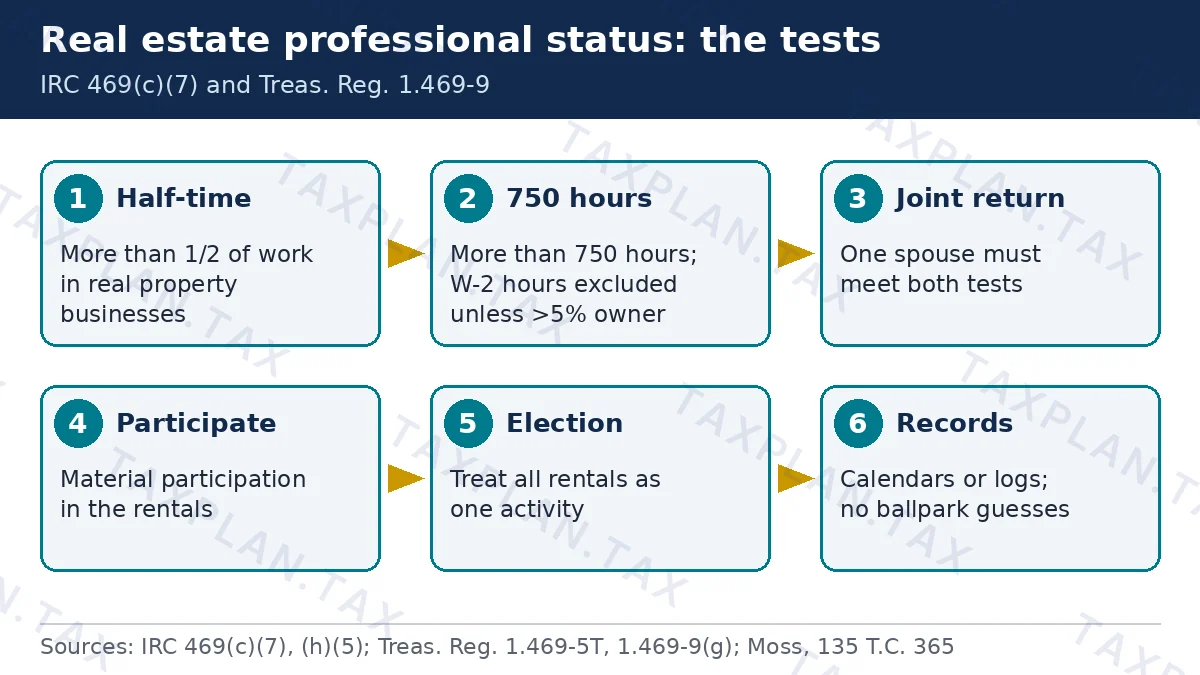

Real estate professional status lets a qualifying taxpayer treat rental real estate losses as nonpassive, so the large first-year depreciation from a cost segregation study can offset wages, business income, or other nonpassive income. To qualify under IRC §469(c)(7), more than half of your personal services must be in real property trades or businesses in which you materially participate. In addition, those services must exceed 750 hours for the year.
However, status alone is not enough. You must also materially participate in the rental activity itself, as the Ninth Circuit confirmed in Gragg v. United States, 831 F.3d 1189 (9th Cir. 2016). For that reason, many real estate professionals elect to treat all rental interests as one activity. This guide explains the tests, the election, the records you need, and how real estate professional status changes the value of cost segregation, with worked examples.
Key Takeaways
- Rental activities are generally passive, even if you work on them, unless you qualify under §469(c)(7).
- Real estate professional status requires more than 750 hours and more than half of your working time in real property trades or businesses.
- On a joint return, one spouse must meet both tests alone.
- You must also materially participate in the rental activity, often through the election to group all rentals.
- Contemporaneous logs are not required, but courts reject after-the-fact “ballpark guesstimates.”
- With 100% bonus, a study can create a large nonpassive loss, subject to other limits.
Introduction and Background: What Is Real Estate Professional Status?
Direct answer: It is a tax status under §469(c)(7) that removes the automatic passive label from a qualifying taxpayer’s rental real estate.
Under §469(c)(2), a rental activity is generally a passive activity. As a result, losses from rentals can usually offset only passive income. Any disallowed loss carries forward to the next year under §469(b). For a full overview of these limits, see Passive Activity Loss Limitations.
Congress added §469(c)(7) in 1993. According to Gragg, Congress found the earlier rule unfair to people who work in real estate. However, the tax code does not use the phrase “real estate professional.” Instead, it speaks of taxpayers in a real property business. “Real estate professional status” is the common shorthand, and IRS Publication 925 uses it too.
How Does Real Estate Professional Status Work?
Direct answer: You pass two time tests, then you show material participation in your rental activity.
Test 1: More than half of your personal services
First, more than half of the personal services you perform in all trades or businesses must be in real property trades or businesses in which you materially participate. Section 469(c)(7)(C) defines those businesses broadly. The list covers development, redevelopment, construction, reconstruction, acquisition, conversion, rental, operation, management, leasing, and brokerage.
Test 2: More than 750 hours
Second, you must perform more than 750 hours of services in those real property businesses. Importantly, services you perform as an employee do not count, unless you own more than 5% of the employer. So a full-time W-2 job outside real estate usually makes the half-time test very hard to meet.
Joint returns
On a joint return, the two tests are met only if either spouse separately meets them. In other words, you cannot combine spouses’ hours for the 750-hour test. However, for material participation, §469(h)(5) does count the other spouse’s participation.
Material participation in the rental activity
Next, you must materially participate in the rental activity itself. Treas. Reg. §1.469-5T(a) lists seven tests. For example, one test is more than 500 hours in the activity. Another is more than 100 hours and not less than any other individual. Unless you elect otherwise, each rental property is a separate activity under §469(c)(7)(A).
The election to treat all rentals as one activity
For that reason, many owners elect to treat all interests in rental real estate as a single activity. Under Treas. Reg. §1.469-9(g), you make the election by attaching a statement to your original return. The election binds you for that year and for all future years in which you qualify. You can revoke it only after a material change in facts and circumstances. If you missed the election, Rev. Proc. 2011-34 provides a late-election procedure if you meet its conditions.
Benefits of Real Estate Professional Status With Cost Segregation
Direct answer: With real estate professional status and material participation, the extra depreciation from a study can reduce tax on nonpassive income right away.
- Current use of losses: nonpassive rental losses are not trapped by the passive loss rules.
- Bigger year-one deductions: 5-, 7-, and 15-year property acquired after January 19, 2025, can qualify for 100% bonus.
- Portfolio planning: the grouping election lets hours across all rentals count toward one activity.
- Timing control: you can elect out of bonus by class if a smaller deduction fits your plan better.
Without real estate professional status, the same study still has value, but the loss may be suspended until you have passive income or sell. For background on the study itself, see Cost Segregation Study Explained: A Complete Guide for Real Estate Investors. Also, see Cost Segregation and Passive Activity Losses for other paths, such as the short-term rental rules.
Legal and Regulatory Considerations for Real Estate Professional Status
Direct answer: The statute, the regulations, and several court cases set strict rules on status, participation, and proof.
Status does not replace material participation
In Gragg v. United States, 831 F.3d 1189 (9th Cir. 2016), a licensed agent qualified as a real estate professional. Even so, the court held that her rental losses were passive because she did not show material participation in the rentals. The court relied on Treas. Reg. §1.469-9(e)(1), which says a qualifying taxpayer’s rental activity is passive unless the taxpayer materially participates.
Only hours actually worked count
In Moss v. Commissioner, 135 T.C. 365 (2010), the taxpayer claimed he was “on call” for his rentals whenever he was not at his regular job. However, the Tax Court held that on-call time does not count toward the 750-hour test, because the statute requires services actually performed. The court also noted that the regulations do not allow a post-event “ballpark guesstimate” of hours.
How to prove your hours
Under §1.469-5T(f)(4), you may prove participation by any reasonable means. Contemporaneous daily logs are not required. Still, the regulation points to appointment books, calendars, or narrative summaries showing the services and the approximate hours. Therefore, a calendar kept during the year, with times and tasks, is far stronger than a summary prepared during an audit.
Trusts can qualify
In Frank Aragona Trust v. Commissioner, 142 T.C. 165 (2014), the Tax Court held that a trust can perform personal services through its individual trustees. As a result, the trust could qualify under §469(c)(7). On its facts, the court also found that the trust materially participated in its real property businesses.
Other limits still apply
Real estate professional status does not override every rule. For example, the §469(c)(7) flush language preserves the separate rules for limited partner interests. Likewise, the excess business loss limitation in IRC §461(l) may cap a large net business loss, with the excess treated as a net operating loss carryover. In addition, depreciation reduces basis, so a later sale can trigger ordinary income under IRC §1245. For exit planning, see Strategies That Eliminate Depreciation Recapture.
Bonus depreciation rules
Under IRC §168(k) as amended by Public Law 119-21, qualified property acquired after January 19, 2025, can receive a permanent 100% first-year deduction. Notice 2026-11 explains the acquisition-date and binding-contract rules. However, the 27.5-year and 39-year building portions are not eligible.
Practical Examples: Real Estate Professional Status in Action
Direct answer: The examples below show how real estate professional status changes the use of a study’s deductions. All figures are illustrative assumptions.
Example 1: A qualifying broker buys an apartment building
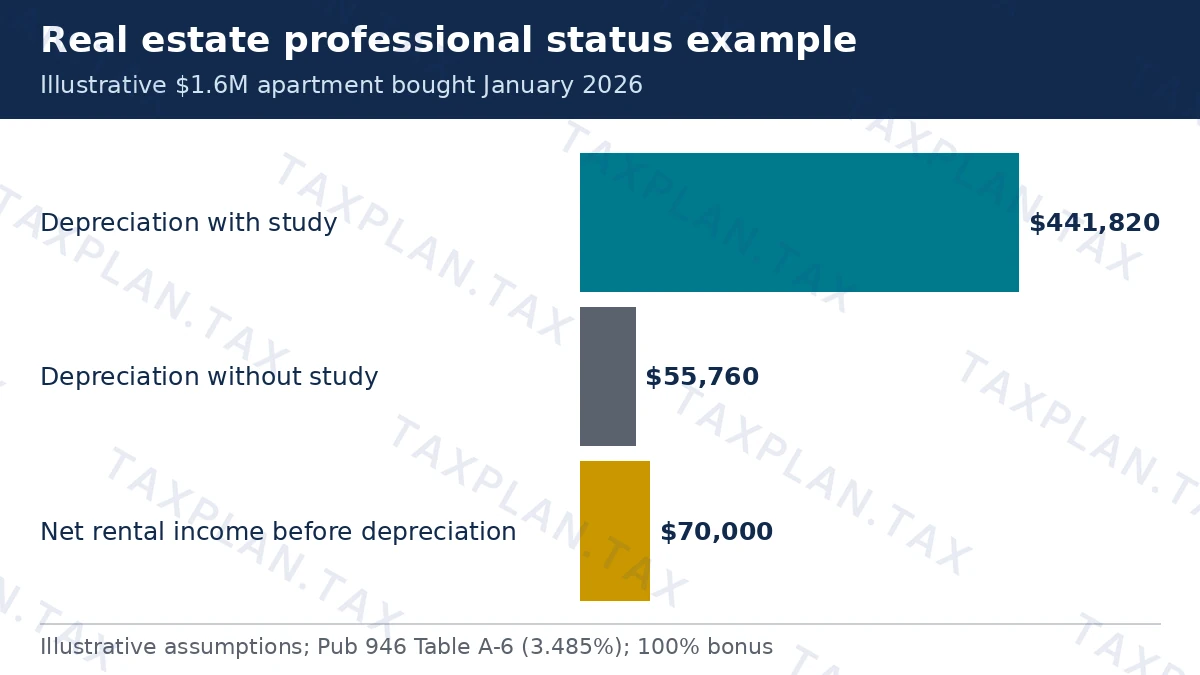
Assume Dana owns her brokerage and works only in real estate. She logs 1,500 hours in brokerage and 550 hours managing her rentals in 2026. She has made the §1.469-9(g) election. In January 2026, she buys an apartment building with $1,600,000 of depreciable basis, excluding land. Assume a study supports $400,000 of 5-, 7-, and 15-year property. Also assume net rental income before depreciation of $70,000.
| Item (illustrative) | With study | Without study |
|---|---|---|
| Bonus on short-life property | $400,000 | $0 |
| 27.5-year depreciation (3.485%, January) | $41,820 | $55,760 |
| Total 2026 depreciation | $441,820 | $55,760 |
| Rental result after $70,000 net income | $371,820 loss | $14,240 income |
Because Dana qualifies and materially participates in the grouped rental activity, the $371,820 loss is nonpassive. However, §461(l) may still limit how much offsets other income in 2026.
Example 2: The same purchase without real estate professional status
Now assume Dana instead works 2,000 hours a year as a W-2 employee of a non-real estate company. Her rental hours are less than half her working time, so she fails the first test. If her modified adjusted gross income is $150,000 or more, the $25,000 allowance under §469(i) is fully phased out. As a result, the $371,820 loss is suspended and carries forward. Nevertheless, it can offset future passive income, and §469(g) generally frees it on a fully taxable sale of the entire interest.
Example 3: A married couple
Finally, assume one spouse is a full-time real estate developer and the other is a teacher. The developer spouse meets both time tests alone, so the couple can claim real estate professional status on a joint return. Then, for material participation in the rentals, both spouses’ rental hours count together under §469(h)(5).
Common Mistakes With Real Estate Professional Status
Direct answer: Most failures come from weak time records or from skipping the material participation step.
- Reconstructing hours after the fact: courts reject ballpark estimates made for an audit.
- Counting on-call or investor time: only services actually performed count, and investor-type work is excluded.
- Combining spouses for the 750 hours: one spouse must meet both time tests alone.
- Forgetting the grouping election: without it, you must materially participate in each property separately.
- Counting employee hours: W-2 hours generally do not count unless you own more than 5% of the employer.
- Ignoring other limits: §461(l), basis rules, and recapture still apply.
Frequently Asked Questions
How do I qualify for real estate professional status?
You must spend more than half of your working time, and more than 750 hours, in real property trades or businesses in which you materially participate. Then you must also materially participate in your rental activity.
Do I need real estate professional status to benefit from cost segregation?
No. A study can still reduce taxable rental income or create a loss you carry forward. However, real estate professional status can let you use a large loss against nonpassive income now.
Can a real estate agent claim real estate professional status?
Possibly, since brokerage is a listed real property business. Still, employee hours count only for owners of more than 5% of the employer. Moreover, the agent must materially participate in the rentals, as Gragg shows.
Can my spouse qualify for real estate professional status for both of us?
Yes, on a joint return, if that spouse meets both time tests alone. In addition, both spouses’ participation counts toward material participation.
Do I need a daily time log?
Not strictly. The regulations accept reasonable means, such as calendars or appointment books. Even so, a log kept during the year is the best evidence.
What happens if I miss the grouping election?
Each rental is then a separate activity for material participation. However, Rev. Proc. 2011-34 offers a late-election procedure if you meet its conditions.
Can a trust have real estate professional status?
Yes, according to Frank Aragona Trust, a trust can qualify through the work of its individual trustees.
Conclusion: Pair Real Estate Professional Status With a Strong Study
Real estate professional status can turn the depreciation from a cost segregation study into an immediate tax benefit. Yet it requires two time tests, material participation in the rentals, and solid records. Furthermore, other limits such as §461(l) and recapture still matter. With 100% bonus now permanent for qualified property, planning both the study and your hours is essential.
Emunah Cost Segregation works with investors and their CPAs to size the deductions a study can create. Alan Goldstein, MBA, EA, can help you understand how your status affects the value of a study. Contact Emunah Cost Segregation in Coral Gables, Florida, to request a feasibility review.
Cases Cited
- Gragg v. United States, 831 F.3d 1189, 1190, 1192-1193 (9th Cir. 2016). Pinpoints verified against the reporter-paginated opinion text. Opinion
- Moss v. Commissioner, 135 T.C. 365, 369-371 (2010) (United States Tax Court). Pinpoints verified against the reporter-paginated opinion text. Opinion
- Frank Aragona Trust v. Commissioner, 142 T.C. 165, 175-176, 180 (2014) (United States Tax Court). Pinpoints verified against the reporter-paginated opinion text. Opinion
Sources and Authorities
- 26 U.S.C. §469, including §469(b), (c)(2), (c)(7), (g), (h), and (i): https://www.law.cornell.edu/uscode/text/26/469
- Treas. Reg. §1.469-9, paragraphs (b), (e), and (g): https://www.ecfr.gov/current/title-26/section-1.469-9
- Treas. Reg. §1.469-5T, paragraphs (a) and (f)(4): https://www.ecfr.gov/current/title-26/section-1.469-5T
- Rev. Proc. 2011-34: https://www.irs.gov/pub/irs-drop/rp-11-34.pdf
- IRS Publication 925 (2025), Passive Activity and At-Risk Rules: https://www.irs.gov/pub/irs-pdf/p925.pdf
- IRS Publication 946 (2025), How To Depreciate Property, Table A-6: https://www.irs.gov/pub/irs-pdf/p946.pdf
- 26 U.S.C. §168: https://www.law.cornell.edu/uscode/text/26/168
- 26 U.S.C. §461: https://www.law.cornell.edu/uscode/text/26/461
- 26 U.S.C. §1245: https://www.law.cornell.edu/uscode/text/26/1245
- Public Law 119-21 (H.R. 1, 119th Congress), §70301: https://www.congress.gov/bill/119th-congress/house-bill/1
- IRS Notice 2026-11: https://www.irs.gov/pub/irs-drop/n-26-11.pdf
- Court opinions: see Cases Cited above.
This article is provided for general educational purposes and does not constitute individualized tax, legal, or accounting advice. Tax consequences depend on the taxpayer’s specific facts and applicable law.
