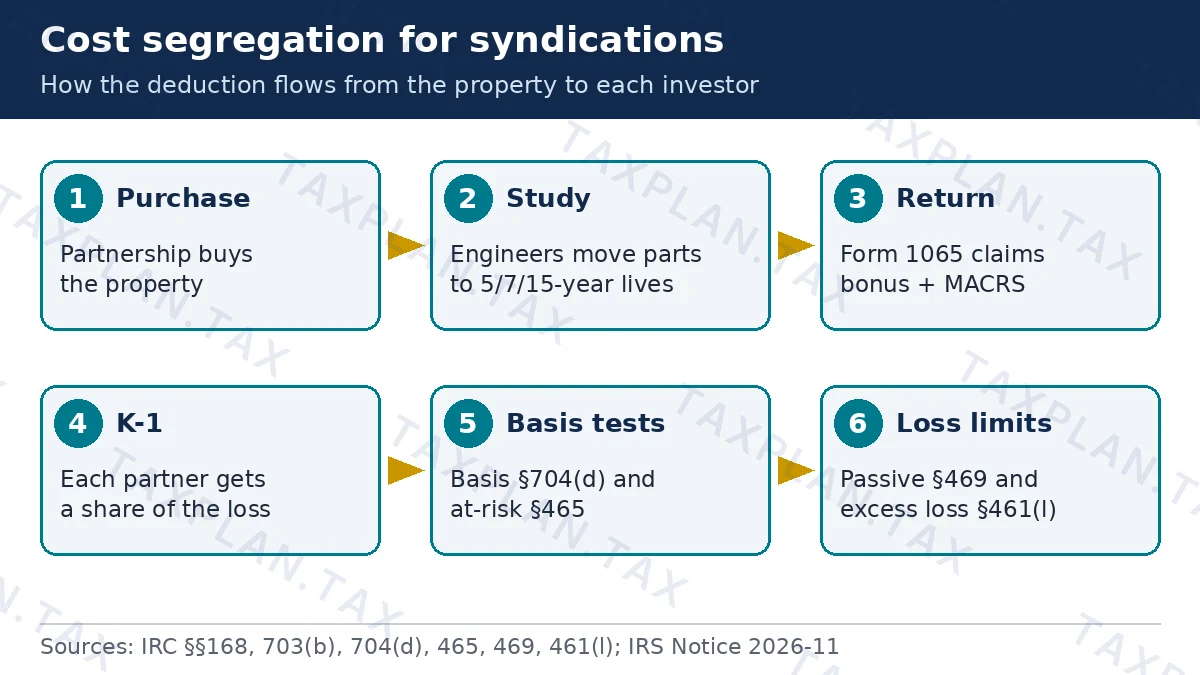

Cost segregation for syndications works the same way it does for a single owner, but the deductions land on investors through Schedule K-1. The partnership that owns the property orders the study, adopts the shorter recovery periods on its Form 1065, and then allocates the extra depreciation among the partners. Because the 2025 tax law made 100% bonus depreciation permanent for property acquired after January 19, 2025, the first-year deduction can be large. However, each investor still faces personal limits.
Specifically, basis, at-risk amounts, the passive activity rules, and the excess business loss cap all apply at the partner level. For most limited partners, moreover, the loss is passive. As a result, it usually offsets only passive income until the investor sells. Still, suspended losses carry forward and are not wasted. In short, cost segregation for syndications can add real value. That value, though, depends on the partnership agreement, the debt, each investor’s tax profile, and a sound engineering study.
Key Takeaways
- The partnership, not the investor, orders the study and makes the depreciation elections.
- Bonus depreciation is 100% for qualified property acquired after January 19, 2025.
- Then investors receive their share of depreciation on Schedule K-1, subject to basis, at-risk, and passive limits.
- However, limited partners usually cannot use the losses against wages or business income.
- Recapture on 5-, 7-, and 15-year property is ordinary income when the property or an interest is sold.
- Sponsors should model cost segregation results before investors commit capital.
Introduction and Background: How Does Cost Segregation for Syndications Differ?
Direct answer: The engineering is the same, but the tax results pass through a partnership to many investors.
First, a real estate syndication pools money from many investors to buy one property or a portfolio. Typically, a sponsor (the general partner or managing member) finds the deal and runs it. Meanwhile, passive investors contribute most of the equity as limited partners or LLC members. In general, the entity files as a partnership for federal tax purposes.
A cost segregation study allocates the building’s cost among recovery classes under IRC §168. Without one, a residential building is generally depreciated over 27.5 years and a nonresidential building over 39 years. With a study, however, qualifying components move into 5-, 7-, or 15-year classes. Also, the IRS describes the methods in its Cost Segregation Audit Techniques Guide (Publication 5653).
For a single owner, for example, the extra deduction goes straight to one return. In a syndication, by contrast, the partnership computes depreciation once. Then it allocates the results to partners under the operating agreement. Therefore, cost segregation for syndications raises questions that individual owners never face. For background on the basic study, see our guide on cost segregation for real estate investors.
How Does Cost Segregation for Syndications Work?
Direct answer: The partnership commissions the study, claims depreciation on its return, and passes each partner’s share through on Schedule K-1.
Step 1: Who orders cost segregation for syndications?
Under IRC §703(b), elections affecting the computation of partnership income are generally made by the partnership. So the sponsor, acting for the entity, decides whether to commission a study. Likewise, the partnership decides whether to elect out of bonus depreciation for any class. Ideally, the study starts soon after closing, while the purchase records are fresh.
Step 2: The study reclassifies components
Next, engineers identify personal property and land improvements inside the purchase price. For example, items include carpet, cabinets, dedicated electrical, paving, and landscaping. Indeed, courts have long allowed this split. In Hospital Corp. of America v. Commissioner, 109 T.C. 21, 55 (1997), the Tax Court held that the old investment tax credit tests apply in deciding what is tangible personal property under MACRS.
Step 3: Depreciation flows to the partners
Then the partnership reports total depreciation on Form 1065 and Form 4562. Next, each partner’s share appears on Schedule K-1, usually within net rental real estate income or loss. The operating agreement controls how the loss is shared, subject to the §704(b) substantial economic effect rules.
Step 4: Each investor applies personal limits
Finally, every investor tests the allocated loss against four separate limits. First comes basis under §704(d). Second is the at-risk rule in §465. Third are the §469 passive activity rules. Fourth, the excess business loss limit in §461(l) can apply. In other words, a loss only reduces taxes once it clears all four.
What Are the Benefits of Cost Segregation for Syndications?
Direct answer: Larger early deductions can shelter distributions, offset passive income, and improve after-tax returns.
- Sheltered cash distributions. Depreciation often makes taxable income lower than cash flow. Consequently, investors may receive distributions while reporting little or no taxable income.
- Passive income offsets. Investors with other passive income, such as gains from other rentals, can often use the loss right away.
- Carryforward value. Unused passive losses carry forward. Moreover, §469(g) generally frees them when the investor disposes of the entire interest in a fully taxable sale to an unrelated party.
- Debt adds basis. Also, under §752(a), an increase in a partner’s share of partnership liabilities counts as a contribution of money. This basis lets investors absorb losses larger than their cash.
- Better marketing data. In addition, sponsors who model the study early can give investors clearer projections.
The leverage point has deep roots. In Crane v. Commissioner, 331 U.S. 1, 11 (1947), the Supreme Court held that basis is the property’s value undiminished by mortgages. As a result, debt-financed buildings can support depreciation on their full cost. Meanwhile, the §465(b)(6) rule treats qualified nonrecourse financing secured by real property as an amount at risk.
Legal and Regulatory Considerations for Cost Segregation in Syndications
Direct answer: Bonus depreciation rules, partnership elections, passive loss limits, and recapture rules all shape the result.
Bonus depreciation after Public Law 119-21
Public Law 119-21, §70301, amended §168(k). IRS Notice 2026-11 explains that the law permanently allows 100% bonus depreciation for qualified property acquired after January 19, 2025. By contrast, property acquired before January 20, 2025, and placed in service in 2025 generally gets the old phase-down rate of 40%. Notice 2026-11 is interim guidance, and Treasury expects to issue proposed regulations.
Elections belong to the partnership
The election out of bonus depreciation applies to a whole class of property for the year, under §168(k)(7). In a syndication, however, the partnership makes that election, not each investor. So sponsors should survey investor needs before filing.
Limited partners and the passive rules
Section 469(h)(2) says that, except as regulations provide, a limited partner does not materially participate. Under Temp. Treas. Reg. §1.469-5T(e)(2), a limited partner can qualify only under tests 1, 5, or 6 of §1.469-5T(a). Test 1, for example, requires more than 500 hours. In addition, §469(i)(6) generally bars the $25,000 rental allowance for limited partners and for interests under 10%.
LLC members are not automatically “limited partners.” In Garnett v. Commissioner, 132 T.C. 368, 380-381 (2009), the Tax Court held that the taxpayers’ LLP and LLC interests fell within the general partner exception. Therefore, the general material participation tests applied to them. Even so, most passive investors in a syndication do not work enough hours to qualify.
The real estate professional rule in §469(c)(7) does not change this result. In fact, the statute states that it does not affect whether an interest held as a limited partner involves material participation. For a deeper look, see our article on cost segregation and passive activity losses.
Excess business loss limit
Even nonpassive losses face §461(l). For tax years beginning in 2026, Rev. Proc. 2025-32 sets the threshold at $256,000, or $512,000 on a joint return. Then amounts above that limit carry forward as a net operating loss.
Recapture and sales of interests
When the partnership sells the building, gain on 5-, 7-, and 15-year §1245 property is ordinary income to the extent of prior depreciation under §1245. Meanwhile, depreciation on the building itself is generally unrecaptured §1250 gain, taxed at a maximum 25% rate under §1(h). If an investor instead sells a partnership interest, §751 treats potential §1245 recapture as an unrealized receivable, which produces ordinary income.
Debt matters on exit, too. In Commissioner v. Tufts, 461 U.S. 300, 317 (1983), the Court held that a seller includes the outstanding nonrecourse debt in the amount realized. The property’s fair market value is irrelevant to that calculation. So investors who received large losses funded by debt can face large gains later.
Partnership audits
Finally, under §6221, adjustments to partnership-related items are generally determined at the partnership level. A weak study could therefore produce an adjustment that affects every investor. The IRS Cost Segregation Audit Techniques Guide describes what examiners review.
Practical Examples of Cost Segregation for Syndications
Direct answer: The examples below show how a study changes the partnership’s first-year deduction and one investor’s share.
Example 1: A 2026 apartment syndication (illustrative)
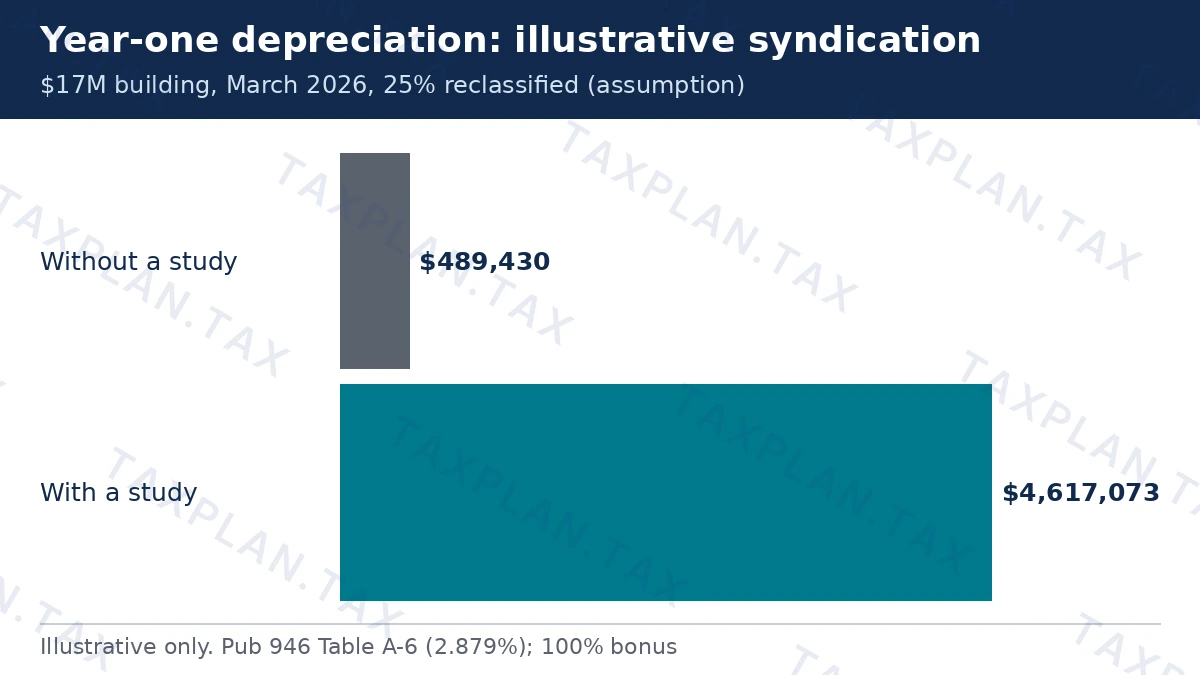
For this example, assume a partnership buys an apartment complex for $20,000,000 and places it in service in March 2026. It acquired the property after January 19, 2025. Assume $3,000,000 is land, leaving $17,000,000 of building basis. Also assume the study reclassifies 25% of the building, or $4,250,000, into 5-, 7-, and 15-year property. These are assumptions only; in practice, actual results depend on the property and the study.
Without a study, first-year depreciation uses the 27.5-year March rate of 2.879% from IRS Publication 946, Table A-6. With a study, the reclassified $4,250,000 qualifies for 100% bonus depreciation. The remaining $12,750,000 uses the same 2.879% rate.
| Item (illustrative) | Without study | With study |
|---|---|---|
| 27.5-year basis | $17,000,000 | $12,750,000 |
| Year-one 27.5-year depreciation (2.879%) | $489,430 | $367,073 |
| Bonus depreciation on reclassified property | $0 | $4,250,000 |
| Total year-one depreciation | $489,430 | $4,617,073 |
| Share for a 2% limited partner | $9,789 | $92,341 |
Example 2: Can the 2% investor use the loss?
Next, assume the investor contributed $200,000 cash. Also assume the partnership allocates $280,000 of qualified nonrecourse mortgage debt to the investor. Basis and at-risk amounts would then be roughly $480,000, so those limits do not bind. However, the investor is a limited partner with a W-2 job. Consequently, the $92,341 share is passive. If the investor has $30,000 of passive income from other rentals, the investor can deduct $30,000 this year. Meanwhile, the remaining $62,341 carries forward on Form 8582.
Example 3: Selling after five years (illustrative)
Suppose the partnership sells the property in year five. The bonus depreciation taken on reclassified property is generally recaptured as ordinary income, to the extent of gain allocated to those assets. At the same time, suspended passive losses generally become deductible in full. For many investors, the net result is a timing benefit rather than a permanent saving. See our guide to depreciation recapture strategies for planning ideas.
Common Mistakes and Risks in Syndication Cost Segregation
Direct answer: Most problems come from weak studies, poor communication, and ignoring partner-level limits.
- Promising losses investors cannot use. For example, marketing materials sometimes imply that every investor can offset wages. In reality, most limited partners cannot.
- Ignoring the operating agreement. Special allocations of depreciation must have substantial economic effect under §704(b). Otherwise, the IRS can reallocate them.
- Skipping the purchase price allocation. The contract, appraisal, and closing statement should support the land and building split.
- Using a rule-of-thumb study. Publication 5653 cautions examiners about studies that lack documentation.
- Forgetting state conformity. Some states do not follow federal bonus depreciation, so check each investor’s state rules.
- Overlooking exit taxes. Recapture and the Tufts rule can create large gains at sale, even with little cash.
- Missing the first return. If the partnership files without a study, it can often catch up later. For example, Rev. Proc. 2025-23 lists automatic accounting method changes, filed on Form 3115.
Frequently Asked Questions
Who pays for cost segregation in syndications?
Usually, the partnership pays the fee as an entity expense. Then the cost is shared indirectly by all partners. Therefore, the operating agreement and the offering documents control the details.
Can a limited partner use syndication losses against W-2 income?
Generally, no. Losses from a limited partnership interest are passive unless the partner meets test 1, 5, or 6 of §1.469-5T(a). Instead, they offset passive income or carry forward.
Does real estate professional status help a passive syndication investor?
Usually not. Section 469(c)(7) says it does not change the material participation analysis for limited partnership interests. In addition, the investor must still materially participate in the activity.
Do investors choose bonus depreciation in cost segregation for syndications?
No. Under §703(b), the partnership makes the election, and it covers the whole class of property. As a result, every partner shares the same depreciation method.
Is cost segregation for syndications worth it for small deals?
It depends on the building basis, the fee, the hold period, and investor tax profiles. Sponsors should compare the study fee with modeled after-tax benefits before engaging a firm. Our guide to bonus depreciation and cost segregation explains the math.
Do losses from cost segregation in syndications expire?
No. Suspended passive losses carry forward with no expiration date. Generally, when an investor disposes of the entire interest in a fully taxable sale to an unrelated party, §469(g) frees suspended losses from that activity. Therefore, they can offset the gain and other income in that year.
Does a new investor get bonus depreciation on a purchased interest?
Possibly. If the partnership has a §754 election, the buyer may receive a §743(b) basis adjustment. Treas. Reg. §1.168(k)-2(b)(3)(iv)(D) allows bonus depreciation on that adjustment when its requirements are met.
Conclusion: Is Cost Segregation for Syndications Right for Your Deal?
Cost segregation for syndications can turn a debt-financed building into large early deductions for investors. Even so, the benefit depends on who the investors are and how long the partnership holds the property. Sponsors should order a well-documented engineering study, model partner-level limits, and explain recapture before closing.
Alan Goldstein, EA, of Emunah Cost Segregation, works with sponsors, CPAs, and investors on study planning and partnership reporting. Contact Emunah Cost Segregation in Coral Gables, Florida, to request a feasibility review for your next acquisition.
Cases Cited
- Hospital Corp. of America v. Commissioner, 109 T.C. 21, 55 (1997) (United States Tax Court). Pinpoint verified against the reporter-paginated opinion text. Opinion
- Crane v. Commissioner, 331 U.S. 1, 11 (1947) (Supreme Court of the United States). Pinpoint verified against the reporter-paginated opinion text. Opinion
- Commissioner v. Tufts, 461 U.S. 300, 317 (1983) (Supreme Court of the United States). Pinpoint verified against the reporter-paginated opinion text. Opinion
- Garnett v. Commissioner, 132 T.C. 368, 380-381 (2009) (United States Tax Court). Pinpoint verified against the reporter-paginated opinion text. Opinion
Sources and Authorities
- 26 U.S.C. §168: https://www.law.cornell.edu/uscode/text/26/168
- 26 U.S.C. §469: https://www.law.cornell.edu/uscode/text/26/469
- 26 U.S.C. §465: https://www.law.cornell.edu/uscode/text/26/465
- 26 U.S.C. §703: https://www.law.cornell.edu/uscode/text/26/703
- 26 U.S.C. §704: https://www.law.cornell.edu/uscode/text/26/704
- 26 U.S.C. §751: https://www.law.cornell.edu/uscode/text/26/751
- 26 U.S.C. §752: https://www.law.cornell.edu/uscode/text/26/752
- 26 U.S.C. §1245: https://www.law.cornell.edu/uscode/text/26/1245
- 26 U.S.C. §6221: https://www.law.cornell.edu/uscode/text/26/6221
- Public Law 119-21 (H.R. 1, 119th Congress), §70301: https://www.congress.gov/bill/119th-congress/house-bill/1
- IRS Notice 2026-11: https://www.irs.gov/pub/irs-drop/n-26-11.pdf
- Rev. Proc. 2025-32, section 4.31: https://www.irs.gov/pub/irs-drop/rp-25-32.pdf
- Rev. Proc. 2025-23, section 6.01: https://www.irs.gov/pub/irs-drop/rp-25-23.pdf
- Temp. Treas. Reg. §1.469-5T: https://www.ecfr.gov/current/title-26/section-1.469-5T
- Treas. Reg. §1.168(k)-2: https://www.ecfr.gov/current/title-26/section-1.168(k)-2
- IRS Publication 946, How To Depreciate Property (2025), Table A-6: https://www.irs.gov/pub/irs-pdf/p946.pdf
- IRS Publication 5653, Cost Segregation Audit Techniques Guide: https://www.irs.gov/pub/irs-pdf/p5653.pdf
- Instructions for Form 1065: https://www.irs.gov/instructions/i1065
- Instructions for Form 8582: https://www.irs.gov/instructions/i8582
- About Form 3115: https://www.irs.gov/forms-pubs/about-form-3115
- Court opinions: see Cases Cited above.
This article is provided for general educational purposes and does not constitute individualized tax, legal, or accounting advice. Tax consequences depend on the taxpayer’s specific facts and applicable law.
