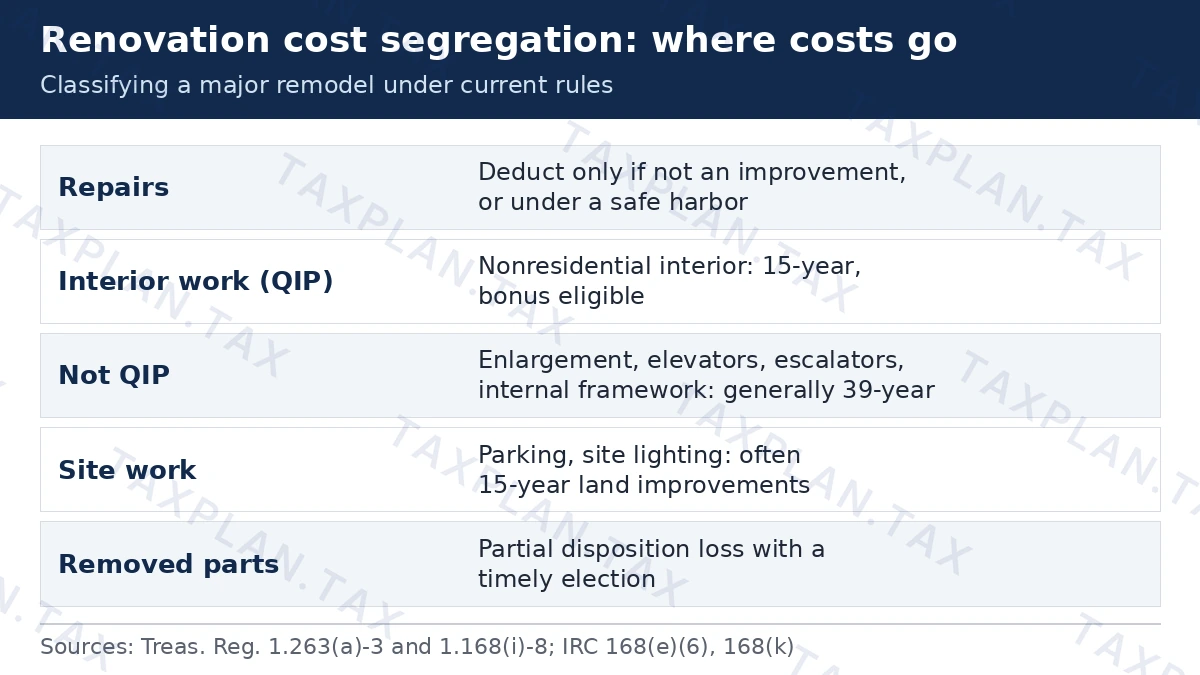

Renovation cost segregation sorts the cost of a major renovation into its proper tax classes, such as 15-year qualified improvement property, land improvements, personal property, and building improvements, and it identifies the old components you removed. That matters because many interior improvements to commercial buildings are 15-year property eligible for bonus depreciation. Meanwhile, the remaining basis of a removed roof or system may be deductible through a partial disposition election.
Without a study, owners often put the entire project on a 39-year schedule and keep depreciating parts that no longer exist. Instead, the rules in Treas. Reg. §1.263(a)-3 decide what you must capitalize. Then IRC §168 decides how fast you recover it. Finally, Treas. Reg. §1.168(i)-8 governs the write-off of what you tore out. This guide walks through each step, the current bonus rules, and a worked example.
Key Takeaways
- First decide what is a deductible repair and what is a capital improvement under the repair regulations.
- Interior improvements to nonresidential buildings are often qualified improvement property (QIP), which is 15-year property.
- QIP excludes enlargements, elevators and escalators, and the internal structural framework.
- A partial disposition election can let you deduct the remaining basis of removed components.
- That election is generally due with your timely filed original return, including extensions.
- Qualified renovation property acquired after January 19, 2025, can qualify for 100% bonus.
Introduction and Background: What Is Renovation Cost Segregation?
Direct answer: It is a cost segregation study applied to the costs of a renovation, rather than to a whole building purchase.
In short, a major renovation creates new assets and retires old ones. For example, a remodel may add new lighting, finishes, and HVAC ductwork, while removing an old roof or storefront. Naturally, each new item belongs in a recovery class. In addition, each removed item may still carry undepreciated basis on your books.
Ideally, a renovation cost segregation study handles both sides. On one side, it classifies the new spending. On the other side, it estimates the basis of retired components. For background on what can move to shorter lives, see What Assets Can Be Reclassified in a Cost Segregation Study?
How Does Renovation Cost Segregation Work?
Direct answer: It follows four steps: test repairs versus improvements, classify the improvements, value the removed parts, and report each result correctly.
Step 1: Separate repairs from improvements
Under Treas. Reg. §1.263(a)-3, you must capitalize amounts that improve a unit of property. Specifically, an improvement is a betterment, a restoration, or an adaptation to a new or different use. For a building, you apply these tests separately to the building structure and to each building system. In fact, the regulation lists nine systems, including HVAC, plumbing, electrical, elevators, escalators, fire protection, security, and gas distribution.
Step 2: Classify the capital improvements
Next, the study sorts capital costs into classes. For instance, interior work on a commercial building may be QIP. Similarly, new parking areas or site lighting may be 15-year land improvements. Also, some items may be 5- or 7-year personal property. Finally, roof, structural, and elevator work generally stays with the 39-year building.
Step 3: Identify and value removed components
Then the study lists what the project removed, such as a roof, windows, or an old HVAC system. Because older records rarely show component costs, the regulations allow a reasonable method. Examples include discounting the replacement cost with a Producer Price Index, a pro rata allocation, or a study allocating cost to components.
Step 4: Report the results
Finally, you report new assets on Form 4562 and any partial disposition loss on the return for the year of disposition. If a prior renovation was never studied, you may be able to catch up through Form 3115. See Look-Back Cost Segregation Studies for that path.
Benefits and Opportunities of Renovation Cost Segregation
Direct answer: The study can shorten recovery periods, unlock bonus depreciation, and remove dead basis from your books.
- 15-year QIP: qualifying interior improvements recover over 15 years instead of 39.
- 100% bonus: QIP, land improvements, and personal property have recovery periods of 20 years or less, so they can qualify.
- Partial disposition losses: the remaining basis of removed components can become a current deduction.
- Cleaner fixed asset records: you stop depreciating assets that no longer exist.
- Better repair decisions: the safe harbors may let you deduct some smaller projects outright.
For a deeper look at QIP, read Qualified Improvement Property (QIP) and Cost Segregation. In addition, see Bonus Depreciation and Cost Segregation for how bonus applies.
Legal and Regulatory Considerations for Renovation Cost Segregation
Direct answer: The repair regulations, the QIP definition, the bonus rules, and the disposition rules each play a role.
Repairs versus improvements
The repair regulations replaced much older case law, but the cases still explain the idea. In Midland Empire Packing Co. v. Commissioner, 14 T.C. 635 (1950), the Tax Court described a repair as keeping property in an ordinarily efficient operating condition. Accordingly, it held that lining a basement against oil seepage was a deductible repair. Later, in Plainfield-Union Water Co. v. Commissioner, 39 T.C. 333 (1962), the court compared the asset’s condition with its status before the condition that made the work necessary.
Also, in INDOPCO, Inc. v. Commissioner, 503 U.S. 79 (1992), the Supreme Court noted that capital expenditures are generally recovered over time, and deductions are the exception. Therefore, the taxpayer bears the burden of showing a cost is deductible.
Safe harbors that may help
In addition, the regulations include a small taxpayer safe harbor. It applies to a qualifying taxpayer with average annual gross receipts of $10 million or less and a building with an unadjusted basis of $1 million or less. If the year’s total repairs and improvements on that building do not exceed the lesser of 2% of its unadjusted basis or $10,000, you may elect not to capitalize them. Separately, a routine maintenance safe harbor covers recurring work you reasonably expect to perform more than once in 10 years.
Qualified improvement property
Under IRC §168(e)(6), QIP is an improvement to an interior portion of a nonresidential building placed in service after the building was first placed in service. However, it excludes costs for enlargements, elevators or escalators, and the internal structural framework. As a result, QIP is 15-year property under §168(e)(3)(E)(vii). However, QIP does not apply to residential rental buildings. Even so, Publication 946 lists appliances, carpets, and furniture used in residential rentals as 5-year property.
Bonus depreciation after Public Law 119-21
Under §168(k) as amended by Public Law 119-21, qualified property acquired after January 19, 2025, can receive a permanent 100% first-year deduction. Notice 2026-11 applies the self-constructed property rules to work built under a contract. So the start of physical work, or a binding contract date, can decide eligibility. You may also elect out of bonus by class.
Partial dispositions
Under Treas. Reg. §1.168(i)-8(d), you may elect to treat the retirement of a portion of an asset as a disposition. Generally, you make the election by reporting the loss on your timely filed original return, including extensions, for the year of disposition. However, if you claim the loss, the replacement is a restoration that you must capitalize under §1.263(a)-3(k). In most major renovations, you capitalize the replacement anyway, so the loss is usually a net benefit.
Classification law
Finally, classifying the new components follows the same law as any study. In Hospital Corp. of America v. Commissioner, 109 T.C. 21 (1997), the Tax Court applied the former investment tax credit tests to separate personal property from structural components under ACRS and MACRS.
Practical Examples of Renovation Cost Segregation
Direct answer: The example below shows how classes and a partial disposition change the first-year deduction. All figures are illustrative assumptions.
Example 1: A $750,000 office renovation
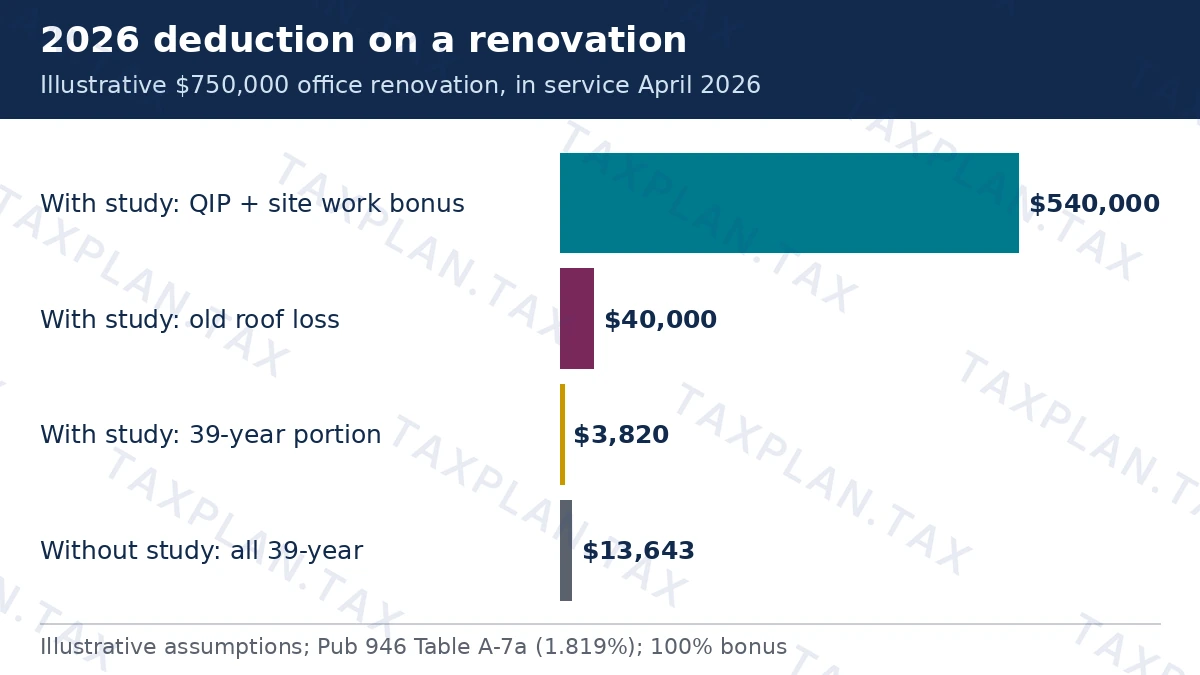
Assume an owner renovates an office building it placed in service in 2016. The contractor signed the contract in 2025, after January 19, and work began after that date. The renovation goes into service in April 2026. Assume the study supports $480,000 of QIP and $60,000 of new parking lot work. Next, assume $120,000 for a new roof and $90,000 for elevator upgrades stay 39-year property. Also assume the old roof had $40,000 of remaining basis.
| Item (illustrative) | With study | Without study |
|---|---|---|
| QIP, 15-year (100% bonus) | $480,000 | $0 |
| Parking lot, 15-year (100% bonus) | $60,000 | $0 |
| Roof and elevator, 39-year (1.819%, April) | $3,820 | $13,643 (all $750,000) |
| Partial disposition loss, old roof | $40,000 | $0 |
| Total 2026 deduction | $583,820 | $13,643 |
| Federal tax deferral at 37% | $210,965 (difference of $570,177 × 37%) | |
Example 2: A small project under the safe harbor
Now consider a qualifying small taxpayer that owns a building with a $600,000 unadjusted basis. The lesser of 2% of basis or $10,000 is $10,000, since 2% is $12,000. So if the year’s total repairs and improvements on that building are $9,500, the owner may elect the safe harbor and deduct them. In this case, a full study would not be needed for that work.
Example 3: A residential rental remodel
By contrast, an apartment owner who remodels units cannot use QIP. Still, new appliances and carpet can be 5-year property, and new site work can be 15-year property. Meanwhile, the remaining construction costs follow the 27.5-year building.
Common Mistakes and Risks in Renovation Cost Segregation
Direct answer: Most errors involve missed elections, wrong classes, or weak support.
- Booking everything as 39-year: this misses QIP, land improvements, and personal property.
- Missing the partial disposition deadline: the election generally rides on the timely filed original return.
- Calling structural work QIP: enlargements, elevators, escalators, and internal framework do not qualify.
- Applying QIP to apartments: QIP covers nonresidential buildings only.
- Deducting improvements as repairs: betterments, restorations, and adaptations must be capitalized.
- Ignoring contract dates: bonus eligibility may depend on when work or the contract began.
- Guessing at removed basis: use and document a reasonable method.
Frequently Asked Questions
Is renovation cost segregation worth it for a small remodel?
Sometimes not. If the project fits a repair safe harbor, you may deduct it without a study. Larger projects, however, usually benefit from a renovation cost segregation study.
What is qualified improvement property?
It is an improvement to the interior of a nonresidential building, placed in service after the building itself. It is 15-year property, but it excludes enlargements, elevators, escalators, and internal structural framework.
Can I deduct the basis of the old roof I replaced?
Often, yes. A partial disposition election lets you recognize a loss on the remaining basis of the removed roof. You generally make it on the timely filed original return for the year of disposition.
Does 100% bonus depreciation apply to renovations?
Yes, for qualified property with a recovery period of 20 years or less, such as QIP. For work done under a contract, the acquisition date rules in Notice 2026-11 apply. However, the 39-year portions do not qualify.
Does renovation cost segregation apply to apartment buildings?
Yes, but QIP does not. Instead, the study looks for 5-year personal property, 15-year land improvements, and removed components.
What if I renovated years ago without a study?
You may be able to correct the classes through a change in accounting method on Form 3115. However, partial disposition elections are generally tied to the year of disposition, with limited exceptions.
Is a renovation cost segregation study different from a full building study?
Yes. A renovation cost segregation study covers only the project costs and the removed components. In contrast, a full study covers the entire building basis.
Conclusion: Make Renovation Cost Segregation Part of the Project
Overall, a major renovation is a good time to review your depreciation. With the right study, interior work may become 15-year QIP, site work may become 15-year property, and removed components may produce a current loss. Moreover, 100% bonus can apply to qualified property acquired after January 19, 2025. Still, the repair rules, the QIP limits, and the election deadline all require care.
Emunah Cost Segregation helps owners and CPAs review renovation budgets before and after construction. Alan Goldstein, MBA, EA, can help you classify the work and document removed components. Contact Emunah Cost Segregation in Coral Gables, Florida, to request a feasibility review.
Cases Cited
- Midland Empire Packing Co. v. Commissioner, 14 T.C. 635, 640, 642-643 (1950) (Tax Court of the United States). Pinpoints verified against the reporter-paginated opinion text. Opinion
- Plainfield-Union Water Co. v. Commissioner, 39 T.C. 333, 338 (1962) (Tax Court of the United States). Pinpoint verified against the reporter-paginated opinion text. Opinion
- INDOPCO, Inc. v. Commissioner, 503 U.S. 79, 83-84 (1992) (Supreme Court of the United States). Pinpoint verified against the reporter-paginated opinion text. Opinion
- Hospital Corp. of America v. Commissioner, 109 T.C. 21, 50-52, 54-55 (1997) (United States Tax Court). Pinpoints verified against the reporter-paginated opinion text. Opinion
Sources and Authorities
- Treas. Reg. §1.263(a)-3, paragraphs (d), (e), (h), (i), (j), (k), and (l): https://www.ecfr.gov/current/title-26/section-1.263(a)-3
- Treas. Reg. §1.168(i)-8, paragraphs (d) and (f): https://www.ecfr.gov/current/title-26/section-1.168(i)-8
- 26 U.S.C. §168, including §168(e)(6) and §168(k): https://www.law.cornell.edu/uscode/text/26/168
- Public Law 119-21 (H.R. 1, 119th Congress), §70301: https://www.congress.gov/bill/119th-congress/house-bill/1
- IRS Notice 2026-11: https://www.irs.gov/pub/irs-drop/n-26-11.pdf
- IRS Publication 946 (2025), How To Depreciate Property, Table A-7a: https://www.irs.gov/pub/irs-pdf/p946.pdf
- Instructions for Form 4562: https://www.irs.gov/instructions/i4562
- About Form 3115: https://www.irs.gov/forms-pubs/about-form-3115
- Court opinions: see Cases Cited above.
This article is provided for general educational purposes and does not constitute individualized tax, legal, or accounting advice. Tax consequences depend on the taxpayer’s specific facts and applicable law.
