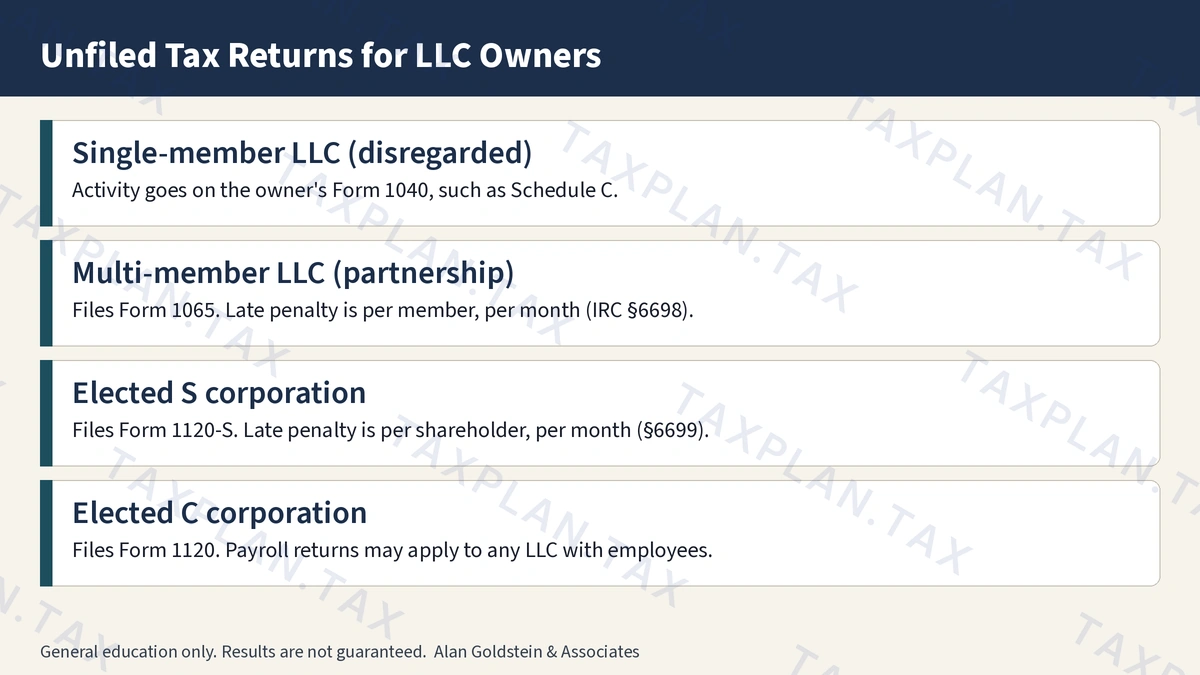

Unfiled tax returns for LLC owners depend on how the IRS classifies the LLC. A limited liability company is a state-law entity, not a federal tax category. For federal tax purposes, the IRS treats an LLC as a disregarded entity, a partnership, or a corporation. Each treatment comes with different returns, deadlines, and penalties. This article explains which returns a single-member or multi-member LLC may have missed, and how to sort them out.
Key Takeaways
- The IRS treats an LLC as a disregarded entity, a partnership, or a corporation, based on its members and elections.
- A single-member LLC usually has no separate federal income tax return. Its activity goes on the owner’s return.
- A multi-member LLC is generally a partnership and must file Form 1065, even in a loss year.
- An LLC that elected corporate or S corporation status must file Form 1120 or Form 1120-S.
- For employment and certain excise taxes, the IRS treats a single-member LLC as a separate entity.
How does the IRS classify an LLC for tax purposes?
It depends on the number of members and any election the LLC made. The IRS says a domestic LLC with at least two members is a partnership unless it elects to be treated as a corporation. An LLC with one member is disregarded as separate from its owner unless it elects corporate treatment (IRS: Limited liability company).
These default rules come from the entity classification regulations at Treas. Reg. §301.7701-3. An LLC changes its default status with Form 8832. An eligible entity elects S corporation status with Form 2553.
What is a disregarded entity?
A disregarded entity is a business entity that the IRS ignores for federal income tax purposes. Its income and expenses are reported as if the owner earned them directly. Most single-member LLCs that make no election fall into this category.
Which returns might be unfiled for a single-member LLC?
Usually the owner’s Form 1040, plus any payroll or excise returns. The LLC itself generally does not file a separate federal income tax return.
The IRS says that if the owner is an individual, the LLC’s activities are generally reported on the owner’s Form 1040 using Schedule C, Schedule E, or Schedule F (IRS: Single member limited liability companies). So an unfiled single-member LLC year is, for income tax, an unfiled personal return.
That has practical results. The owner’s filing requirement, self-employment tax, and personal penalties all apply. The IRS says you must file if your net earnings from self-employment were $400 or more (IRS: Self-employed individuals tax center).
Does a single-member LLC have its own payroll returns?
Yes, if it has employees. The IRS says a single-member LLC is still a separate entity for employment tax and certain excise taxes. It must use its own EIN for those requirements. The rule appears in Treas. Reg. §301.7701-2(c)(2)(iv). Therefore, an LLC with workers may have unfiled Forms 941 and 940 under the LLC’s EIN, separate from the owner’s Form 1040.
Which returns might be unfiled for a multi-member LLC?
A multi-member LLC taxed as a partnership must file Form 1065 and issue a Schedule K-1 to each member. The members then report their shares on their own returns.
The IRS says an LLC classified as a partnership should file Form 1065, and each owner shows a pro-rata share on Schedule K-1 (IRS: LLC filing as a corporation or partnership). It adds that members generally pay self-employment tax on their share of partnership earnings.
What is the penalty for a late partnership return?
It is a monthly penalty multiplied by the number of members. Under IRC §6698, the penalty applies for each month or part of a month the return is late, up to 12 months. The statute sets a $195 base amount per partner per month, adjusted each year for inflation. Additionally, for 2025 returns due in 2026, the amount is $255 per partner per month (2025 Form 1065 instructions).
The penalty does not depend on tax due. A partnership does not pay income tax itself, so even a loss-year Form 1065 can generate a penalty. For example, a two-member LLC that files many months late may face a penalty for each member for up to 12 months. Relief may be available for reasonable cause.
What if the LLC elected to be taxed as a corporation?
Then it must file a corporate return each year. An LLC taxed as a C corporation files Form 1120, and one taxed as an S corporation files Form 1120-S.
- S corporation election. The LLC files Form 1120-S and issues Schedules K-1. Under IRC §6699, a late return faces a per-shareholder, per-month penalty, up to 12 months. For 2025 returns due in 2026, that amount is also $255 per shareholder per month (2025 Form 1120-S instructions).
- C corporation election. The LLC files Form 1120. The failure-to-file penalty under IRC §6651 applies to unpaid tax. For returns due after December 31, 2025, the IRS lists a minimum of $525 or 100% of the unpaid tax, whichever is less, for Form 1120 returns more than 60 days late (IRS: Failure to file penalty).
Owners sometimes forget an old election. If an LLC elected S status years ago, it may owe Forms 1120-S for every year since, even if the owners filed Schedule C. In that case, review the election records before filing anything. The IRS notes that an LLC may be eligible for late election relief in certain circumstances.
How should you resolve unfiled tax returns for LLC owners?
Confirm the classification first, then file entity returns before personal returns. The classification controls every later step.
- Confirm the classification. First, check for any Form 8832 or Form 2553 and any IRS acceptance letters. Count the members for each year.
- List required returns by year. Next, list income tax, payroll, and information returns for each open year.
- File entity returns. Then file Forms 1065, 1120-S, or 1120 so owners receive their K-1s.
- File owner returns. After that, file each owner’s Form 1040 using the entity figures or the Schedule C results.
- Address balances and penalties. Finally, review payment options and reasonable-cause relief.
For the individual filing steps, see our guide to filing past-due federal tax returns. If the LLC has employees, our page on employment and payroll tax issues covers related risks.
Does an LLC protect the owner from IRS collection?
Not always, and owners often assume more protection than federal tax law gives. For a disregarded single-member LLC, income tax is the owner’s own liability, because the income is reported on the owner’s return. In addition, the Trust Fund Recovery Penalty under IRC §6672 can reach responsible persons for unpaid payroll trust fund taxes. Liability limits under state law do not change these federal rules.
Frequently Asked Questions
Does a single-member LLC file its own federal income tax return?
Generally, no, unless it elected corporate treatment. Its activity goes on the owner’s return, such as Schedule C of Form 1040.
Do I need to file Form 1065 if my two-member LLC had no income?
Generally, yes. A multi-member LLC taxed as a partnership must file, and the §6698 penalty is based on members, not on tax due.
Can my LLC change its tax classification to fix the problem?
An election generally applies going forward, with limited look-back. The IRS says Form 8832 elections cannot take effect more than 75 days before filing. Late relief may be available in some cases.
Does my single-member LLC need its own EIN?
It does if it has employees or certain excise tax requirements. Otherwise, the IRS says a disregarded LLC without employees or excise tax liability generally uses the owner’s taxpayer number.
Who pays the partnership late-filing penalty?
The partnership. Under §6698(c), the IRS assesses the penalty against the partnership itself.
Will the IRS accept late S corporation returns?
The IRS generally accepts late returns, but penalties may apply. Filing promptly limits how many months the penalty runs, up to its 12-month cap.
Can penalties on LLC returns be removed?
Possibly. Many penalties do not apply when you show reasonable cause. The IRS decides each request on its facts.
Conclusion
Unfiled tax returns for LLC owners start with one question: how does the IRS classify the LLC? A single-member LLC usually means an unfiled Form 1040, plus any payroll returns. A multi-member LLC usually means Form 1065 and its per-member penalty. An elected corporation means Form 1120 or Form 1120-S. Confirming the classification first helps prevent filing the wrong returns.
Alan Goldstein, MBA, IRS Enrolled Agent, of Alan Goldstein & Associates in Coral Gables, Florida, helps LLC owners confirm their filing obligations and catch up on missing returns. We can also review penalty relief and payment options. Every case depends on its facts, and we cannot guarantee any outcome. To request a confidential review, visit our Tax Resolution Services page.
Sources and Authorities
- IRS: Limited liability company (LLC)
- Treas. Reg. §301.7701-3, Classification of certain business entities
- IRS: About Form 8832, Entity Classification Election
- IRS: About Form 2553, Election by a Small Business Corporation
- IRS: Single member limited liability companies
- IRS: Self-employed individuals tax center
- Treas. Reg. §301.7701-2, Business entities; definitions
- IRS: About Form 1065
- IRS: LLC filing as a corporation or partnership
- IRC §6698, Failure to file partnership return
- IRS: Instructions for Form 1065 (2025), Late Filing of Return
- IRS: About Form 1120-S
- IRC §6699, Failure to file S corporation return
- IRS: Instructions for Form 1120-S (2025), Late filing of return
- IRS: About Form 1120
- IRC §6651, Failure to file tax return or to pay tax
- IRS: Failure to file penalty
- IRC §6672, Failure to collect and pay over tax
This article is provided for general educational purposes and does not constitute individualized tax, legal, or accounting advice. Tax consequences depend on the taxpayer’s specific facts and applicable law.
