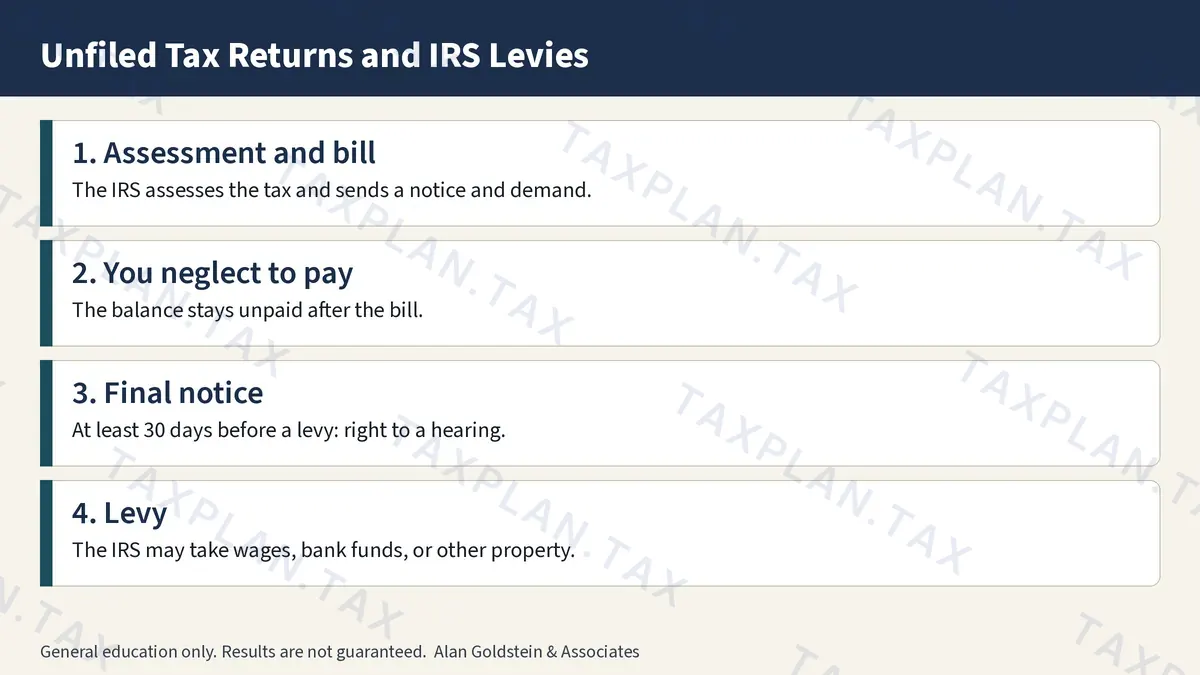

Unfiled tax returns do not trigger an IRS levy by themselves. A levy generally requires an assessed balance, a bill, and a final notice. However, a substitute return can create that balance. This article explains unfiled tax returns and IRS levies, the notices that come first, what a levy can take, and how you may stop or release one.
Key Takeaways
- A levy is the legal seizure of property to pay a tax debt. A lien only secures the claim.
- The IRS usually levies only after it assesses tax, sends a bill, and you neglect to pay.
- The IRS must send a Final Notice of Intent to Levy at least 30 days before the first levy.
- A substitute for return (SFR) can create the balance that leads to a levy.
- A pending payment plan request or offer in compromise generally pauses levy.
- A levy that causes economic hardship may be released.
What is an IRS levy?
An IRS levy is a legal seizure of your property to satisfy a tax debt. The IRS says a levy can garnish wages, take money from bank accounts, and seize and sell vehicles, real estate, and other property (IRS: Levy).
How is a levy different from a lien?
A lien is a legal claim against property. A levy actually takes the property. The IRS draws this line clearly, and the two often appear in the same collection case (IRS: What is a levy?).
For lien rules, see our overview of federal tax liens. This section is only a short comparison.
What law lets the IRS levy?
IRC §6331 authorizes levies to collect delinquent tax. The IRS says any property or right to property that belongs to you can be levied unless the Code exempts it. IRC §6334 lists the exempt property.
How are unfiled tax returns and IRS levies connected?
They connect only indirectly. Unfiled returns do not create an assessed balance. A substitute return, or a return you file with a balance due, can.
How does an SFR create a levy risk?
If you do not file, the IRS may prepare a substitute return under IRC §6020(b). The IRS then sends a notice of deficiency, CP3219N, with a 90-day window to file your own return or petition the Tax Court. If you do neither, the IRS can assess the proposed tax (IRS: Filing past due tax returns).
The IRS says an unpaid balance from that return will trigger the collection process. This can include a levy on wages or a bank account. Our article on IRS substitute for return risks explains the earlier steps.
What must the IRS do before it levies?
The IRS says it usually levies only after four steps. It must assess the tax and send a notice and demand. You must neglect or refuse to pay. It must send a Final Notice of Intent to Levy and Notice of Your Right to a Hearing at least 30 days before the levy. It must also send advance notice of third-party contacts (IRS: What is a levy?).
One exception applies to state tax refunds. The IRS says you may receive the hearing notice after that levy.
Which IRS notices come before a levy?
Several balance-due notices usually come first. The two that matter most before a levy are the CP504 and the final notice, which the IRS sends as the LT11 or Letter 1058.
What is a CP504 notice?
A CP504 is the Notice of Intent to Levy under IRC §6331(d). The IRS says that if you do not pay immediately, it can levy your income and bank accounts and seize property, including your state income tax refund. The notice asks you to pay, set up a payment plan, or contact the IRS if you disagree.
What is an LT11 or Letter 1058?
The LT11 and Letter 1058 are versions of the Final Notice of Intent to Levy and Notice of Your Right to a Hearing. The IRS says to contact it right away if you receive one. The notice also explains how to request a collection due process (CDP) hearing (IRS: Understanding your LT11 or Letter 1058).
You may request that hearing on Form 12153. Follow the deadline printed in your notice, because it controls.
What can the IRS take with a levy?
The IRS can levy a wide range of property. The levy type determines how fast the money moves and what protections apply.
How does a wage levy work?
A wage levy is continuous. The IRS says part of your wages goes to the IRS each pay period until you make other arrangements, you pay the debt, or the IRS releases the levy. Part of your wages is exempt, based on your standard deduction and the number of dependents you can claim. Publication 1494 helps your employer compute that amount (IRS: Information about wage levies).
How does a bank levy work?
A bank levy freezes the funds in your account at the time the bank receives it. The Code gives you a 21-day waiting period before the bank sends the money (IRC §6332(c)). The IRS says the delay gives you time to contact it and arrange payment or report an error.
The IRS also says a bank levy normally does not affect funds you deposit after the levy date. If the IRS levied by mistake, you may seek reimbursement of bank fees on Form 8546 if you meet the conditions.
What other property can the IRS levy?
The IRS lists wages, bank accounts, business assets, cars, homes, Alaska Permanent Fund Dividends, state tax refunds, and Social Security benefits (IRS: LT11 or Letter 1058). Certain federal payments may also face levy through the Federal Payment Levy Program (IRS: Enforced collection actions).
How can you stop or release an IRS levy?
You may be able to stop a levy by resolving the debt, requesting a payment plan or offer, asking for a hardship release, or using your hearing rights. Each path has conditions.
Does a payment plan or offer in compromise pause a levy?
Generally, yes while the request is pending or the agreement is in effect. IRC §6331(k) bars levy during a pending installment request, an agreement in effect, and a pending offer, with a 30-day tail after a rejection or termination. However, the IRS needs filing compliance before it treats a payment plan request as pending (IRM 5.14.1).
Because unfiled returns can block this protection, filing comes first. See how to file past-due federal tax returns.
Can you get a levy released for hardship?
Possibly. The IRS says a wage levy that creates an immediate economic hardship must be released. A bank or other account levy causing hardship may be released. Economic hardship means the levy prevents you from meeting basic, reasonable living expenses (IRS: What if a levy is causing a hardship?).
The statutory release rule is IRC §6343(a)(1)(D). A release does not erase the balance.
Can you challenge the tax in a CDP hearing?
Sometimes. Under IRC §6330(c)(2), you may challenge the underlying tax at the hearing if you did not receive a notice of deficiency or otherwise have a chance to dispute it. That can matter after an SFR. You can also offer collection alternatives, such as an installment agreement.
Publication 1660 explains collection appeal rights in more detail.
What does a levy cost if you wait?
Waiting adds cost. Interest on underpayments is 7% per year, compounded daily, for the quarter that began October 1, 2026 (IRS: Quarterly interest rates). Rates reset each quarter.
The failure-to-pay penalty also rises to 1% per month if you do not pay within 10 days after a notice of intent to levy (IRS: Failure to pay penalty). For broader collection options, see our article on IRS levies and wage garnishments.
Frequently Asked Questions
Can the IRS levy me if I never filed a return?
Only after it assesses tax and sends the required notices. An SFR assessment can meet that first step.
How much notice does the IRS give before a levy?
The IRS usually sends a Final Notice of Intent to Levy at least 30 days before the first levy. State refund levies are an exception for the hearing notice.
Can the IRS take my entire paycheck?
No. Part of your wages is exempt, based on your standard deduction and dependents. The rest may go to the IRS each pay period.
How long does a bank have before sending levied funds?
Under the Code, a bank surrenders deposits only after 21 days from service of the levy.
Does filing my overdue returns stop a levy?
Not by itself. Filing helps you qualify for payment options. If you then request a payment plan, the pending-request levy bar may apply.
Can I ask the IRS to release a levy for hardship?
Yes. Call the number on the levy and explain your situation. Expect to provide financial information.
Does a levy release cancel what I owe?
No. A release stops that levy. You still owe the balance, and interest and penalties may continue.
Should I get professional help with a levy notice?
Many people do, because deadlines are short. A representative can review your account and communicate with the IRS for you.
Conclusion
An IRS levy follows an assessed balance, not just a missing return. Even so, a substitute return can start that chain. Filing your returns, reading each notice, and meeting the hearing deadline give you more options. No approach guarantees that a levy will stop or be released.
If you have unfiled returns or an IRS levy notice, contact Alan Goldstein, MBA, IRS Enrolled Agent, at Alan Goldstein & Associates in Coral Gables, Florida. We offer a confidential review of your unfiled returns and IRS collection and resolution options. We do not guarantee outcomes, because every case depends on its facts.
Sources
- IRS: Levy
- IRS: What is a levy?
- IRS: Filing past due tax returns
- IRS: Understanding your CP504 notice
- IRS: Understanding your LT11 notice or Letter 1058
- IRS: Information about wage levies
- IRS Publication 1494, Table for Figuring Amount Exempt From Levy on Wages, Salary, and Other Income
- IRS Form 8546, Claim for Reimbursement of Bank Charges
- IRS: Enforced collection actions
- IRS: What if a levy is causing a hardship?
- IRM 5.14.1, Securing Installment Agreements (Payment Plans)
- IRS Form 12153, Request for a Collection Due Process or Equivalent Hearing
- IRS Publication 1660, Collection Appeal Rights
- IRS: Quarterly interest rates
- IRS: Failure to pay penalty
- 26 U.S.C. §6020
- 26 U.S.C. §6330
- 26 U.S.C. §6331
- 26 U.S.C. §6332
- 26 U.S.C. §6334
- 26 U.S.C. §6343
This article is provided for general educational purposes and does not constitute individualized tax, legal, or accounting advice. Tax consequences depend on the taxpayer’s specific facts and applicable law.
