
To prepare for a cost segregation audit, gather the study and the records behind it, reconcile them to your return, and be ready to explain every short-life asset. The IRS reviews these studies with Publication 5653, the Cost Segregation Audit Techniques Guide. Specifically, that guide tells examiners to start with a risk analysis. Then they request documents, interview the preparer, and often inspect the property. So your preparation should mirror those steps. First, pull the full report, workpapers, engagement letter, purchase or construction documents, and depreciation schedules. Next, confirm that the study’s totals tie to your fixed asset ledger and tax return. In addition, check any written purchase price allocation, because it can bind you under IRC §1060.
Finally, plan for penalties. A 20% accuracy-related penalty can apply under §6662, but reasonable cause and good faith can be a defense under §6664(c). Overall, a well-documented study built to the guide’s standards is usually the strongest position you can have.
Key Takeaways
- Examiners follow the 16 suggested steps in Chapter 5 of IRS Publication 5653.
- The guide includes seven sample document requests, so you can assemble those records before the IRS asks.
- Your study must reconcile to your depreciation schedules and to total actual or purchase cost.
- A written §1060 purchase price allocation can override a later study.
- Reasonable reliance on a competent, fully informed adviser can defend against the 20% penalty.
- If you disagree with the result, you generally have appeal rights and, later, Tax Court rights.
Why Does the IRS Audit Cost Segregation Studies?
Direct answer: The IRS audits studies because they move cost into short recovery periods, and the guide says studies vary widely in quality.
In short, a study splits a building’s cost into classes under IRC §168. For example, a commercial building is 39-year property, while many interior items are 5- or 7-year property. As a result, a study can produce large early deductions, especially with bonus depreciation. Of course, that is legitimate when the facts support it. However, the guide notes that studies differ widely in method, documentation, and preparer expertise. It also says the IRS has not set standards for preparing them. So examiners look closely at how each study was built.
For context on what a cost segregation audit typically targets, see our article on documentation that helps avoid IRS challenges to cost segregation studies.
How Does a Cost Segregation Audit Work?
Direct answer: Chapter 5 of the guide lays out 16 suggested steps in three stages: risk analysis, examination, and other considerations.
Stage 1: risk analysis
First, the examiner reads your study report. Next, the examiner reconciles its cost basis to your depreciation schedules and return. Then the examiner decides whether the issue is worth pursuing. Along the way, the guide lists warning signs. For instance, these include mixed asset types in one group and building components given short lives. Other red flags also include little or no cost assigned to land and “creative” asset names. Notably, the guide says studies with little tax impact should be closed quickly.
Stage 2: examination
If the examination continues, the examiner asks for the engagement letter and reviews the fee arrangement. Specifically, the guide tells examiners to closely scrutinize contingency-fee studies. After that, the examiner interviews the preparer and may tour the property. Next, the examiner verifies asset classes and recovery periods and researches the law. Finally, the examiner discusses findings with you and prepares a report or proposed adjustment.
Stage 3: other considerations
Some audits, however, go further. For example, an engineer may perform a detailed cost analysis, or a computer audit specialist may test sampling. Similarly, the examiner may review §263A capitalization and accounting method changes. In addition, the guide’s last step addresses a possible §6701 penalty on the study preparer.
What Should You Gather Before a Cost Segregation Audit?
Direct answer: Assemble the items the IRS’s own sample requests ask for, and organize them so each short-life asset can be traced to a document.
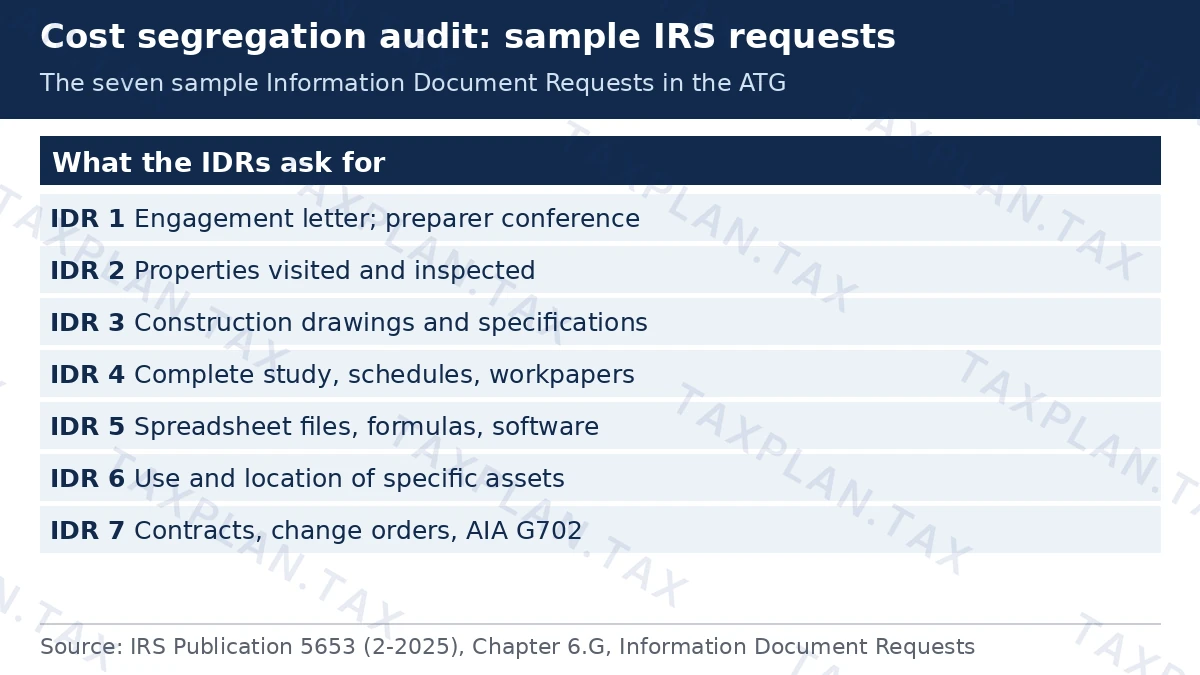
Chapter 6.G of the guide contains seven sample Information Document Requests (IDRs). Together, they show what an examiner is likely to ask for.
| Sample IDR in the guide | What to have ready |
|---|---|
| IDR 1: participants and roles | Engagement letter; preparer contact for a conference |
| IDR 2: properties studied | Names and locations of properties the preparer visited |
| IDR 3: drawings | Access to construction drawings and specifications |
| IDR 4: the study | The complete study, schedules, attachments, and workpapers |
| IDR 5: computations | Native spreadsheet files, formulas, and software description |
| IDR 6: specific assets | Use and location of assets that could fit more than one class |
| IDR 7: specific amounts | Contracts, change orders, bid breakdowns, AIA G702 pay applications |
Records that support cost and use
Beyond the IDRs, also keep the purchase agreement, closing statement, and any appraisal. Similarly, for new construction, keep contractor pay applications, invoices, and job cost reports. Also keep the building permit and certificate of occupancy, since the guide uses them to confirm placed-in-service dates. Under Treas. Reg. §1.6001-1(e), records must be kept as long as they may become material. For depreciable property, that is often many years.
A reconciliation package
Next, build a short package that ties the study to the return. First, start with total cost. Then show land, land improvements, building, and personal property. Finally, match each class to the depreciation schedule. In particular, the guide warns examiners to look for furniture or equipment counted twice. So list separately purchased items on their own line.
What Are the Benefits of Preparing Early?
Direct answer: Early preparation shortens the audit, reduces adjustments, and supports a penalty defense.
- Faster risk review. The guide says a quality study expedites the exam and reduces burden.
- Fewer disputed assets. Clear names and drawings answer questions before they become issues.
- Stronger penalty position. Records showing you gave your adviser full facts help a reasonable cause defense.
- Better use of your preparer. The guide tells examiners to interview the preparer and ask the preparer to attend the tour.
For broader audit strategy on complex returns, see our article on IRS audit defense for high net worth individuals.
What Legal Rules Apply in a Cost Segregation Audit?
Direct answer: The Code and regulations decide the classification, while penalty and procedure rules decide the cost of losing an issue.
Classification and allocation
Generally, classification turns on §168, the §1245 definition of personal property, and the investment tax credit rules in Treas. Reg. §1.48-1. The Tax Court applied those rules in Hospital Corp. of America (109 T.C. 21, 48-52). For acquired property, Treas. Reg. §1.167(a)-5 apportions a lump-sum price by relative value at acquisition.
Also, check for a written allocation. Under §1060(a), a written allocation in an applicable asset acquisition binds both parties. In Peco Foods, the Eleventh Circuit held the taxpayer to its allocation schedule (522 F. App’x 840, 843-844). That court applied the Danielson rule, which limits when a party can escape its own agreement (378 F.2d 771, 775).
Burden of proof and records
In general, you must support your deductions. For example, in AmeriSouth XXXII, the Tax Court credited the IRS expert, who relied on the study firm’s contemporaneous workpapers. However, the taxpayer had not put those workpapers into evidence. As a result, the court sustained the IRS on the site-preparation costs. So keep your preparer’s workpapers available.
Penalties and defenses
Under §6662, a 20% penalty can apply to a substantial understatement or negligence. For individuals, an understatement is substantial if it exceeds the greater of 10% of the correct tax or $5,000. By contrast, corporations have a different test. However, §6664(c) bars the penalty for any portion with reasonable cause and good faith. Specifically, in Neonatology Associates, the Tax Court set out a three-part test for reliance on an adviser (115 T.C. 43, 99). The adviser must be a competent professional, you must give accurate and complete information, and you must actually rely in good faith. In addition, for individuals the IRS bears the burden of production on penalties under §7491(c), as Higbee explains (116 T.C. 438, 446-447). See Treas. Reg. §1.6664-4 for the reasonable cause rules.
Method changes and timing
If your study was done after a return was filed, it was generally implemented by an accounting method change on Form 3115. The guide lists common Form 3115 errors, such as using the wrong procedure or lacking records for the §481(a) adjustment. Meanwhile, the general assessment period is three years after the return is filed under §6501(a).
Additionally, full case citations appear in the Cases Cited section below.
What Could a Cost Segregation Audit Adjustment Cost? (Illustrative)
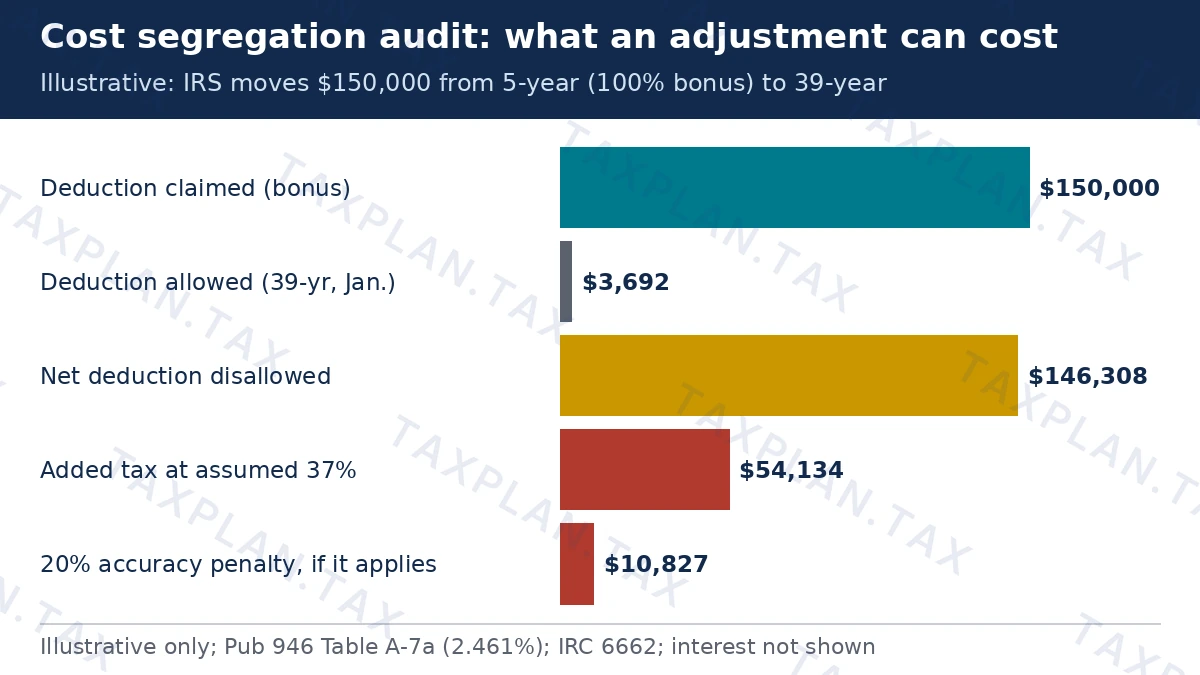
Direct answer: The example below shows how one reclassified asset group can create added tax and a possible penalty. All figures are illustrative assumptions.
For example, assume an individual placed a building in service in January 2026. The study treated $150,000 of components as 5-year property and claimed 100% bonus depreciation on it. Now assume the IRS shows those components are structural parts of the 39-year building. Then the allowable first-year deduction drops to $3,692, using the 2.461% January rate in Table A-7a of Publication 946.
| Illustrative item | Amount |
|---|---|
| Deduction claimed (5-year, 100% bonus) | $150,000 |
| Deduction allowed (39-year, placed in service January) | $3,692 |
| Net deduction disallowed | $146,308 |
| Added tax at an assumed 37% marginal rate | $54,134 |
| 20% accuracy-related penalty, if it applies | $10,827 |
Next, test whether the understatement is substantial. Also assume the correct tax for the year is $400,000. In that case, ten percent of that is $40,000, which is greater than $5,000. Because $54,134 exceeds $40,000, the understatement is substantial. Even so, reasonable cause could still remove the penalty. Interest would also apply, but it is not shown here. In addition, the disallowed amount is not lost; it is recovered over 39 years instead.
What Are the Common Mistakes in a Cost Segregation Audit?
Direct answer: Most problems come from missing records, poor reconciliation, and weak explanations.
- Not having the workpapers. The report alone may not prove the numbers.
- Letting totals drift. A study that does not tie to the return invites a full review.
- Overlooking a written allocation. A binding §1060 schedule can defeat a later study.
- Giving the examiner a rule-of-thumb study. The guide tells examiners to view these with caution.
- Touring without preparation. Prepare the property manager and ask the preparer to attend.
- Missing deadlines. Answer IDRs on time, and calendar the 30-day and 90-day letters.
- Ignoring penalty facts. Document what you gave your adviser and why you relied on it.
Frequently Asked Questions
Does a cost segregation study increase my audit risk?
We are not aware of published IRS data on audit rates for returns that use studies. However, the guide exists because studies are a recognized exam issue. So plan as if yours could be reviewed.
Should my cost segregation preparer join the IRS audit?
Often, yes. Indeed, the guide suggests interviewing the preparer and asking the preparer to attend the property tour. After all, a preparer who can explain each class is very helpful.
What if my study used estimates instead of actual costs?
Yes, estimates can be acceptable. Still, the guide expects clear sources and consistent techniques. It also expects the totals to reconcile to the purchase price less land value.
Can the IRS penalize the study preparer?
Yes, in some cases. For example, the guide cites CCA 201805001, which applied the §6701 penalty to an engineer. That penalty is $1,000 per return, or $10,000 for a corporate return.
How long should I keep cost segregation records?
Keep them as long as they may be material. In fact, IRS guidance on how long to keep records says to generally keep property records until the limitations period expires for the year you dispose of the property.
What happens if I disagree with the examiner?
According to Publication 556, you generally receive a 30-day letter explaining your right to appeal. If you do not agree, a 90-day letter, or notice of deficiency, follows. You can then petition the Tax Court within the period in §6213(a).
Can I fix cost segregation problems before an IRS audit starts?
Often, yes. You may be able to correct errors through a proper method change or amended return, depending on the facts. However, get advice before filing anything.
Conclusion: How Can You Be Ready for a Cost Segregation Audit?
Preparing for a cost segregation audit means thinking like the examiner. Gather what the sample IDRs request, reconcile every number, and keep the workpapers. In addition, confirm there is no binding allocation and document your reliance on qualified advisers. Then an audit becomes a review of facts you already have in order.
Emunah Cost Segregation, led by Alan Goldstein, MBA, EA, prepares studies with audit support in mind and helps owners and CPAs organize records for IRS review. As an Enrolled Agent, Alan can also represent taxpayers before the IRS. Contact Alan Goldstein & Associates in Coral Gables to discuss your study or an open examination.
Cases Cited
- AmeriSouth XXXII, Ltd. v. Commissioner, T.C. Memo. 2012-67, 103 T.C.M. (CCH) 1324 (2012) (United States Tax Court, memorandum opinion). Pinpoint uncertainty: T.C. Memos have no volume or reporter page of their own, and we could not confirm the T.C.M. (CCH) page numbers for the specific holdings. In the CourtListener text, the discussion of the IRS expert’s reliance on the study firm’s workpapers appears at star pages *22-*24; we believe those star pages track the Lexis version, but we could not confirm that. Opinion
- Commissioner v. Danielson, 378 F.2d 771, 775 (3d Cir. 1967). Pinpoint verified against the reporter-paginated opinion text. Later history, if any, not independently verified and not listed. Opinion
- Higbee v. Commissioner, 116 T.C. 438, 446-447 (2001) (United States Tax Court). Pinpoint verified against the reporter-paginated opinion text. Opinion
- Hospital Corp. of America v. Commissioner, 109 T.C. 21, 48-52 (1997) (United States Tax Court). Pinpoint verified against the reporter-paginated opinion text. Opinion
- Neonatology Associates, P.A. v. Commissioner, 115 T.C. 43, 99 (2000) (United States Tax Court). Pinpoint verified against the reporter-paginated opinion text. Later appellate history not independently verified and not listed. Opinion
- Peco Foods, Inc. v. Commissioner, 522 F. App’x 840, 843-844 (11th Cir. 2013) (unpublished), aff’g T.C. Memo. 2012-18. Pinpoint verified against the reporter-paginated opinion text. Opinion
Sources and Authorities
- IRS Publication 5653, Cost Segregation Audit Techniques Guide (rev. 2-6-2025), Chapters 4, 5, and 6.G: https://www.irs.gov/pub/irs-pdf/p5653.pdf
- IRS Publication 556, Examination of Returns, Appeal Rights, and Claims for Refund: https://www.irs.gov/pub/irs-pdf/p556.pdf
- IRS Publication 946, Table A-7a: https://www.irs.gov/pub/irs-pdf/p946.pdf
- 26 U.S.C. §168: https://www.law.cornell.edu/uscode/text/26/168
- 26 U.S.C. §1245: https://www.law.cornell.edu/uscode/text/26/1245
- 26 U.S.C. §1060: https://www.law.cornell.edu/uscode/text/26/1060
- 26 U.S.C. §6501: https://www.law.cornell.edu/uscode/text/26/6501
- 26 U.S.C. §6213: https://www.law.cornell.edu/uscode/text/26/6213
- 26 U.S.C. §6662: https://www.law.cornell.edu/uscode/text/26/6662
- 26 U.S.C. §6664: https://www.law.cornell.edu/uscode/text/26/6664
- 26 U.S.C. §6701: https://www.law.cornell.edu/uscode/text/26/6701
- 26 U.S.C. §7491: https://www.law.cornell.edu/uscode/text/26/7491
- Treas. Reg. §1.48-1: https://www.ecfr.gov/current/title-26/section-1.48-1
- Treas. Reg. §1.167(a)-5: https://www.ecfr.gov/current/title-26/section-1.167(a)-5
- IRS, How long should I keep records?: https://www.irs.gov/businesses/small-businesses-self-employed/how-long-should-i-keep-records
- Treas. Reg. §1.6001-1: https://www.ecfr.gov/current/title-26/section-1.6001-1
- Treas. Reg. §1.6664-4: https://www.ecfr.gov/current/title-26/section-1.6664-4
- About Form 3115: https://www.irs.gov/forms-pubs/about-form-3115
- Court opinions: see Cases Cited above.
This article is provided for general educational purposes and does not constitute individualized tax, legal, or accounting advice. Tax consequences depend on the taxpayer’s specific facts and applicable law.
