
Multifamily cost segregation is a study that splits an apartment complex’s cost into faster tax classes instead of depreciating it all over 27.5 years. Large complexes hold many short-lived assets. For example, they include unit appliances, removable flooring, parking lots, site lighting, pools, playgrounds, and furnished amenity spaces. The IRS lists how it classifies these items in its Cost Segregation Audit Techniques Guide, Chapter 7.H. Under IRS Notice 2026-11, the 5-, 7-, and 15-year parts of property acquired after January 19, 2025 can get 100% bonus depreciation.
However, scale also brings complexity. A leasing office or clubhouse building is 39-year property, not 27.5-year property. Ground-floor retail can push a building out of the residential class entirely. In addition, many apartment investors hold interests through partnerships, so the passive loss rules matter. This guide explains multifamily cost segregation with primary sources, two worked examples, and the mistakes that most often draw IRS attention.
Key Takeaways
- An apartment building is 27.5-year residential rental property only if 80% or more of its gross rent comes from dwelling units, under IRC §168(e)(2)(A).
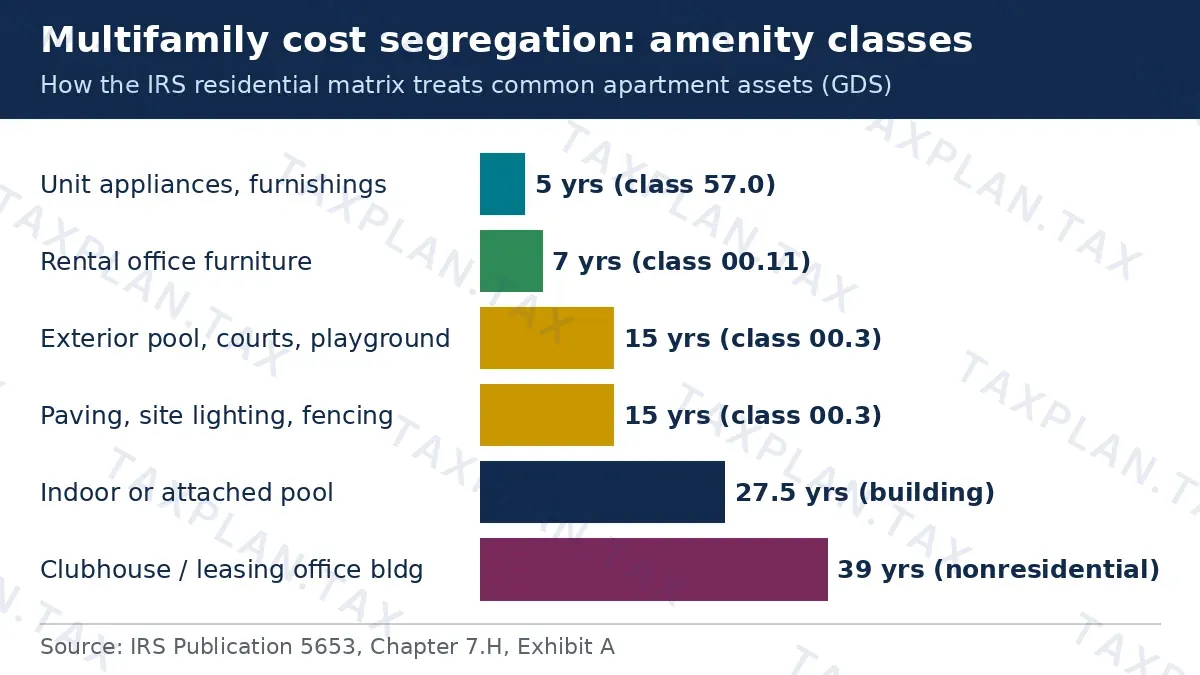
- The IRS residential matrix treats most §1245 assets in apartments as 5-year property in asset class 57.0.
- Exterior pools, courts, and playgrounds built on land are 15-year land improvements, while indoor ones stay with the building.
- A rental office or clubhouse building is nonresidential real property with a 39-year life.
- Limited partners generally cannot treat their interest as materially participating under IRC §469(h)(2).
- Qualified improvement property rules do not apply to residential buildings.
What Is Multifamily Cost Segregation?
Direct answer: Multifamily cost segregation applies an engineering-based cost allocation to apartment buildings and complexes. It identifies parts that are personal property or land improvements, then assigns each part its own tax life.
Apartment complexes are a natural fit for this work. They often sit on large sites with parking, drives, lighting, fences, and landscaping. They also repeat the same unit features dozens or hundreds of times. As a result, small per-unit items can add up to large totals in a multifamily cost segregation study. For a broader introduction, see Cost Segregation Study Explained: A Complete Guide for Real Estate Investors.
Why does the 80% test matter for apartments?
The class of the building depends on rent mix. Specifically, IRC §168(e)(2)(A) requires that 80% or more of gross rental income for the taxable year come from dwelling units. A dwelling unit is a house or apartment used to provide living accommodations. However, units in a hotel, motel, or other establishment where more than half the units are used on a transient basis do not count.
So a garden-style complex with only apartments easily meets the test. In contrast, a mixed-use tower with large retail space may not. Because the statute applies the test for each taxable year, a change in rent mix deserves attention.
How Does Multifamily Cost Segregation Work?
Direct answer: The study team gathers cost records, inspects the property, removes land value, and allocates the remaining basis among recovery classes. Then it prepares a report that supports each allocation.
For new construction, the study usually starts from contractor pay applications and invoices. For an acquisition, it often uses the purchase price, an appraisal, and cost-estimating methods. Either way, multifamily cost segregation should follow the audit guide favors detailed, documented methods over rough estimates. To see each stage, read Cost Segregation Study Process: Step-by-Step Breakdown.
Which apartment assets are 5-year property?
The IRS residential matrix in Publication 5653, Chapter 7.H, Exhibit A says asset class 57.0 applies to most §1245 property used with residential rental property. That class has a 5-year life. Examples in the matrix include:
- Kitchen appliances in each unit
- Electrical and plumbing branch lines dedicated to those appliances
- Readily removable floor coverings and strippable wallpaper
- Window treatments and decorative light fixtures
- Furniture in furnished units, pool areas, and fitness rooms
- Freestanding spas and sound systems
- Data cable and wiring for telephone and computer systems
In addition, the matrix places furniture in the rental office in asset class 00.11. That class covers office furniture and has a 7-year life.
Which site improvements are 15-year property?
Multifamily cost segregation often finds large totals outside the buildings, especially on garden-style sites. The matrix places sidewalks, curbs, site work, fencing, site lighting, landscaping, and detached trash enclosures in asset class 00.3. Exterior pools, spas, athletic courts, and playground equipment built on land also fall in class 00.3. That class has a 15-year life.
However, location matters. According to the matrix, pools and courts within, on, or attached to a residential building stay in the 27.5-year class. Similarly, built-in interior mailboxes stay with the building, while a freestanding mailbox shelter is a land improvement.
What stays with the building?
Many large-cost items stay in the 27.5-year class. For example, the matrix lists kitchen cabinets and counters, building HVAC, elevators, roofs, stairs, windows, doors, and general plumbing as §1250 property. Likewise, fire protection systems and building security systems stay with the building. These rules follow the structural component definition in Treas. Reg. §1.48-1(e)(2).
What Are the Benefits of Multifamily Cost Segregation?
Direct answer: The main benefit is earlier deductions. For property acquired after January 19, 2025, the reclassified 5-, 7-, and 15-year parts can be fully deducted in the first year through bonus depreciation.
Public Law 119-21, enacted July 4, 2025, made 100% bonus depreciation permanent for qualified property acquired after January 19, 2025. However, property acquired under a written binding contract signed before January 20, 2025 keeps the old phase-down rates. Those rates are 40% for 2025 and 20% for 2026. Notice 2026-11 explains how acquisition dates are determined. Also, used property can qualify if you did not use it before, under Treas. Reg. §1.168(k)-2.
Earlier deductions from multifamily cost segregation can support reinvestment, debt paydown, or reserves. For a deeper look at timing value, read Cost Segregation ROI: How Quickly Do Studies Pay for Themselves?
What Legal Rules Apply to Multifamily Cost Segregation?
Direct answer: IRC §168, the structural component regulations, IRS asset classes, the IRS audit guide, and the passive loss rules control the result.
- IRC §168(c): sets 27.5 years for residential rental property and 39 years for nonresidential real property.
- IRC §168(e)(6): limits qualified improvement property to nonresidential buildings, so apartment interiors do not qualify.
- Rev. Proc. 87-56: sets asset classes 00.11, 00.3, and 57.0, as shown in Publication 946, Appendix B.
- Publication 5653: includes the residential rental matrix and summarizes key cases.
Two cases frame the multifamily cost segregation analysis. Hospital Corporation of America v. Commissioner, 109 T.C. 21 (1997), held that the former investment tax credit rules still decide §1245 status. Also, Whiteco Industries, Inc. v. Commissioner, 65 T.C. 664 (1975), gave factors for whether an item is inherently permanent.
How do the passive rules affect syndications?
Many multifamily deals use partnerships. In that case, depreciation is computed by the partnership and passes to partners on Schedule K-1. However, rental activities are generally passive under IRC §469. Moreover, §469(h)(2) generally says a limited partner does not materially participate, except as regulations provide.
So a passive investor may not be able to use a large loss against wages or business income. Instead, the loss can offset other passive income, or carry forward. According to Publication 925, suspended losses are generally allowed when you dispose of your entire interest in a fully taxable transaction. In contrast, a general partner who qualifies as a real estate professional under §469(c)(7) may use the loss currently. Therefore, multifamily cost segregation helps different investors in different ways.
What about recapture at sale?
When you sell, gain on §1245 property is ordinary income up to prior depreciation under IRC §1245. Meanwhile, straight-line depreciation on the building creates unrecaptured §1250 gain, taxed at up to 25% under IRC §1(h). As a result, multifamily cost segregation should be paired with a plan for the purchase price allocation at sale.
What Does Multifamily Cost Segregation Look Like in Practice?
Direct answer: The example below shows a 120-unit garden complex with a separate clubhouse. All amounts are illustrative assumptions, not typical results.
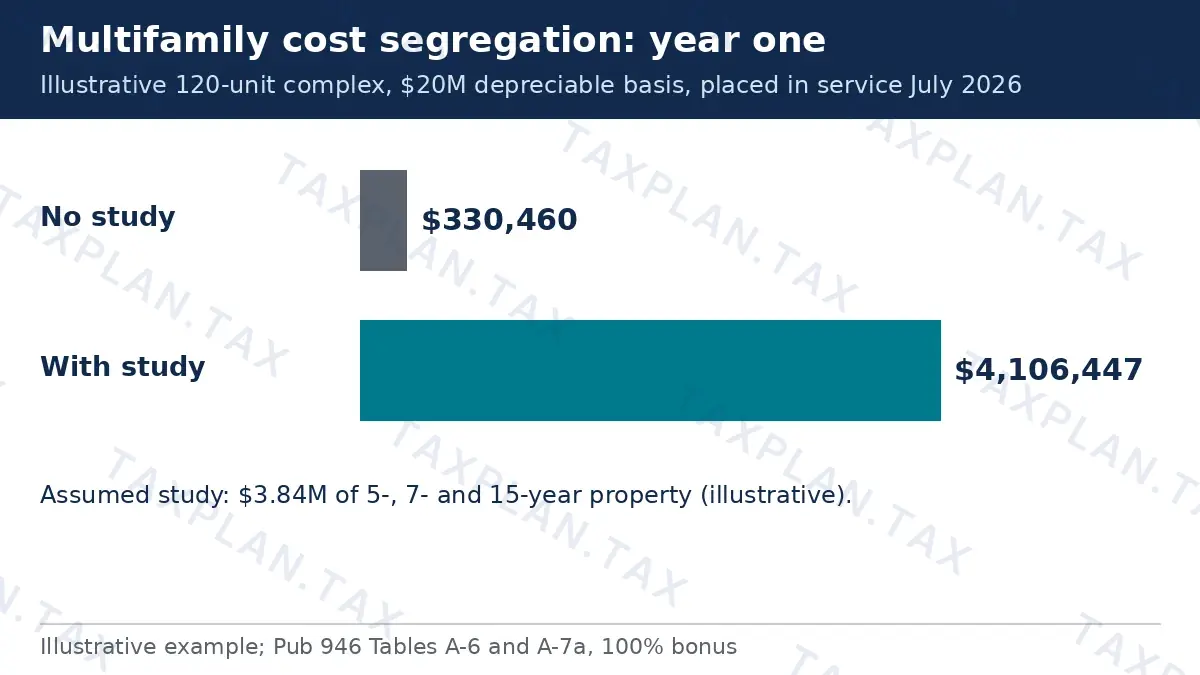
Assume a partnership buys a 120-unit complex for $24,000,000 under a contract signed in 2026. Land is worth $4,000,000, so the depreciable basis is $20,000,000. The property is placed in service in July 2026.
| Class (illustrative study) | Basis | Year-one depreciation |
|---|---|---|
| 5-year unit and amenity property (class 57.0) | $2,200,000 | $2,200,000 (100% bonus) |
| 7-year rental office furniture (class 00.11) | $40,000 | $40,000 (100% bonus) |
| 15-year site work, pool, and playground (class 00.3) | $1,600,000 | $1,600,000 (100% bonus) |
| 39-year clubhouse and leasing office | $600,000 | $7,062 |
| 27.5-year apartment buildings | $15,560,000 | $259,385 |
| Total | $20,000,000 | $4,106,447 |
The building figures use July rates from Publication 946. Table A-6 gives 1.667% for 27.5-year property. Table A-7a gives 1.177% for 39-year property.
Without a study, the apartment portion would be $19,400,000 at 1.667%, or $323,398. Adding the same clubhouse amount gives $330,460. Therefore, multifamily cost segregation adds about $3,775,987 of first-year depreciation in this example.
Example 2: Mixed-use building and the 80% test
Next, assume a five-story building has apartments above ground-floor retail. Gross rent for the year is $2,400,000. Apartments produce $1,968,000, which is 82% of the total. So the building is residential rental property for that year. However, suppose retail rents rose so that apartments produced $1,900,000 of the same $2,400,000. Then the share would fall to about 79%. Then the building would be nonresidential real property with a 39-year life.
What Are Common Multifamily Cost Segregation Mistakes?
Direct answer: Errors usually involve misclassified amenities, unsupported percentages, or ignoring the investor’s tax position.
- Classing indoor pools as land improvements. The IRS matrix keeps pools in or attached to a residential building in the 27.5-year class.
- Treating kitchen cabinets as 5-year property. The matrix lists them as 27.5-year building property.
- Missing the clubhouse. A separate leasing office or clubhouse building is 39-year property.
- Claiming QIP on apartments. Qualified improvement property is limited to nonresidential buildings.
- Applying a percentage from another deal. Each complex needs its own facts and cost support.
- Ignoring the binding contract date. Contracts signed before January 20, 2025 limit the bonus rate.
- Forgetting investors’ passive limits. A large K-1 loss may be suspended for passive partners.
Also, check state rules, since some states do not follow federal bonus depreciation. That can change the state-level value of multifamily cost segregation.
Frequently Asked Questions
Does multifamily cost segregation work for older complexes?
Yes. A look-back study can cover a complex placed in service years ago. You generally file Form 3115 and claim the missed depreciation as a §481(a) adjustment under Rev. Proc. 2025-23.
Can multifamily cost segregation help after renovations?
Yes. A study can classify renovation costs, such as new appliances, flooring, and site work. In addition, you may be able to deduct the remaining basis of replaced components through a partial disposition election under Treas. Reg. §1.168(i)-8.
Are washers and dryers 5-year property?
Generally, yes. Appliances used in residential rental property are listed as 5-year property in Publication 527, Table 2-1.
Is a parking lot 15-year property?
Surface paving is generally a land improvement in asset class 00.3, with a 15-year life. However, the IRS treats stand-alone open-air parking structures as buildings, according to Chapter 8.B of the audit guide.
Can passive investors benefit from multifamily cost segregation?
Often, yes, but timing varies. Their losses can offset passive income from other activities. Otherwise, the losses carry forward until passive income arises or the interest is sold.
Does a study change the depreciable basis?
No. Multifamily cost segregation reallocates the same basis among classes. Total depreciation over the life of the property stays the same.
Conclusion: Is Multifamily Cost Segregation Right for Your Complex?
To sum up, multifamily cost segregation can move unit appliances, removable finishes, amenities, and site work into 5-, 7-, and 15-year classes. For property acquired after January 19, 2025, those classes can get 100% bonus depreciation. However, the 80% test, clubhouse rules, passive limits, and recapture all affect the outcome. So the study and the investors’ tax plans should line up.
Emunah Cost Segregation works with apartment owners, sponsors, and their CPAs. Alan Goldstein, EA, reviews your complex, purchase records, and ownership structure before any study begins. Then he gives you a clear view of whether a study fits. Contact Emunah Cost Segregation in Coral Gables, Florida, to request a review. To see how timing affects value, read When Is a Cost Segregation Study Worth It?
Sources and Authorities
- 26 U.S.C. §168 (including §168(c), §168(e)(2), §168(e)(6), and §168(k)): https://www.law.cornell.edu/uscode/text/26/168
- 26 U.S.C. §469 (including §469(c)(7) and §469(h)(2)): https://www.law.cornell.edu/uscode/text/26/469
- 26 U.S.C. §1245: https://www.law.cornell.edu/uscode/text/26/1245
- 26 U.S.C. §1 (including §1(h)): https://www.law.cornell.edu/uscode/text/26/1
- Public Law 119-21 (H.R. 1, 119th Congress): https://www.congress.gov/bill/119th-congress/house-bill/1
- IRS Notice 2026-11: https://www.irs.gov/pub/irs-drop/n-26-11.pdf
- Treas. Reg. §1.48-1: https://www.ecfr.gov/current/title-26/section-1.48-1
- Treas. Reg. §1.168(k)-2: https://www.ecfr.gov/current/title-26/section-1.168(k)-2
- Treas. Reg. §1.168(i)-8: https://www.ecfr.gov/current/title-26/section-1.168(i)-8
- IRS Publication 527 (2025): https://www.irs.gov/pub/irs-pdf/p527.pdf
- IRS Publication 925 (2025): https://www.irs.gov/pub/irs-pdf/p925.pdf
- IRS Publication 946, including Tables A-6 and A-7a and Appendix B: https://www.irs.gov/pub/irs-pdf/p946.pdf
- IRS Publication 5653, Cost Segregation Audit Techniques Guide, Chapters 7.H and 8.B: https://www.irs.gov/pub/irs-pdf/p5653.pdf
- About Form 3115: https://www.irs.gov/forms-pubs/about-form-3115
- Rev. Proc. 2025-23: https://www.irs.gov/pub/irs-drop/rp-25-23.pdf
- Hospital Corporation of America v. Commissioner, 109 T.C. 21 (1997), and Whiteco Industries, Inc. v. Commissioner, 65 T.C. 664 (1975), as discussed in IRS Publication 5653.
This article is provided for general educational purposes and does not constitute individualized tax, legal, or accounting advice. Tax consequences depend on the taxpayer’s specific facts and applicable law.
