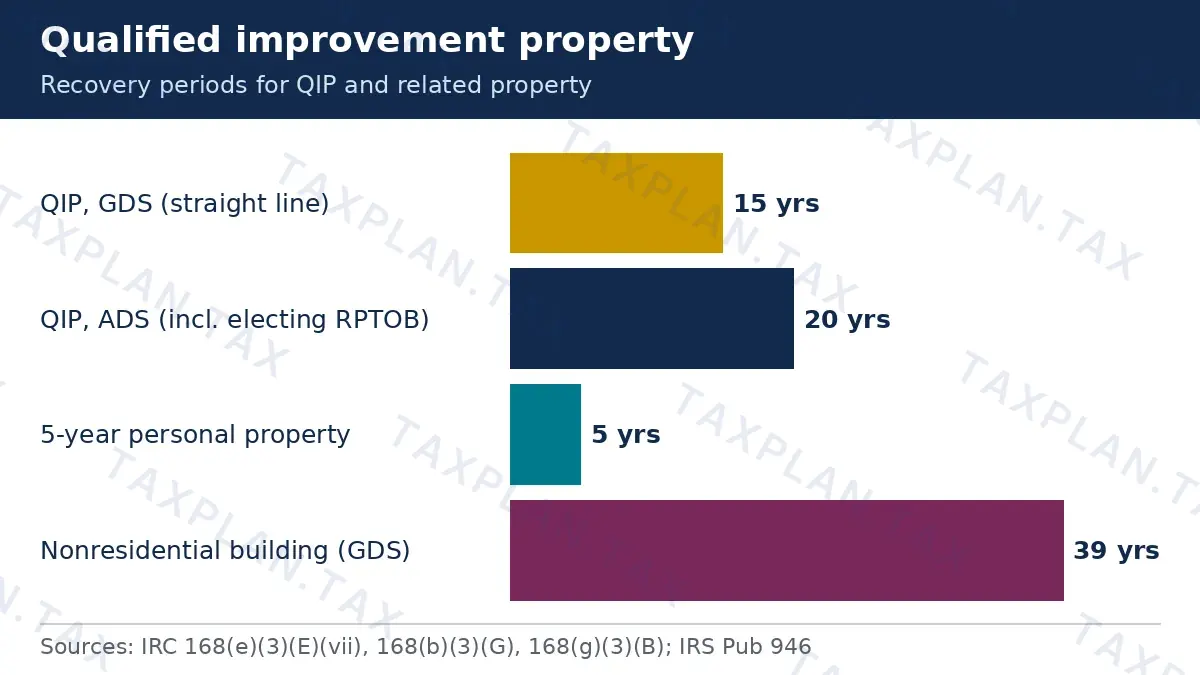

Qualified improvement property (QIP) is an improvement that a taxpayer makes to the interior of a nonresidential building after the building was first placed in service. Under IRC §168(e)(6), QIP excludes costs for enlarging the building, elevators and escalators, and the internal structural framework. QIP is 15-year property that must use the straight-line method, and it qualifies for bonus depreciation. As a result, interior renovation costs that once followed a 39-year schedule can often be deducted much faster. In a cost segregation study, QIP works alongside the usual 5-, 7-, and 15-year categories. The study separates §1245 items, QIP, and costs that must stay in the 39-year class. Residential rental buildings, original construction, and exterior work do not produce QIP.
This guide explains the definition, the depreciation rules, the history behind the 2020 fix, and how qualified improvement property fits into a cost segregation study.
Key Takeaways
- QIP is a §1250 interior improvement to nonresidential real property, made by the taxpayer, placed in service after the building was first placed in service.
- Enlargements, elevators and escalators, and internal structural framework are excluded.
- QIP has a 15-year GDS period with straight-line depreciation and a 20-year ADS period.
- QIP generally qualifies for bonus depreciation, which is 100% for property acquired after January 19, 2025.
- An electing real property trade or business must use ADS for QIP, so it cannot claim bonus on that QIP.
- A cost segregation study can still separate 5- and 7-year items from QIP for faster recovery.
What Is Qualified Improvement Property?
Direct answer: QIP is a defined category of building improvements created by the Tax Cuts and Jobs Act and given a 15-year life by the CARES Act.
What does the statute require?
Section 168(e)(6)(A) defines qualified improvement property as “any improvement made by the taxpayer to an interior portion of a building which is nonresidential real property if such improvement is placed in service after the date such building was first placed in service.” Then §168(e)(6)(B) excludes any improvement for which the expenditure is attributable to the enlargement of the building, any elevator or escalator, or the internal structural framework of the building.
What do the regulations add?
Treas. Reg. §1.168(b)-1(a)(5) adds detail. It limits QIP to improvements that are §1250 property. It also requires that the building was first placed in service “by any person” before the improvement. Moreover, it borrows definitions from other regulations. An enlargement increases the building’s total volume under Treas. Reg. §1.48-12(c)(10), and an increase in floor space from interior remodeling is not an enlargement. Internal structural framework, under §1.48-12(b)(3)(iii), includes all load-bearing internal walls and other internal structural supports, such as columns, girders, beams, and trusses.
Why did QIP need a “technical fix”?
The Tax Cuts and Jobs Act created QIP for property placed in service after 2017, but it did not assign QIP a 15-year class. As a result, QIP defaulted to 39 years and could not get bonus depreciation. Rev. Proc. 2020-25 explains that §2307 of the CARES Act fixed this retroactively. It made QIP 15-year property, added the “made by the taxpayer” requirement, and set a 20-year ADS period. The revenue procedure also let taxpayers change their 2018, 2019, and 2020 treatment.
How Is Qualified Improvement Property Depreciated?
Direct answer: QIP uses a 15-year recovery period, the straight-line method, and usually the half-year convention.
Which method applies?
Unlike most 15-year property, qualified improvement property cannot use 150% declining balance. Section 168(b)(3)(G) requires the straight-line method. Under Publication 946, Table A-8, a 15-year straight-line asset with the half-year convention gets 3.33% in year one and about 6.67% in each middle year.
Which convention applies?
QIP is 15-year property, not nonresidential real property, so the half-year convention normally applies instead of the mid-month convention. However, that also means QIP counts toward the mid-quarter test under §168(d)(3). If more than 40% of the year’s depreciable basis (excluding real property) is placed in service in the last quarter, the mid-quarter convention applies. Large year-end renovations can trigger it.
What happens under ADS?
The table in §168(g)(3)(B) gives QIP a 20-year ADS period. Under §168(g)(8), an electing real property trade or business under §163(j)(7)(B) must use ADS for its nonresidential real property, residential rental property, and QIP. Furthermore, §168(k)(2)(D) excludes property that must use ADS from bonus depreciation. Therefore, that election costs the QIP bonus.
What Are the Benefits of Qualified Improvement Property in a Cost Segregation Study?
Direct answer: QIP shortens interior renovation costs from 39 to 15 years and makes them eligible for bonus, while a study can move some items even faster.
How does bonus depreciation apply to QIP?
Because qualified improvement property has a 15-year recovery period, it meets the 20-years-or-less test in §168(k)(2)(A). Public Law 119-21 set the bonus rate at 100% for qualified property acquired after January 19, 2025. IRS Notice 2026-11 explains how to apply the acquisition date rules, including the rules for self-constructed property. In general, self-constructed property is acquired when physical work of a significant nature begins.
Why still do a study if QIP already gets bonus?
There are three reasons. First, a study separates costs that are not QIP, such as an elevator, so they are not claimed incorrectly. Second, it identifies §1245 items inside a renovation, such as removable carpet or equipment wiring, that have 5- or 7-year lives. Those items matter if you elect out of bonus or if bonus does not apply. Third, the study documents the allocation in case the IRS examines it. For the process, see Cost Segregation Study Process: Step-by-Step Breakdown.
Can QIP be expensed under §179?
Yes, if you elect it and meet the limits. Section 179(e) treats QIP as qualified real property. It also covers roofs, HVAC property, fire protection and alarm systems, and security systems added to nonresidential real property after it was first placed in service. Under §179(b), as amended by Public Law 119-21, the base limit is $2,500,000, reduced once §179 property placed in service exceeds $4,000,000. Those amounts are indexed for inflation after 2025, and the deduction is limited to business taxable income.
What Legal Rules and Court Cases Shape Qualified Improvement Property Decisions?
Direct answer: The statute and regulations define QIP. Court cases do not interpret QIP directly, but they decide the structural-component questions that QIP depends on.
- IRC §168(b)(3)(G), (e)(3)(E)(vii), (e)(6), (g)(3)(B), and (g)(8): method, class, definition, and ADS rules.
- Treas. Reg. §1.168(b)-1(a)(5): regulatory definition of QIP.
- Treas. Reg. §1.48-12: definitions of enlargement and internal structural framework.
- Rev. Proc. 2020-25: CARES Act background and transition relief.
Which cases matter for qualified improvement property?
We found no court opinion that interprets the QIP definition itself. Instead, three older cases help with the line between personal property and building components. In Hospital Corp. of America v. Commissioner, 109 T.C. 21, 74-75 (1997), the court held that adhesive-installed carpeting was tangible personal property. So carpet in a renovation may be 5-year property rather than QIP. In contrast, Boddie-Noell Enterprises, Inc. v. United States, 36 Fed. Cl. 722, 748 (1996), held that suspended ceilings in restaurant kitchens were structural components. A new interior ceiling is therefore §1250 property, which can be QIP.
Finally, L.L. Bean, Inc. v. Commissioner, 145 F.3d 53, 56-57 (1st Cir. 1998), held that a storage rack system that supported a building’s roof and walls was a structural component. That case arose under the former investment tax credit, not QIP. Still, it shows that items that hold up a building are treated as structure. Under §168(e)(6)(B), such internal structural framework is excluded from QIP. Full citations appear in the Cases Cited section below.
What Does Qualified Improvement Property Look Like in Practice?
Direct answer: The examples below use Publication 946 table rates on assumed amounts. All dollar figures are illustrative assumptions.
Example 1: An office renovation placed in service in September 2026
Assume an owner renovates the interior of an office building first placed in service in 2010. Physical work begins after January 19, 2025, and the work is placed in service in September 2026. The total cost is $1,200,000. A study allocates $150,000 to 5-year §1245 property, $900,000 to QIP, and $150,000 to a new elevator, which is excluded from QIP.
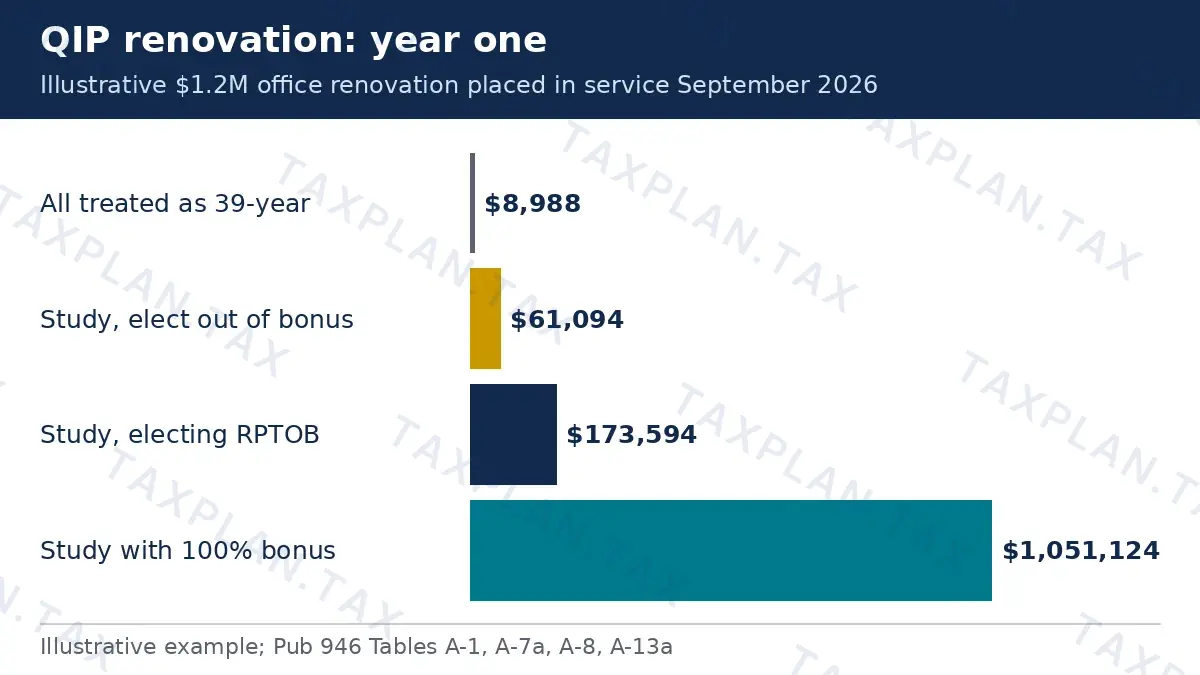
With 100% bonus on the 5-year property and the QIP, the first-year deduction is $1,050,000. The elevator stays in the 39-year class and yields $1,124 ($150,000 × 0.749% under Table A-7a for September). So the total is $1,051,124. If the owner instead treated all $1,200,000 as 39-year property, the first-year deduction would be only $8,988.
Example 2: Electing out of bonus
Next, assume the owner elects out of bonus for both the 5-year and 15-year classes under §168(k)(7). The 5-year property yields $30,000 (20%). The QIP yields $29,970 (3.33%). Adding the elevator’s $1,124 gives $61,094 in year one.
Example 3: An electing real property trade or business
Finally, assume the owner made the §163(j)(7)(B) election to avoid the business interest limit. Its QIP must then use ADS, with a 20-year straight-line period, and bonus is not allowed on that QIP. The $900,000 of QIP would yield $22,500 in year one (2.5% under Table A-8). However, the $150,000 of 5-year property is not real property, so it can still get bonus. The elevator, as part of the building, must also use ADS, with a 40-year period: $1,094 in year one (0.729% under Table A-13a). The year-one total is $173,594.
| Scenario (illustrative, $1.2M renovation) | 5-year items | QIP | Elevator (39-year) | Year-one total |
|---|---|---|---|---|
| All treated as 39-year | n/a | n/a | n/a | $8,988 |
| Study, elect out of bonus | $30,000 | $29,970 | $1,124 | $61,094 |
| Study, electing RPTOB (ADS on QIP and building) | $150,000 | $22,500 | $1,094 | $173,594 |
| Study with 100% bonus | $150,000 | $900,000 | $1,124 | $1,051,124 |
What Are the Common Mistakes and Risks?
Direct answer: Most QIP errors involve the wrong building type, the wrong timing, or excluded costs.
- Claiming QIP on apartments. QIP requires nonresidential real property.
- Claiming QIP during original construction. The building must already have been placed in service.
- Treating a seller’s improvements as your QIP. QIP must be made by the taxpayer.
- Including exterior work. Roofs and facades are not interior improvements, although §179(e) may cover roofs.
- Including excluded costs. Elevators, escalators, enlargements, and load-bearing work are not QIP.
- Using 150% declining balance. QIP must use straight line.
- Forgetting the ADS election effect. An electing real property trade or business loses bonus on QIP.
Frequently Asked Questions
What is qualified improvement property?
It is a §1250 improvement to the interior of a nonresidential building, made by the taxpayer and placed in service after the building was first placed in service, excluding enlargements, elevators and escalators, and internal structural framework.
Is qualified improvement property eligible for 100% bonus depreciation?
Generally, yes, if it was acquired after January 19, 2025, and ADS does not apply. Otherwise, other rates or rules may apply.
Does qualified improvement property apply to residential rental property?
No. The statute requires a building that is nonresidential real property.
Is a new roof QIP?
No, because a roof is not an interior improvement. However, §179(e) lets taxpayers elect to expense roofs on nonresidential real property, within the §179 limits.
Does a tenant’s build-out qualify as QIP?
It can, if the improvement meets the definition and is made by the taxpayer claiming it. Who pays for and owns the improvement for tax purposes matters, so lease terms should be reviewed.
What is the recovery period for qualified improvement property?
Fifteen years under GDS, using straight line, and 20 years under ADS.
Can I fix QIP that I depreciated over 39 years?
Often, yes. A change in recovery period is usually made through Form 3115 under Rev. Proc. 2025-23.
Conclusion: How Should You Use Qualified Improvement Property?
In summary, qualified improvement property turns many interior renovation costs into 15-year, bonus-eligible property. Yet QIP has firm limits: nonresidential buildings only, interior work only, and no enlargements, elevators, or structural framework. A cost segregation study helps apply those limits and also finds 5- and 7-year items inside the project.
Emunah Cost Segregation helps owners and CPAs classify renovation costs between §1245 property, QIP, and the building. Alan Goldstein, EA, reviews your project and records before any study begins. Then he tells you plainly whether a study makes sense. Contact Emunah Cost Segregation in Coral Gables, Florida, to request a review. For related reading, see Cost Segregation for Office Buildings.
Cases Cited
- Hospital Corp. of America v. Commissioner, 109 T.C. 21, 74-75 (1997) (United States Tax Court). Pinpoint verified against the reporter-paginated opinion text. Opinion
- Boddie-Noell Enterprises, Inc. v. United States, 36 Fed. Cl. 722, 748 (1996) (United States Court of Federal Claims). Pinpoint verified against the reporter-paginated opinion text. We did not independently verify any later appellate history, so none is listed. Opinion
- L.L. Bean, Inc. v. Commissioner, 145 F.3d 53, 56-57 (1st Cir. 1998). Pinpoint verified against the reporter-paginated opinion text. Opinion
Sources and Authorities
- 26 U.S.C. §168 (including §168(b)(3)(G), (d)(3), (e)(3)(E)(vii), (e)(6), (g), and (k)): https://www.law.cornell.edu/uscode/text/26/168
- 26 U.S.C. §179 (including §179(b) and (e)): https://www.law.cornell.edu/uscode/text/26/179
- Public Law 119-21 (H.R. 1, 119th Congress), §§70301 and 70306: https://www.congress.gov/bill/119th-congress/house-bill/1
- IRS Notice 2026-11: https://www.irs.gov/pub/irs-drop/n-26-11.pdf
- Rev. Proc. 2020-25: https://www.irs.gov/pub/irs-drop/rp-20-25.pdf
- Treas. Reg. §1.168(b)-1: https://www.ecfr.gov/current/title-26/section-1.168(b)-1
- Treas. Reg. §1.48-12: https://www.ecfr.gov/current/title-26/section-1.48-12
- IRS Publication 946, including Tables A-1, A-7a, and A-8: https://www.irs.gov/pub/irs-pdf/p946.pdf
- IRS Publication 5653, Cost Segregation Audit Techniques Guide: https://www.irs.gov/pub/irs-pdf/p5653.pdf
- About Form 3115: https://www.irs.gov/forms-pubs/about-form-3115
- Rev. Proc. 2025-23: https://www.irs.gov/pub/irs-drop/rp-25-23.pdf
- Court opinions: see Cases Cited above.
This article is provided for general educational purposes and does not constitute individualized tax, legal, or accounting advice. Tax consequences depend on the taxpayer’s specific facts and applicable law.
