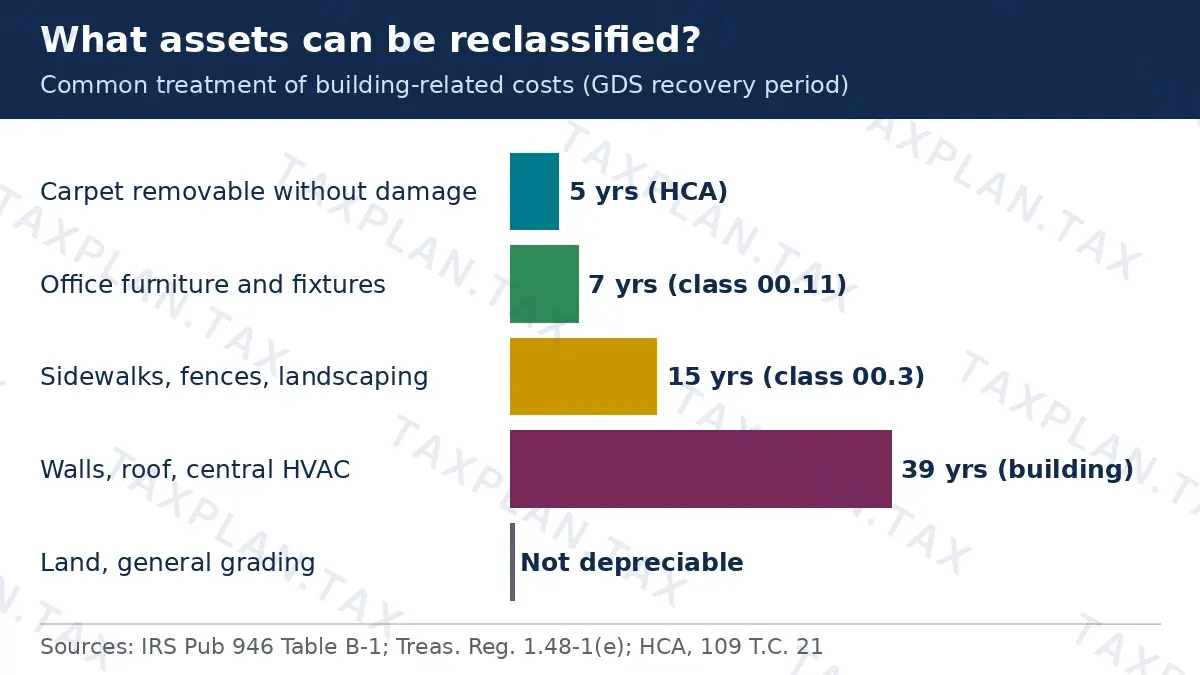

What assets can be reclassified in a cost segregation study? They are the parts of a property that are not the building itself or the land under it. In practice, that means three groups. First, tangible personal property (§1245 property), such as removable carpet, dedicated electrical, and equipment connections, often moves to a 5- or 7-year class. Second, land improvements, such as paving, sidewalks, fencing, and landscaping, usually move to the 15-year class. Third, for nonresidential buildings, later interior improvements may qualify as 15-year qualified improvement property. Everything else stays put. Land is not depreciable, and structural components such as walls, roofs, central HVAC, and general plumbing stay with the 27.5- or 39-year building.
So what assets can be reclassified depends on two questions: is the item part of the building, and which asset class fits it? This guide explains how a study answers both questions under IRC §168, Treas. Reg. §1.48-1, and the court cases that shape the line.
Key Takeaways
- Reclassification moves cost out of the building’s 27.5- or 39-year life into shorter MACRS classes.
- Tangible personal property, land improvements, and qualified improvement property are the main categories that can move.
- Land, nondepreciable site preparation, and building structural components cannot be reclassified.
- Courts decide close calls with the Whiteco permanence factors and the “operation or maintenance of a building” test.
- For property acquired after January 19, 2025, reclassified assets can generally qualify for 100% bonus depreciation.
- Weak documentation and binding purchase-price allocations are the most common reasons the IRS reverses a study.
What Does “Reclassified” Mean in a Cost Segregation Study?
Direct answer: Reclassification means assigning part of a property’s cost to a shorter recovery class than the building’s default class.
By default, residential rental property has a 27.5-year recovery period and nonresidential real property has a 39-year period under §168(c). If you buy or build a property and depreciate everything as one asset, every dollar except land gets that long life. A cost segregation study instead breaks the cost into components. It then assigns each component to the class the law requires. For an overview of the full process, see What Is a Cost Segregation Study and How Does It Work?
Why is the building/personal property line so important?
The line matters because MACRS classes depend on it. Treas. Reg. §1.48-1(c) defines tangible personal property as any tangible property except land and improvements to land, such as buildings and their structural components. It also says tangible personal property includes property “contained in or attached to a building,” other than structural components. Meanwhile, §1.48-1(e)(2) lists structural components: walls, floors, ceilings, windows, doors, central HVAC, plumbing, wiring, lighting fixtures, elevators, sprinkler systems, and “other components relating to the operation or maintenance of a building.”
Does this old investment tax credit rule still apply?
Yes. In Hospital Corp. of America v. Commissioner, 109 T.C. 21, 48-52 (1997), the Tax Court held that the tests developed under the former investment tax credit still decide whether property is §1245 or §1250 property for MACRS. As a result, decades of case law on that line remain relevant today.
How Do You Decide What Assets Can Be Reclassified?
Direct answer: A study works through three steps: separate land from depreciable property, separate the building from everything else, and then assign each remaining item to its asset class.
Step 1: Is the cost land or a depreciable improvement?
Land itself is never depreciable. Treas. Reg. §1.167(a)-2 says the depreciation allowance does not apply “to land apart from the improvements or physical development added to it.” Moreover, some site work is treated as part of the land. For example, the IRS Cost Segregation Audit Techniques Guide (Pub. 5653) lists general land shaping and grading as nondepreciable land improvements.
Step 2: Is the item part of the building?
Next, the study asks whether each item is a structural component or something else. Courts often use the six factors from Whiteco Industries, Inc. v. Commissioner, 65 T.C. 664, 672-673 (1975). These factors ask whether the item can be moved, whether it is designed to stay in place, how hard and costly removal is, how much damage removal causes, and how the item is attached. In addition, courts ask whether an item serves the building generally or serves a specific business function. Items that serve the business, rather than the building, can be personal property even when they are attached.
Step 3: Which asset class applies?
Finally, the study assigns each non-building item an asset class from Rev. Proc. 87-56, reproduced in IRS Publication 946, Table B-1 and Table B-2. For example, asset class 57.0 (distributive trades and services) has a 5-year GDS period. Asset class 00.11 (office furniture, fixtures, and equipment) has a 7-year period. Asset class 00.3 (land improvements) has a 15-year period. However, the activity a business conducts can override the asset category, so the class is not always obvious.
Which assets are commonly reclassified, and which stay with the building?
The table below summarizes common results. It reflects general rules and examples from IRS guidance and court cases. However, the right answer for any item depends on its facts, its use, and the property type.
| Asset | Common treatment | Authority or source |
|---|---|---|
| Carpeting attached with adhesive and removed without damage | Tangible personal property (5-year in HCA) | HCA, 109 T.C. at 74-75 |
| Branch wiring that serves specific business equipment | Tangible personal property, if it does not serve the building generally | HCA; Morrison, 891 F.2d at 863-864 |
| Gas lines and vents serving only clothes dryers | Tangible personal property | AmeriSouth, T.C. Memo. 2012-67 |
| Office furniture and fixtures | 7-year (asset class 00.11) | Pub. 946, Table B-1 |
| Sidewalks, roads, fences, landscaping, drainage | 15-year land improvements (asset class 00.3) | Pub. 946, Table B-1 |
| Walls, roofs, central HVAC, general plumbing and wiring, elevators, sprinklers | Stay with the building (structural components) | Treas. Reg. §1.48-1(e)(2) |
| Land and general clearing or grading | Not depreciable | Treas. Reg. §1.167(a)-2; Pub. 5653 |
What Are the Benefits of Reclassifying Assets?
Direct answer: Reclassified assets recover their cost faster, and they can qualify for bonus depreciation that the building itself cannot get.
How much faster is the recovery?
The difference is large. Under Publication 946, Table A-1, 5-year property gets a 20% first-year rate under the half-year convention. By contrast, a 39-year building placed in service in March gets 2.033% under Table A-7a. In other words, the same dollar can produce roughly ten times the first-year deduction once it is properly classified.
How does bonus depreciation fit in?
Bonus depreciation under §168(k) applies only to property with a recovery period of 20 years or less, among other categories. Buildings do not qualify, but reclassified 5-, 7-, and 15-year assets generally do. Public Law 119-21 made the deduction 100% for qualified property acquired after January 19, 2025. IRS Notice 2026-11 describes this as a permanent 100% deduction. Property acquired under a written binding contract signed before January 20, 2025, still follows the old phase-down, which is 20% for property placed in service in 2026.
Are there trade-offs?
Yes. When you sell, gain on §1245 property is generally ordinary income up to the depreciation taken, under IRC §1245. Also, passive activity rules under IRC §469 can limit how much of a larger deduction you can use each year. Therefore, faster depreciation is a timing benefit that should be modeled, not assumed.
What Legal Rules and Court Cases Govern Reclassification?
Direct answer: The statute sets the classes, the regulations define the building, and court cases apply those definitions to specific items.
- IRC §168: recovery classes, methods, conventions, and bonus depreciation.
- Treas. Reg. §1.48-1(c) and (e): definitions of tangible personal property and structural components.
- Rev. Proc. 87-56: class lives, reproduced in Publication 946.
- Publication 5653: the IRS examiner guide, including industry matrices.
Which court cases matter most?
Five cases frame the analysis. In HCA, 109 T.C. at 74-75, the court held that adhesive-installed carpeting was tangible personal property because it could be removed easily and was not an integral part of the floor. In Whiteco, 65 T.C. at 672-673, the court set out the six permanence factors. Then, in Morrison, Inc. v. Commissioner, 891 F.2d 857, 863-864 (11th Cir. 1990), the Eleventh Circuit approved allocating part of a primary electrical system to the equipment it serves. That circuit covers Florida, Georgia, and Alabama.
However, the IRS often wins when studies overreach. In AmeriSouth XXXII, Ltd. v. Commissioner, T.C. Memo. 2012-67, the court treated most claimed apartment components, including site utility lines, kitchen sinks, and stove-hood vents, as structural components. It did allow dryer vents and dryer gas lines as personal property, because they served specific equipment. Likewise, in Peco Foods, Inc. v. Commissioner, 522 F. App’x 840, 843-844 (11th Cir. 2013), the court held a buyer to the purchase-price allocation in its written acquisition agreements. As a result, a later study could not carve components out of assets the contracts had defined. Full citations appear in the Cases Cited section below.
What Does Reclassification Look Like in Practice?
Direct answer: The examples below use Publication 946 table rates on assumed amounts. All dollar figures and percentages are illustrative assumptions, not typical results.
Example 1: An office building placed in service in March 2026
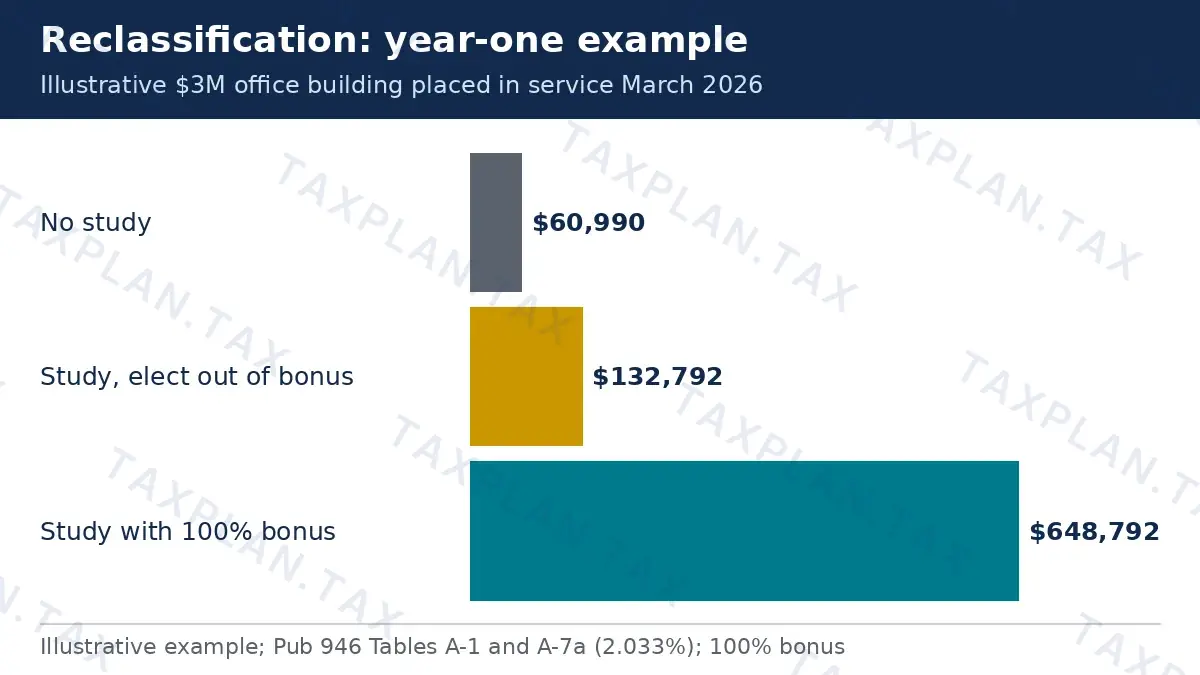
Assume an investor acquires an office building after January 19, 2025, and places it in service in March 2026. The depreciable basis, after removing land, is $3,000,000. Without a study, the first-year deduction is $60,990 ($3,000,000 × 2.033%).
Now assume a study identifies $360,000 of 5-year property and $240,000 of 15-year land improvements. That leaves $2,400,000 in the 39-year building. With 100% bonus depreciation, the first-year deduction is $648,792. That total is $600,000 of bonus plus $48,792 on the building ($2,400,000 × 2.033%).
Example 2: The same study, electing out of bonus
Next, assume the investor elects out of bonus depreciation for both classes under §168(k)(7). The 5-year property then yields $72,000 (20%), and the 15-year property yields $12,000 (5%). Adding the $48,792 building amount gives $132,792. That is still more than double the no-study result, but it spreads the benefit over more years.
| Scenario (illustrative) | 5-year | 15-year | 39-year building | Year-one total |
|---|---|---|---|---|
| No study | $0 | $0 | $60,990 | $60,990 |
| Study, elect out of bonus | $72,000 | $12,000 | $48,792 | $132,792 |
| Study with 100% bonus | $360,000 | $240,000 | $48,792 | $648,792 |
Example 3: When an asset cannot be reclassified
Finally, suppose the same study had also placed $150,000 of site water and sewer lines in the 15-year class. Under AmeriSouth, lines that serve the building generally can be structural components instead. If an examiner agreed with that view, the $150,000 would move back to the 39-year building. For more on how classes differ, see 5-Year, 7-Year, and 15-Year Property in Cost Segregation.
What Are the Common Mistakes and Risks?
Direct answer: Most problems come from overreaching on structural items, weak records, or ignoring purchase agreements.
- Treating building systems as personal property. Central HVAC, general wiring, and general plumbing usually stay with the building.
- Depreciating land costs. General clearing and grading usually belong to the land.
- Ignoring the purchase agreement. A written allocation can bind the buyer, as Peco Foods shows.
- Using rule-of-thumb percentages. Pub. 5653 expects support based on actual costs or reliable estimates.
- Skipping the asset class review. An activity class can change the recovery period for land improvements and equipment.
- Forgetting recapture. §1245 gain on a sale can be ordinary income.
Frequently Asked Questions
What assets can be reclassified in a cost segregation study?
Tangible personal property, land improvements, and, for nonresidential buildings, qualified improvement property. Structural components and land cannot be reclassified.
Can HVAC be reclassified?
Usually not. Treas. Reg. §1.48-1(e)(2) lists central air conditioning and heating systems as structural components. However, machinery whose sole justification is to meet temperature or humidity needs of other machinery or processing is excluded from that list.
Is carpet 5-year property?
Often, yes. In HCA, the Tax Court treated adhesive-installed carpeting as tangible personal property with a 5-year recovery period. Still, permanently affixed floor coverings, such as ceramic tile, are usually structural components.
Are parking lots reclassified?
Generally, yes. Paved areas, sidewalks, and similar site improvements typically fall in asset class 00.3, with a 15-year GDS period, unless an activity class applies.
Can I reclassify assets in a building I already own?
Often, yes. A change in depreciation method or life can usually be made with Form 3115 and a §481(a) adjustment. The automatic change list appears in Rev. Proc. 2025-23.
Do reclassified assets qualify for bonus depreciation?
Generally, yes, if they meet §168(k). For property acquired after January 19, 2025, the rate is 100% unless you elect otherwise.
Does the IRS publish a list of what can be reclassified?
Not a complete list. However, Pub. 5653 includes industry matrices that show how examiners usually classify common items.
Conclusion: How Should You Approach Reclassification?
In short, what assets can be reclassified comes down to the ones that are not land and not part of the building’s structure. A sound study applies the regulations, the Whiteco factors, and the right asset class, and it documents each decision. Because case law punishes overreach, accuracy matters more than the size of the number.
Emunah Cost Segregation helps owners and CPAs identify assets that can be reclassified and support each one. Alan Goldstein, EA, reviews your property and records first. Then he tells you plainly whether a study makes sense. Contact Emunah Cost Segregation in Coral Gables, Florida, to request a review. For a broader view, read What Property Qualifies for a Cost Segregation Study?
Cases Cited
- Hospital Corp. of America v. Commissioner, 109 T.C. 21, 48-52, 74-75 (1997) (United States Tax Court). Pinpoints verified against the reporter-paginated opinion text. Opinion
- Whiteco Industries, Inc. v. Commissioner, 65 T.C. 664, 672-673 (1975) (United States Tax Court). Pinpoint verified against the reporter-paginated opinion text. Opinion
- Morrison, Inc. v. Commissioner, 891 F.2d 857, 863-864 (11th Cir. 1990). Pinpoint verified against the reporter-paginated opinion text. Opinion
- AmeriSouth XXXII, Ltd. v. Commissioner, T.C. Memo. 2012-67, 103 T.C.M. (CCH) 1324 (2012) (United States Tax Court, memorandum opinion). Pinpoint uncertainty: T.C. Memos have no volume or reporter page of their own, and we could not confirm the T.C.M. (CCH) page numbers for the specific holdings. In the CourtListener text, the utility-line holdings appear at star pages *44-*46 and the dryer vent and gas line holdings at *47-*48 and *53; we believe those star pages track the Lexis version, but we could not confirm that. Opinion
- Peco Foods, Inc. v. Commissioner, 522 F. App’x 840, 843-844 (11th Cir. 2013) (unpublished), aff’g T.C. Memo. 2012-18. Pinpoint verified against the reporter-paginated opinion text. Opinion
Sources and Authorities
- 26 U.S.C. §168: https://www.law.cornell.edu/uscode/text/26/168
- 26 U.S.C. §1245: https://www.law.cornell.edu/uscode/text/26/1245
- 26 U.S.C. §469: https://www.law.cornell.edu/uscode/text/26/469
- Public Law 119-21 (H.R. 1, 119th Congress), §70301: https://www.congress.gov/bill/119th-congress/house-bill/1
- IRS Notice 2026-11: https://www.irs.gov/pub/irs-drop/n-26-11.pdf
- Treas. Reg. §1.48-1: https://www.ecfr.gov/current/title-26/section-1.48-1
- Treas. Reg. §1.167(a)-2: https://www.ecfr.gov/current/title-26/section-1.167(a)-2
- IRS Publication 946, including Tables A-1, A-7a, B-1, and B-2: https://www.irs.gov/pub/irs-pdf/p946.pdf
- IRS Publication 5653, Cost Segregation Audit Techniques Guide: https://www.irs.gov/pub/irs-pdf/p5653.pdf
- About Form 3115: https://www.irs.gov/forms-pubs/about-form-3115
- Rev. Proc. 2025-23: https://www.irs.gov/pub/irs-drop/rp-25-23.pdf
- Court opinions: see Cases Cited above.
This article is provided for general educational purposes and does not constitute individualized tax, legal, or accounting advice. Tax consequences depend on the taxpayer’s specific facts and applicable law.
