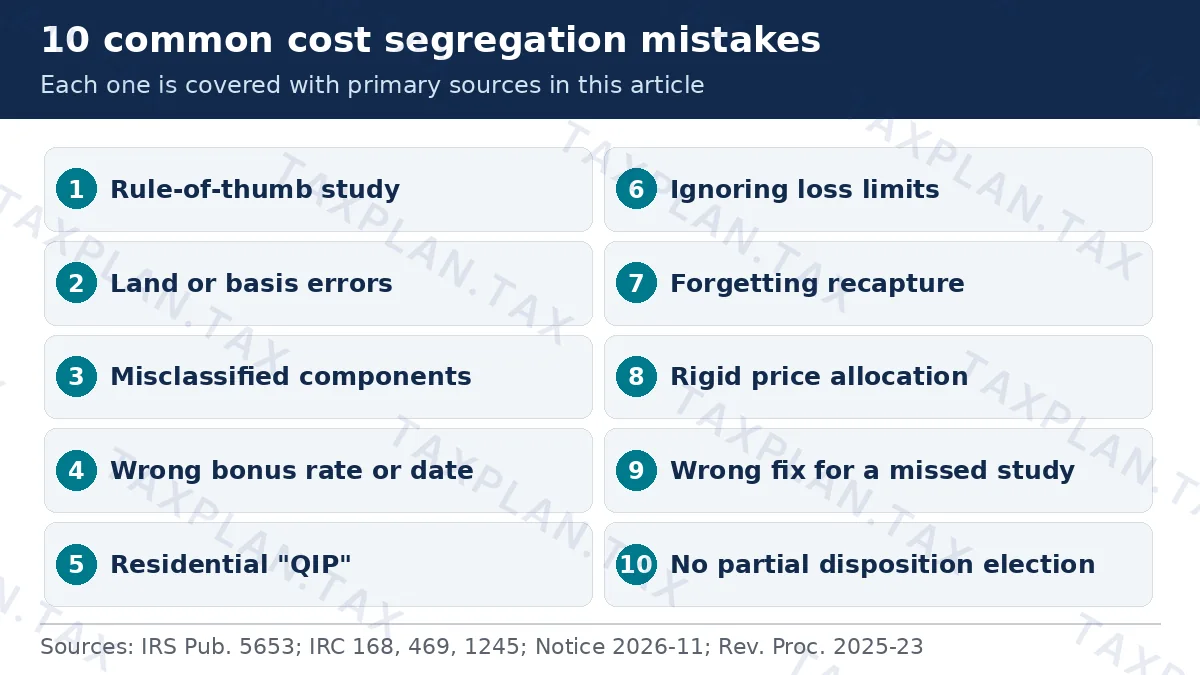

The most common cost segregation mistakes are a weak study, a wrong basis or land figure, the wrong bonus depreciation rate, and a tax return that cannot use the deductions. In addition, other frequent errors include ignoring recapture, signing a rigid purchase price allocation, and fixing a missed study the wrong way. Notably, the IRS says it has not set any required method for studies. However, its Cost Segregation Audit Techniques Guide (Publication 5653) tells examiners exactly what to look for. As a result, that list doubles as a checklist of what to avoid.
Fortunately, most of these cost segregation mistakes are preventable. In fact, nearly all of them come from treating the study as a stand-alone report instead of part of your tax plan. This guide walks through ten common errors, the primary-source rules behind each one, and illustrative examples. As a result, you and your CPA can catch problems before the return is filed.
Key Takeaways
- “Rule of thumb” studies with little documentation draw IRS caution, according to Publication 5653.
- Land, building basis, and component costs must reconcile to the actual purchase price or project cost.
- 100% bonus depreciation applies only to qualified property acquired after January 19, 2025; older contracts use the phase-down rates.
- Passive loss limits under IRC §469 can suspend most of the deduction for many investors.
- A missed study is usually fixed with Form 3115, not an amended return, once two returns are filed.
- Partial disposition elections and purchase contract language can save or cost real money.
Introduction and Background: What Are Cost Segregation Mistakes?
Direct answer: A cost segregation mistake is any error that overstates, understates, or wastes depreciation from a study.
In simple terms, a cost segregation study allocates a building’s cost among recovery classes under IRC §168. For example, some components are 5-, 7-, or 15-year property, while the structure stays 27.5-year or 39-year property. IRS Publication 946 lists these recovery periods. Because the study drives deductions for decades, an early error can repeat on every return.
In general, mistakes fall into two groups. Some are technical, such as misclassifying a structural component. Others are planning errors, such as claiming deductions you cannot use. Both groups matter, because either one can cost you money. For a primer on how studies work, see What Is a Cost Segregation Study and How Does It Work?
How Do Cost Segregation Mistakes Happen? The 10 Most Common Errors
Direct answer: They happen at four points: before purchase, during the study, on the return, and in later years.
1. Relying on a “rule of thumb” study
For example, Publication 5653 describes studies that estimate §1245 property as a fixed percentage of cost. In particular, it says this approach “uses little or no documentation.” It also tells examiners to view it with caution. Instead, the guide describes detailed engineering approaches and 13 principal elements of a quality study. See our guide to what makes a high-quality cost segregation study.
2. Getting land or basis wrong
First, land is not depreciable. Therefore, an inflated building allocation overstates every later deduction. For this reason, Publication 5653 says estimated costs should reasonably approximate the purchase price minus the fair market value of the land. It also says a pro-rata “step-up” factor used only to force a match is not an appropriate method.
3. Misclassifying structural components
Walls, wiring, plumbing, and central HVAC are generally structural components under Treas. Reg. §1.48-1(e)(2). As a result, they are part of the building, not 5-year property. In Hospital Corp. of America, the Tax Court applied the former investment tax credit tests to this question (109 T.C. at 48-52). Similarly, Whiteco Industries set out factors for deciding whether property is inherently permanent (65 T.C. at 672-673).
4. Using the wrong bonus depreciation rate
Under Public Law 119-21, §70301, 100% bonus depreciation applies to qualified property acquired after January 19, 2025. However, property is not treated as acquired after the date a written binding contract for it was signed. According to IRS Notice 2026-11, the old phase-down rate is 40% for such pre-cutoff property placed in service in 2025. Consequently, the contract date matters as much as the closing date.
5. Treating residential interiors as QIP
Qualified improvement property under §168(e)(6) covers interior improvements to nonresidential real property only. It also excludes enlargements, elevators, escalators, and the internal structural framework. Consequently, an apartment renovation does not qualify as QIP. Our article on qualified improvement property explains the details.
6. Ignoring loss limits
Of course, a large deduction is only useful if your return can absorb it. Rental activities are generally passive under §469. In addition, the $25,000 allowance for active participants phases out as adjusted gross income rises above $100,000. The excess business loss rule in §461(l) can also limit use.
7. Forgetting recapture on sale
First, under §1245, gain on §1245 property is ordinary income up to the depreciation taken. Likewise, depreciation on the building itself can produce unrecaptured §1250 gain, taxed at up to 25% under §1(h)(1)(E). For this reason, plan the exit before you accelerate deductions.
8. Signing a rigid purchase price allocation
In Peco Foods, the Eleventh Circuit held a buyer to the allocation in its asset purchase agreements (522 F. App’x at 843-844). As a result, the buyer could not later reclassify components through a study. The court applied the rule from Commissioner v. Danielson (378 F.2d at 775).
9. Fixing a missed study the wrong way
Once you have used a depreciation method on two or more returns, you generally have adopted it. Therefore, the fix is usually an automatic method change on Form 3115. Rev. Proc. 2025-23, section 6.01, covers changes from an impermissible to a permissible depreciation method. Publication 5653 also says amended-return claims based on a later study should not be allowed in that situation. For more, see look-back cost segregation studies.
10. Skipping the partial disposition election
For instance, when you replace a roof or HVAC system, Treas. Reg. §1.168(i)-8(d)(2) lets you elect to treat the old component as disposed of. Generally, you make it on a timely filed original return, including extensions, for the year of disposition. Without it, however, the retired component simply keeps depreciating.
Benefits and Opportunities of Avoiding Cost Segregation Mistakes
Direct answer: Avoiding cost segregation mistakes protects the deduction, lowers audit risk, and keeps future options open.
- Defensible deductions. First, a documented study is easier to support if the IRS examines it.
- Better timing. Also, matching deductions to years when you can use them improves their real value.
- Cleaner exits. Similarly, a component schedule helps you estimate recapture before a sale or exchange.
- Future write-offs. Moreover, detailed records support partial disposition elections later.
To estimate the upside before you start, see How Much Can You Save with a Cost Segregation Study?
Legal and Regulatory Considerations Behind Cost Segregation Mistakes
Direct answer: The key rules are §168, the structural component regulations, the method change rules, and the penalty provisions.
First, the IRS reviews studies against Publication 5653. In its initial risk analysis, the guide lists issues such as questionable basis, misclassified assets, double deductions, incorrect placed-in-service dates, and large look-back computations. Notably, it also says examiners should closely scrutinize studies performed on contingency fees.
Second, the method change rules control how errors are fixed. Publication 5653 cites Treas. Reg. §1.446-1(e)(2)(ii)(d) for the rule that changes in recovery period or method are accounting method changes. In addition, it lists common Form 3115 problems, including informal claims filed instead of Form 3115 and a lack of records for the §481(a) adjustment.
Third, penalties can apply. IRC §6662(a) imposes a 20% accuracy-related penalty on certain underpayments. However, reasonable reliance on a professional may help. In Neonatology Associates, the Tax Court set a three-part test for that defense (115 T.C. at 99). In short, the adviser must be competent, the taxpayer must give accurate information, and the taxpayer must rely in good faith.
Practical Examples of Cost Segregation Mistakes (Illustrative)
Direct answer: The examples below use illustrative assumptions, federal tax only, and Publication 946 Table A-1 rates.
Example 1: The wrong bonus rate
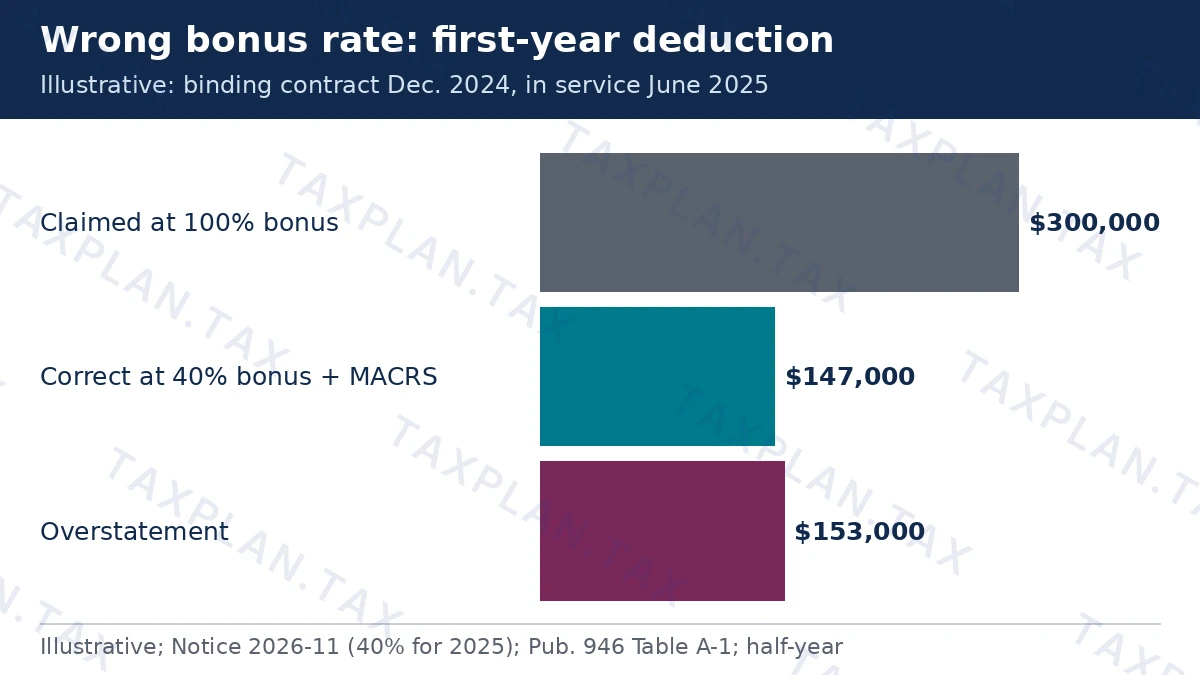
Assume an investor signed a binding purchase contract in December 2024 and placed the property in service in June 2025. The study identifies $200,000 of 5-year property and $100,000 of 15-year property. Even so, the investor claims 100% bonus. However, because of the contract date, the correct rate is 40%.
| Item | Claimed (100% bonus) | Correct (40% bonus) |
|---|---|---|
| 5-year property bonus | $200,000 | $80,000 |
| 5-year regular MACRS (20% of $120,000) | $0 | $24,000 |
| 15-year property bonus | $100,000 | $40,000 |
| 15-year regular MACRS (5% of $60,000) | $0 | $3,000 |
| First-year total | $300,000 | $147,000 |
As a result, the first-year deduction is too high by $153,000. At a 37% rate, that means $56,610 of understated tax. If the §6662 penalty applied, it would add $11,322. For simplicity, this example assumes the half-year convention applies.
Example 2: A deduction the return cannot use
Next, assume an investor with $210,000 of adjusted gross income actively participates in a rental. After a study, the rental shows a $180,000 loss. The $25,000 allowance drops by 50% of the $110,000 excess over $100,000, which is $55,000. Therefore, the allowance is zero, and the loss is suspended under §469. Instead, it carries forward until the investor has passive income or disposes of the entire interest in a fully taxable transaction.
Example 3: The missed partial disposition
Finally, assume a study shows the original roof with $130,000 of remaining basis in 2026, when the owner replaces it. If the owner makes the partial disposition election on the timely 2026 return, that basis can generally be deducted as a loss. Otherwise, the $130,000 keeps depreciating with the building, while the new roof is also capitalized.
Common Mistakes and Risks When You Fix Cost Segregation Mistakes
Direct answer: The fix can create new problems if you skip procedure or documentation.
- Filing informal claims. Publication 5653 lists informal claims filed instead of Form 3115 as a common issue.
- Using the wrong revenue procedure. It also lists automatic procedures used where non-automatic ones apply.
- Adding items to a filed Form 3115. The guide flags this as a recurring problem too.
- Thin records for the §481(a) adjustment. So keep the study, closing documents, and depreciation history.
- Contingency-fee incentives. Fees tied to tax benefits draw closer IRS scrutiny under Publication 5653.
- Relying on an adviser without giving full facts. Under Neonatology, accurate information is part of the reliance defense.
If you expect an exam, our guide on how to prepare for an IRS audit of a cost segregation study covers documentation in depth.
Frequently Asked Questions
What is the most common cost segregation mistake?
In our view, a poorly documented study is among the most serious. Publication 5653 tells examiners to view “rule of thumb” studies with caution.
Can I fix cost segregation mistakes on an amended return?
Sometimes, but only before you have adopted a method. After two or more returns, you generally need Form 3115 under Rev. Proc. 2025-23.
Does a cost segregation study increase audit risk?
A study does not change what you must prove. However, examiners who review a study use Publication 5653, so documentation matters.
Is 100% bonus depreciation available for every 2025 purchase?
No. Specifically, it applies to qualified property acquired after January 19, 2025. Property under an earlier binding contract uses the phase-down rate.
Can residential rental owners claim QIP?
No. QIP under §168(e)(6) is limited to interior improvements to nonresidential real property.
What happens to suspended passive losses?
Generally, they carry forward under §469. You can then use them against passive income, or when you dispose of your entire interest in a fully taxable transaction.
Do purchase contracts affect cost segregation?
Yes. As Peco Foods shows, an agreed allocation can bind the buyer. Therefore, review the contract before signing it.
How do I avoid cost segregation mistakes on a new purchase?
Start early. For example, bring the study provider in before closing, confirm the contract date, and model your loss limits with your CPA.
Conclusion: How Can You Avoid Cost Segregation Mistakes?
In short, most cost segregation mistakes come from rushing the study or separating it from your tax plan. So use a documented engineering approach, reconcile basis, confirm bonus dates, and test whether your return can use the deductions. Then, keep records that support later method changes, partial dispositions, and sales.
Emunah Cost Segregation reviews new and existing studies for these issues. Alan Goldstein, MBA, EA, works with owners and CPAs to check basis, classifications, bonus eligibility, and filing method before deductions are claimed. Contact Emunah Cost Segregation in Coral Gables, Florida, to request a feasibility review or a second look at a prior study.
Cases Cited
- Hospital Corp. of America v. Commissioner, 109 T.C. 21, 48-52 (1997) (United States Tax Court). Pinpoint verified against the reporter-paginated opinion text. Opinion
- Whiteco Industries, Inc. v. Commissioner, 65 T.C. 664, 672-673 (1975) (United States Tax Court). Pinpoint verified against the reporter-paginated opinion text. Opinion
- Peco Foods, Inc. v. Commissioner, 522 F. App’x 840, 843-844 (11th Cir. 2013) (unpublished), aff’g T.C. Memo. 2012-18. Pinpoint verified against the reporter-paginated opinion text. Opinion
- Commissioner v. Danielson, 378 F.2d 771, 775 (3d Cir. 1967). Pinpoint verified against the reporter-paginated opinion text. Opinion
- Neonatology Associates, P.A. v. Commissioner, 115 T.C. 43, 99 (2000) (United States Tax Court). Pinpoint verified against the reporter-paginated opinion text. Opinion
Sources and Authorities
- IRS Publication 5653 (Rev. 2-2025), Cost Segregation Audit Techniques Guide, Chapters 3, 4, 5, and 6: https://www.irs.gov/pub/irs-pdf/p5653.pdf
- IRS Publication 946, How To Depreciate Property (Table A-1): https://www.irs.gov/pub/irs-pdf/p946.pdf
- 26 U.S.C. §168: https://www.law.cornell.edu/uscode/text/26/168
- 26 U.S.C. §469: https://www.law.cornell.edu/uscode/text/26/469
- 26 U.S.C. §461: https://www.law.cornell.edu/uscode/text/26/461
- 26 U.S.C. §1245: https://www.law.cornell.edu/uscode/text/26/1245
- 26 U.S.C. §1: https://www.law.cornell.edu/uscode/text/26/1
- 26 U.S.C. §6662: https://www.law.cornell.edu/uscode/text/26/6662
- Public Law 119-21 (H.R. 1, 119th Congress), §70301: https://www.congress.gov/bill/119th-congress/house-bill/1
- IRS Notice 2026-11: https://www.irs.gov/pub/irs-drop/n-26-11.pdf
- Treas. Reg. §1.48-1: https://www.ecfr.gov/current/title-26/section-1.48-1
- Treas. Reg. §1.168(i)-8: https://www.ecfr.gov/current/title-26/section-1.168(i)-8
- About Form 3115: https://www.irs.gov/forms-pubs/about-form-3115
- Rev. Proc. 2025-23, section 6.01: https://www.irs.gov/pub/irs-drop/rp-25-23.pdf
- Court opinions: see Cases Cited above.
This article is provided for general educational purposes and does not constitute individualized tax, legal, or accounting advice. Tax consequences depend on the taxpayer’s specific facts and applicable law.
