
The IRS cost segregation audit techniques guide is the manual IRS examiners use to review cost segregation studies. Specifically, its formal name is Publication 5653, Cost Segregation Audit Techniques Guide, and the current revision is dated February 6, 2025. In short, the guide explains why owners order studies, how preparers build them, and what examiners should check. For example, it lists 13 principal elements of a quality study and 16 suggested examination steps. It also covers related issues, such as accounting method changes, §263A, and industry-specific asset tables.
However, the guide is not law. In fact, the IRS states that it is not an official pronouncement and may not be cited as authority. Even so, it is the best public window into how the IRS thinks about a study. So owners, CPAs, and study preparers can use it as a checklist before a return is filed. One caution matters in 2026: the guide predates Public Law 119-21, so its bonus depreciation discussion is out of date.
Below, we walk through the cost segregation audit techniques guide chapter by chapter and also explain how to use it in practice.
Key Takeaways
- The cost segregation audit techniques guide is IRS Publication 5653, revised February 6, 2025.
- It guides examiners, but it is not binding law and may not be cited as authority.
- Chapter 4 lists 13 principal elements of a quality study; Chapter 5 lists 16 suggested exam steps.
- The guide says the IRS has not set required standards or a required method for studies.
- However, its bonus depreciation material predates P.L. 119-21, so check current §168(k) rules separately.
- A study built to the guide’s standards is easier to defend and usually faster to examine.
What Is the IRS Cost Segregation Audit Techniques Guide?
Direct answer: It is an IRS training and reference guide for examiners who review depreciation claimed under a cost segregation study.
A cost segregation study allocates the cost of a property among land, land improvements, the building, and personal property. In turn, each class has its own recovery period under IRC §168. For instance, many items of tangible personal property are 5- or 7-year property, while a commercial building is 39-year property. As a result, moving cost out of the building can speed up deductions a great deal.
Indeed, that incentive is exactly why the IRS wrote the cost segregation audit techniques guide. According to Chapter 1, studies “vary widely” in method, documentation, depth, format, and preparer expertise. In addition, the guide notes that there are currently no standards for preparing these studies. Therefore, the IRS gives examiners a common framework instead.
Who wrote it, and how current is it?
First of all, the guide comes from the IRS Large Business and International division. The preface says the 2024 update was led by the Deductible and Capital Expenditures Practice Network, with two other practice networks. In particular, that update reflected the Inflation Reduction Act of 2022 and added guidance for residential rental property. Currently, the published revision date is February 6, 2025. You can find it on the IRS Audit Techniques Guides page.
Is the guide binding on taxpayers?
No. The cover states that the guide “is not an official pronouncement of the law or the position of the Service.” Chapter 1 repeats that it may not be cited as authority. Instead, binding rules come from the Code, Treasury regulations, and court decisions. Still, the cost segregation audit techniques guide shows what an examiner is trained to ask for. As a result, it is very useful in planning.
How Is the Cost Segregation Audit Techniques Guide Organized?
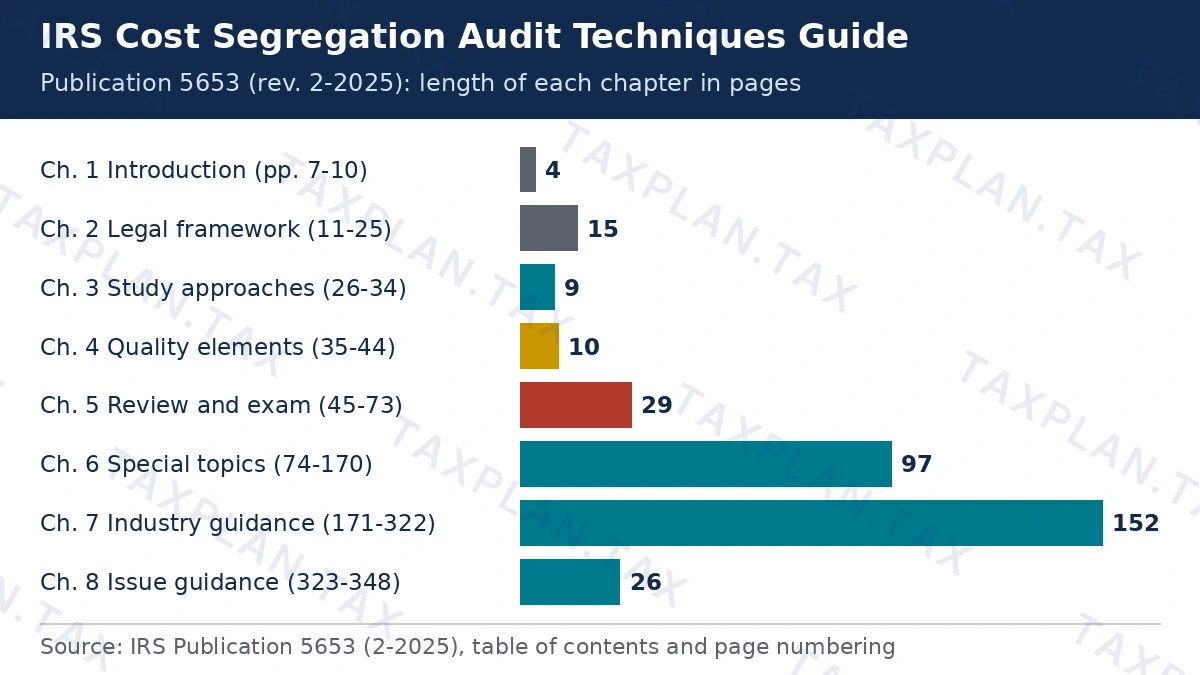
Direct answer: The guide has eight chapters that move from law, to study methods, to quality standards, to audit steps, and then to special and industry topics.
| Chapter | Topic | What it covers |
|---|---|---|
| 1 | Introduction | Purpose, background, and the lack of preparation standards |
| 2 | Legal framework | Depreciation history, §1245 vs. §1250, ITC tests, the HCA case |
| 3 | Cost segregation approaches | Six common study methods and their weak points |
| 4 | Quality study and report | 13 study elements and 9 report elements |
| 5 | Review and examination | 16 suggested examination steps |
| 6 | Special topics | §263A, method changes, case tables, IDRs, §179, §179D, bonus |
| 7 | Industry guidance | Asset tables for retail, restaurants, casinos, auto, residential rental, and more |
| 8 | Issue guidance | Electrical distribution systems and open-air parking structures |
Chapter 2: the legal framework
Chapter 2 traces depreciation from early law through MACRS. After that, it explains how courts separate §1245 property from §1250 property. Notably, it relies on the old investment tax credit rules in Treas. Reg. §1.48-1. It also summarizes the Tax Court’s decision in Hospital Corp. of America v. Commissioner, 109 T.C. 21 (1997). According to Chapter 1, the IRS acquiesced to using those ITC rules to tell §1245 property from §1250 property.
Chapter 3: the six study approaches
Chapter 3 describes six approaches. Briefly, they are the detailed engineering approach from actual cost records, the detailed engineering cost estimate approach, the survey or letter approach, the residual estimation approach, the sampling or modeling approach, and the “rule of thumb” approach. The guide calls the actual-cost approach generally “the most methodical and accurate.” By contrast, it tells examiners to view rule-of-thumb studies “with caution.”
Importantly, Chapter 3 also says the IRS “has not established any requirements or standards” for preparing studies. Even so, taxpayers must still substantiate their deductions. So method matters, even though no single method is required.
How Does the IRS Use the Cost Segregation Audit Techniques Guide During an Exam?
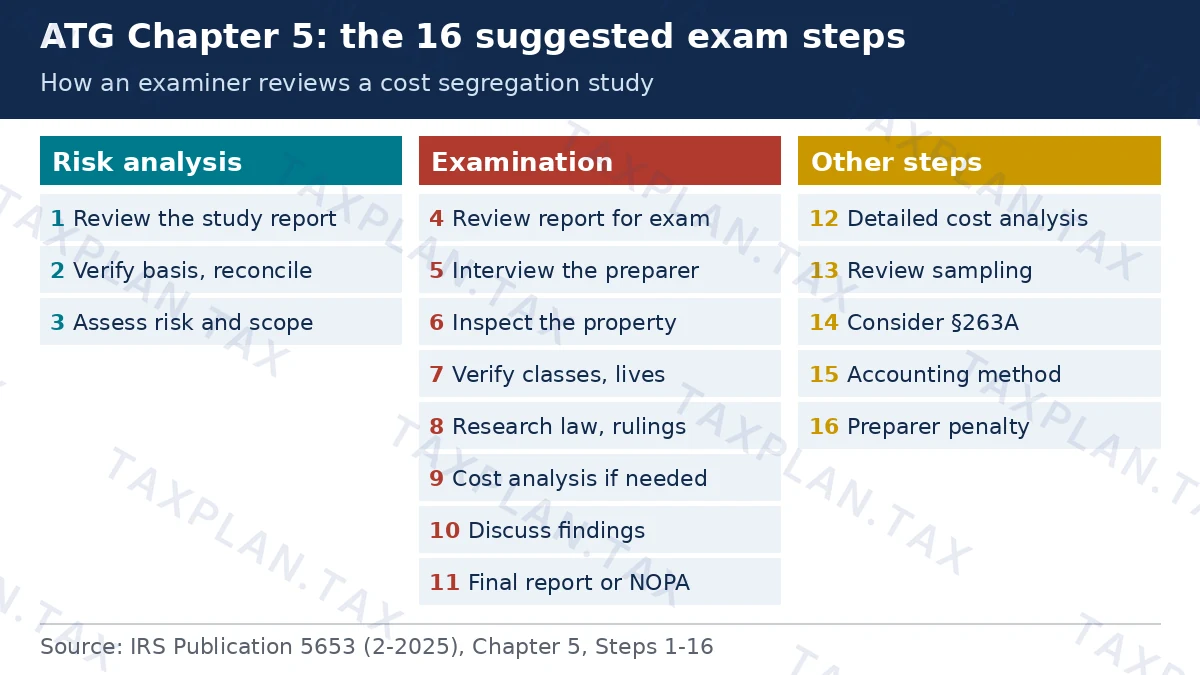
Direct answer: Examiners follow Chapter 5, which starts with a risk analysis and then moves to a detailed review, a site visit, and, if needed, a cost analysis.
Steps 1 to 3: risk analysis
First, the examiner reads the study report. Next, the examiner reconciles the study’s cost basis to the depreciation schedules and the return. Then the examiner decides whether the issue is worth examining. Chapter 5 also lists common red flags. For example, these include mixed asset types in one group, structural components given short lives, little or no cost assigned to land, and “creative” asset names. Under the guide, studies with little tax impact “should be closed expeditiously.”
Steps 4 to 11: the examination
Second, if the risk is real, the examiner asks for the engagement letter and checks the fee arrangement. In particular, the guide says studies done on contingency fees should be closely scrutinized. After that, the examiner interviews the preparer and inspects the property. Likewise, the examiner verifies asset classes against Rev. Proc. 87-56, whose class lives appear in IRS Publication 946. Finally, the examiner discusses findings with the taxpayer and issues a report or proposed adjustment.
Steps 12 to 16: other considerations
In addition, the last five steps cover deeper work. For instance, they include a detailed cost analysis, a review of sampling, and §263A capitalization. Similarly, they include accounting method issues and a possible penalty on the study preparer. For that last step, the guide cites Chief Counsel Advice 201805001. In that advice, Chief Counsel concluded that an engineer who furnished reports mischaracterizing 39-year building components was liable under IRC §6701. Under the statute, that penalty is $1,000 per return, or $10,000 for a corporate return.
What Benefits Does the Cost Segregation Audit Guide Offer Owners and Advisors?
Direct answer: The guide tells you, in the IRS’s own words, what a defensible study looks like.
- A built-in quality checklist. Chapter 4’s 13 elements give owners a way to compare proposals from different firms.
- A preview of document requests. Chapter 6 includes seven sample Information Document Requests, so you can gather those records early.
- Industry asset tables. Chapter 7 also shows how the IRS views common assets in several industries.
- Fewer surprises. Because the guide flags common problems, a preparer can fix them before filing.
Moreover, the guide states its own aim plainly. Specifically, a quality study, it says, will “expedite the exam process” and reduce burden for everyone. For background on what a study involves, see our guide to what a cost segregation study is.
What Legal Rules Sit Behind the Cost Segregation Audit Techniques Guide?
Direct answer: The guide applies the Code, regulations, and case law; it does not replace them.
To begin with, the core rules are in §168, which sets MACRS recovery periods and methods. Meanwhile, the §1245 and §1250 definitions decide which items are personal property and which are real property. In addition, courts still use the ITC framework. For example, Whiteco Industries lists questions about whether property can be moved and whether it is designed to stay in place (65 T.C. 664, 672-673).
Accounting method changes
The cost segregation audit techniques guide states the IRS position that a change in recovery period or method is a change in accounting method. Today, that position is in Treas. Reg. §1.446-1(e)(2)(ii)(d). So a study done after a return is filed is generally put into effect with Form 3115, not an amended return. Accordingly, the guide points to Rev. Proc. 2015-13 for the procedures.
Purchase price allocations
The guide also discusses §1060. Under that section, if buyer and seller agree in writing on an allocation in an applicable asset acquisition, the agreement binds both of them. For example, in Peco Foods, the Eleventh Circuit held the taxpayer to its allocation schedule and rejected a later study-based change (522 F. App’x 840, 843-844).
Bonus depreciation is now out of date in the cost segregation audit guide
Chapter 6.H discusses bonus depreciation under prior law. However, Public Law 119-21 later restored a 100% rate for qualified property acquired after January 19, 2025. Later, the IRS explained the change in Notice 2026-11. So rely on current §168(k) and IRS notices for bonus rates, not the February 2025 guide.
Additionally, full case citations appear in the Cases Cited section below.
What Does the Cost Segregation Audit Techniques Guide Look Like in Practice?
Direct answer: The guide’s own examples show how examiners test a study’s numbers. The figures below come from the guide or are labeled illustrative.
Example 1: the step-up factor red flag
Chapter 3 gives an example of an acquired warehouse. Here, the purchase price is $5 million, and the land is worth $1.88 million. Thus, that leaves $3.12 million for the improvements and personal property. However, the study’s estimates totaled only $2.6 million. So the preparer multiplied every estimate by 1.2 to close the gap.
| Item (ATG Chapter 3 example) | Study estimate | After 1.2 step-up |
|---|---|---|
| §1245 property | $800,000 | $960,000 |
| Land improvements | $600,000 | $720,000 |
| Building | $1,200,000 | $1,440,000 |
| Total | $2,600,000 | $3,120,000 |
The math ties out: $2.6 million times 1.2 equals $3.12 million, a $520,000 increase. Yet the guide says this pro-rata step-up “is not an acceptable method.” Instead, a gap like this signals errors, such as a wrong land value or missed assets.
Example 2: reconciling to the return (illustrative)
Now assume a study on a $2 million building reports $400,000 of 5-year property. Also assume the depreciation schedule shows only $350,000 in that class. Under Step 2, the examiner would then ask why. For example, perhaps $50,000 of furniture was bought separately and booked twice. Indeed, the guide specifically warns about duplicated furniture, fixtures, and equipment. Therefore, a clean reconciliation is one of the easiest ways to avoid an adjustment.
What Are the Common Mistakes and Risks?
Direct answer: Most problems the guide flags come from weak documentation, inflated short-life classes, and poor reconciliation.
- Treating the guide as law. It is guidance for examiners. So cite the Code, regulations, and cases instead.
- Relying on old bonus rules. The guide’s bonus chapter predates P.L. 119-21.
- Using a rule of thumb. A fixed percentage of cost lacks the support the guide expects.
- Undervaluing land. The guide says land should be valued first, at highest and best use.
- Creative asset names. For example, calling sewer piping “process piping” invites scrutiny.
- Ignoring the method change rules. A post-filing study generally needs Form 3115.
- Missing a binding allocation. A written §1060 allocation can block a later study.
For a deeper look at the records that support a study, read our article on documentation for avoiding IRS challenges to cost segregation studies.
Frequently Asked Questions
What publication number is the cost segregation audit techniques guide?
It is IRS Publication 5653. Also, the current revision shown on the document is dated February 6, 2025.
Can I cite the cost segregation audit guide in a protest or in Tax Court?
The guide says it may not be cited as authority. Even so, you can still point to it to show the IRS’s own published expectations. However, your legal argument should rest on the Code, regulations, and cases.
Does the IRS require a specific study method?
No. In fact, Chapter 3 states that the IRS has not established requirements or standards for preparing studies. Even so, the guide favors methods based on actual costs or sound estimates.
Does the cost segregation audit guide cover residential rental property?
Yes. Specifically, the 2024 update added industry guidance for residential rental property in Chapter 7.H.
Are contingency-fee studies a problem?
The guide tells examiners to closely scrutinize them. After all, it reasons that such fees create an incentive to push costs into §1245 property.
Is the guide’s bonus depreciation discussion current?
No. It predates P.L. 119-21. Therefore, for current rates and dates, see §168(k) as amended and IRS Notice 2026-11.
Can a study preparer be penalized?
Yes, in some cases. For example, the guide cites CCA 201805001, which applied the §6701 penalty to an engineer whose reports mischaracterized building components.
Conclusion: How Should You Use the Cost Segregation Audit Techniques Guide?
Overall, use the cost segregation audit techniques guide as a preview of the exam. After all, its quality elements, red flags, and sample document requests show what the IRS will test. So a study that meets them is easier to defend. Remember, though, that it is not law, and its bonus discussion is dated.
At Emunah Cost Segregation, Alan Goldstein, MBA, EA, reviews studies against the standards in Publication 5653 and current law. If you want a study built to hold up under review, or a second look at an existing one, contact Alan Goldstein & Associates in Coral Gables to discuss your property.
Cases Cited
- Hospital Corp. of America v. Commissioner, 109 T.C. 21, 48-52 (1997) (United States Tax Court). Pinpoint verified against the reporter-paginated opinion text. Opinion
- Whiteco Industries, Inc. v. Commissioner, 65 T.C. 664, 672-673 (1975) (United States Tax Court). Pinpoint verified against the reporter-paginated opinion text. Opinion
- Peco Foods, Inc. v. Commissioner, 522 F. App’x 840, 843-844 (11th Cir. 2013) (unpublished), aff’g T.C. Memo. 2012-18. Pinpoint verified against the reporter-paginated opinion text. Opinion
Sources and Authorities
- IRS Publication 5653, Cost Segregation Audit Techniques Guide (rev. 2-6-2025), Chapters 1-6: https://www.irs.gov/pub/irs-pdf/p5653.pdf
- IRS, Audit Techniques Guides (ATGs): https://www.irs.gov/businesses/small-businesses-self-employed/audit-techniques-guides-atgs
- 26 U.S.C. §168: https://www.law.cornell.edu/uscode/text/26/168
- 26 U.S.C. §1245: https://www.law.cornell.edu/uscode/text/26/1245
- 26 U.S.C. §1250: https://www.law.cornell.edu/uscode/text/26/1250
- 26 U.S.C. §263A: https://www.law.cornell.edu/uscode/text/26/263A
- 26 U.S.C. §1060: https://www.law.cornell.edu/uscode/text/26/1060
- 26 U.S.C. §6701: https://www.law.cornell.edu/uscode/text/26/6701
- Treas. Reg. §1.48-1: https://www.ecfr.gov/current/title-26/section-1.48-1
- Treas. Reg. §1.446-1: https://www.ecfr.gov/current/title-26/section-1.446-1
- IRS Chief Counsel Advice 201805001: https://www.irs.gov/pub/irs-wd/201805001.pdf
- IRS Publication 946 (Rev. Proc. 87-56 class lives in Table B-1): https://www.irs.gov/pub/irs-pdf/p946.pdf
- Rev. Proc. 2015-13: https://www.irs.gov/pub/irs-drop/rp-15-13.pdf
- About Form 3115: https://www.irs.gov/forms-pubs/about-form-3115
- Public Law 119-21 (H.R. 1, 119th Congress): https://www.congress.gov/bill/119th-congress/house-bill/1
- IRS Notice 2026-11: https://www.irs.gov/pub/irs-drop/n-26-11.pdf
- Court opinions: see Cases Cited above.
This article is provided for general educational purposes and does not constitute individualized tax, legal, or accounting advice. Tax consequences depend on the taxpayer’s specific facts and applicable law.
