
Cost segregation fees are usually worth paying when the after-tax value of the faster deductions, measured over your expected holding period, clearly exceeds the after-tax cost of the study. In practice, that test has three parts. First, the study must move enough basis into 5-, 7-, or 15-year property. Second, you must be able to use the deductions soon. Third, the value of deferral must survive any recapture when you sell. Under IRC §168(k), as amended by Public Law 119-21, qualified property acquired after January 19, 2025, generally gets 100% bonus depreciation.
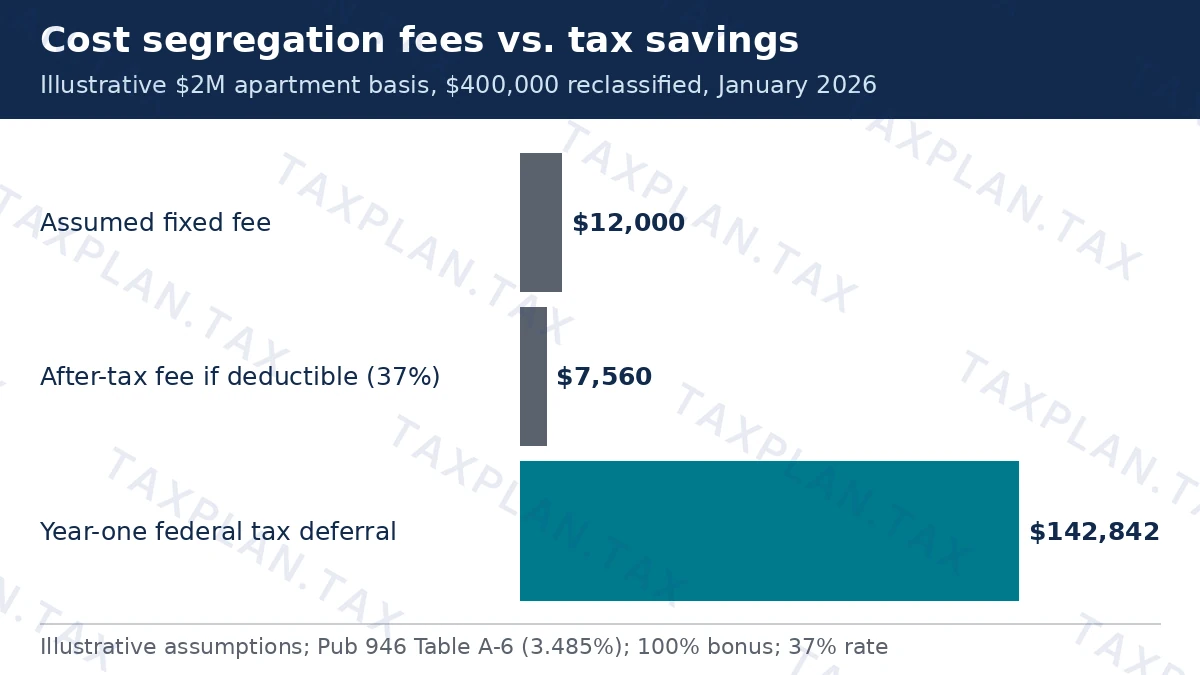
As a result, much of the benefit now arrives in year one. In our illustrative apartment example, an assumed $12,000 fee is compared with about $142,842 of first-year federal tax deferral. Even under a conservative five-year sale test, the present-value result stays positive. However, the result can turn negative when losses are suspended, the building is small, or the fee is out of line with the work.
Key Takeaways
- Compare the after-tax fee with the present value of the tax deferral, not with gross deductions.
- For property acquired after January 19, 2025, reclassified short-life property can generally be deducted in full in year one.
- Most of the savings are deferral; recapture under §1245 can reverse part of the benefit on a sale.
- Passive loss and other limits can delay the savings and lower ROI.
- A purchase agreement allocation or a weak study can shrink the savings a fee was meant to buy.
- Fixed cost segregation fees avoid the incentive problems the IRS associates with contingency fees.
Introduction and Background: Why Compare Cost Segregation Fees With Tax Savings?
Direct answer: A study is an up-front cost that buys earlier deductions, so it should be judged like any other investment.
To begin with, a cost segregation study does not create new deductions in total. Instead, it moves deductions earlier. For example, a carpet or a parking lot recovered over 5 or 15 years, rather than 27.5 or 39 years, gives you more depreciation now and less later. Thus, the value comes from paying less tax today and investing or using that cash in the meantime.
So, comparing cost segregation fees with “tax savings” needs care. Typically, the headline number is the first-year deferral. However, the true return also reflects later years, your tax rate, and what happens on a sale. We cover payback timing in Cost Segregation ROI: How Quickly Do Studies Pay for Themselves?, and owner-level factors in When Is a Cost Segregation Study Worth It? By comparison, this article focuses on the fee side of that equation.
How Do You Measure Cost Segregation Fees Against Tax Savings?
Direct answer: Estimate the extra deductions, convert them to tax, adjust for timing and recapture, and then subtract the after-tax fee.
- Estimate the reclassified basis. This is the cost a study moves out of the building into shorter classes listed in IRS Publication 946.
- Compute the year-one difference. Compare depreciation with and without the study, including bonus if it applies.
- Apply a realistic tax rate. Use the rate at which you can actually use the deduction this year.
- Test usability. The passive activity rules in §469 and the excess business loss rule in §461(l) can defer the benefit.
- Model the exit. On a sale, depreciation on §1245 property is generally recaptured as ordinary income under §1245. In contrast, building depreciation for an individual is generally unrecaptured §1250 gain, taxed at a maximum 25% rate under §1(h)(1)(E).
- Discount and net the fee. Discount the yearly tax differences, and then subtract the after-tax fee.
A quick screen also helps. To use it, divide the fee by the first-year tax value of one reclassified dollar. The result, in turn, is the reclassified basis needed for year-one savings to equal the fee.
Benefits and Opportunities: When Are Cost Segregation Fees Easiest to Justify?
Direct answer: Fees are easiest to justify when bonus applies, deductions are usable now, and the holding period is long.
- 100% bonus depreciation. For qualified property acquired after January 19, 2025, the full reclassified amount can generally be deducted in year one. IRS Notice 2026-11 provides interim guidance on the amended §168(k).
- Usable deductions. Active owners, real estate professionals, and investors with passive income can often use the losses sooner.
- Long holds. The longer you hold, the more time value the deferral earns before any recapture.
- Transfers at death. Under §1245(b)(2), §1245 recapture generally does not apply to a transfer at death, except as provided for income in respect of a decedent.
- Catch-up options. A study done later can often claim missed depreciation through Form 3115 under Rev. Proc. 2025-23.
Legal and Regulatory Considerations for Cost Segregation Fees
Direct answer: Classification law, purchase contracts, fee arrangements, and capitalization rules all affect the real return on a fee.
Classification rules set the savings
Above all, the savings depend on how much property truly qualifies as §1245 property. In Hospital Corp. of America v. Commissioner, 109 T.C. 21 (1997), the Tax Court held that the former investment tax credit tests still govern that question under MACRS. Those tests appear in Treas. Reg. §1.48-1. Meanwhile, in AmeriSouth XXXII, Ltd. v. Commissioner, T.C. Memo. 2012-67, the court sided with the Commissioner on several items, including utility lines. So savings that rest on aggressive classifications may not last.
Contracts can cap the savings
In Peco Foods, Inc. v. Commissioner, 522 F. App’x 840 (11th Cir. 2013), the buyer was bound by the allocation schedules in its asset purchase agreements. As a result, it could not use a later study to reallocate the price. Therefore, review any allocation clause before you pay for a study.
Fee arrangements draw attention
The IRS Cost Segregation Audit Techniques Guide (Publication 5653) says many firms charge a fee based mainly on project size. It also says, however, that contingency fees create an incentive to maximize §1245 property. Accordingly, it tells examiners to closely scrutinize contingency-fee studies. In other words, a higher audit risk is a real cost, even if it never shows up on the invoice.
Deducting the fee is not automatic
We found no regulation, revenue ruling, or IRS publication that specifically addresses cost segregation fees. Generally, ordinary and necessary expenses are deductible under §162 or §212. Yet Treas. Reg. §1.263(a)-2(f) requires capitalization of amounts paid to facilitate an acquisition, including appraisals and engineering services pertaining to particular properties. Also, in INDOPCO, Inc. v. Commissioner, 503 U.S. 79 (1992), the Supreme Court described deductions as exceptions to the norm of capitalization. For that reason, the examples below show results both ways. Full case citations appear in the Cases Cited section below.
Practical Examples: Cost Segregation Fees vs Tax Savings in Numbers
Direct answer: In these examples, the fee is small next to first-year deferral, and the present-value result stays positive even with an early sale. All figures are illustrative assumptions.
Example 1: First-year savings on an apartment building
Assume an investor buys an apartment building and places it in service in January 2026. The depreciable basis, excluding land, is $2,000,000. First, without a study, first-year depreciation is $69,700, using the 3.485% January rate in Publication 946, Table A-6.
Next, assume a study reclassifies $400,000 to 5-, 7-, and 15-year property, and 100% bonus applies. Meanwhile, the remaining $1,600,000 yields $55,760 of 27.5-year depreciation. So first-year depreciation becomes $455,760, which is $386,060 more. At an assumed 37% marginal federal rate, that defers about $142,842 of federal tax.
Now, compare that deferral with cost segregation fees of $12,000, an assumed fixed fee. If the fee is deductible at 37%, its after-tax cost is $7,560. On the other hand, if it must be capitalized, the near-term cost is closer to the full $12,000.
Example 2: A conservative five-year sale test
Then, assume the investor sells in December 2030, the fifth year. For a stress test, also assume the entire $400,000 is recaptured as ordinary income at 37%. Without the study, that same $400,000 of cost would have produced $71,510 of building depreciation through the sale, taxed at 25% as unrecaptured §1250 gain.
| Illustrative item (study vs. no study) | Amount |
|---|---|
| Year-one federal tax deferral | $142,842 |
| Lost building deductions, years 2-5 (tax at 37%) | About $21,301 |
| Extra tax at sale (worst case) | $130,122 |
| Net nominal tax difference | About -$8,581 |
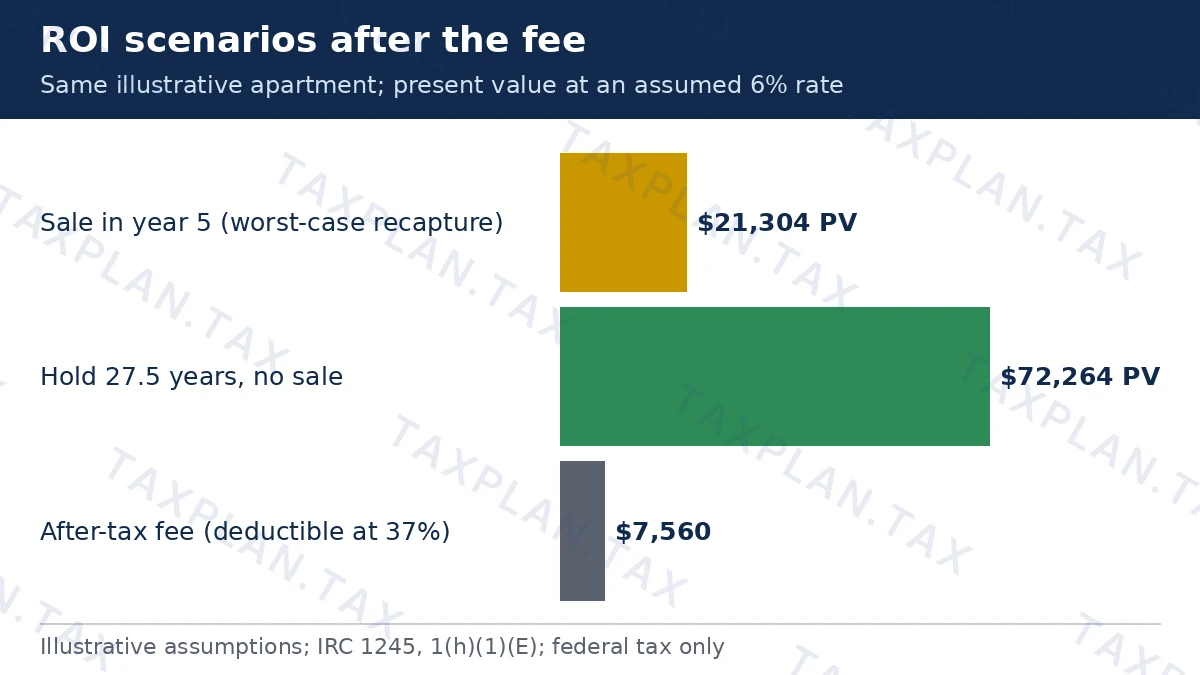
| Present value at an assumed 6% discount rate | About $21,304 |
| Net of $7,560 after-tax fee | About $13,744 |
In nominal dollars, this worst case costs slightly more tax, because part of the gain is taxed at 37% instead of 25%. Even so, the present value is positive, since the deferral arrives years before the extra tax. In practice, recapture is limited to the gain allocable to the §1245 property, which may be less than its original cost.
Example 3: A long hold
Finally, assume the same investor holds the building for the full 27.5-year recovery period and never sells. In that case, total deductions are the same either way. However, at a 6% discount rate, the present value of the deferral is about $72,264. After the $7,560 after-tax fee, the net benefit is about $64,704.
Quick breakeven screen
Using the same 37% rate and January placement, one reclassified dollar is worth about 35.7 cents of first-year tax. So $12,000 of cost segregation fees breaks even in year one at about $33,600 of reclassified basis. If the fee is deductible, the breakeven drops to about $21,170.
Common Mistakes When Weighing Cost Segregation Fees
Direct answer: Most errors overstate the savings or ignore what can reduce them.
- Treating deferral as permanent savings. Recapture can reverse part of the benefit on a sale.
- Ignoring loss limits. Suspended passive losses produce no current cash benefit.
- Using the wrong tax rate. A deduction used against low-bracket income is worth less.
- Forgetting the acquisition date. Property under a binding contract signed before January 20, 2025, may get a lower bonus rate.
- Choosing on fee alone. A cheap study that fails on audit can cost more than it saved.
- Ignoring state tax. States may not follow federal bonus depreciation, so check conformity.
Frequently Asked Questions
Are cost segregation fees worth it for a small property?
Sometimes. To decide, use the breakeven screen: if the likely reclassified basis is near or below the breakeven amount, the fee may not pay off.
How fast do the savings cover the fee?
If bonus applies and you can use the loss, often in the first tax year. If losses are suspended, the payback waits until you have passive income or dispose of the activity.
Does recapture wipe out the benefit?
Not necessarily. For example, in our worst-case five-year example, the nominal result was slightly negative, but the present value stayed positive.
Should I pay a percentage-of-savings fee?
Be cautious, because Publication 5653 tells examiners to closely scrutinize contingency-fee studies, and Circular 230 limits contingent fees for practitioners.
Can I deduct the study fee?
Possibly, but we found no published guidance that addresses study fees directly. Ask your tax adviser how the capitalization rules apply to your facts.
What if I already filed without a study?
Often, you can catch up through Form 3115 in a later year. That makes waiting an option, although it delays the savings.
Do the savings depend on state taxes?
Yes. Note that our examples use federal tax only. State conformity and rates can raise or lower the result.
Conclusion: Is the ROI on Cost Segregation Fees Worth It?
For many owners who can use the deductions and plan to hold, the math favors the study. Still, the answer is personal, since it depends on your basis, tax rate, loss limits, contracts, and exit plan. A sound fee decision compares the after-tax fee with present-value savings, not with the gross deduction.
Emunah Cost Segregation can run these numbers before you commit. Alan Goldstein, MBA, EA, reviews your property, purchase documents, and tax position before any study begins. If the ROI is weak, he will say so. Contact Emunah Cost Segregation in Coral Gables, Florida, to request a feasibility review.
Cases Cited
- Hospital Corp. of America v. Commissioner, 109 T.C. 21, 48-52 (1997) (United States Tax Court). Pinpoint verified against the reporter-paginated opinion text. Opinion
- AmeriSouth XXXII, Ltd. v. Commissioner, T.C. Memo. 2012-67, 103 T.C.M. (CCH) 1324 (2012) (United States Tax Court, memorandum opinion). Pinpoint uncertainty: T.C. Memos have no volume or reporter page of their own, and we could not confirm the T.C.M. (CCH) page numbers for the specific holdings. In the CourtListener text, the utility-line holdings appear at star pages *44-*46; we believe those star pages track the Lexis version, but we could not confirm that. Opinion
- Peco Foods, Inc. v. Commissioner, 522 F. App’x 840, 843-844 (11th Cir. 2013) (unpublished), aff’g T.C. Memo. 2012-18. Pinpoint verified against the reporter-paginated opinion text. Opinion
- INDOPCO, Inc. v. Commissioner, 503 U.S. 79, 84 (1992) (Supreme Court of the United States). Pinpoint verified against the reporter-paginated opinion text. Opinion
Sources and Authorities
- 26 U.S.C. §168 (including §168(k)): https://www.law.cornell.edu/uscode/text/26/168
- Public Law 119-21 (H.R. 1, 119th Congress), §70301: https://www.congress.gov/bill/119th-congress/house-bill/1
- IRS Notice 2026-11: https://www.irs.gov/pub/irs-drop/n-26-11.pdf
- 26 U.S.C. §1 (including §1(h)(1)(E)): https://www.law.cornell.edu/uscode/text/26/1
- 26 U.S.C. §1245 (including §1245(b)(2)): https://www.law.cornell.edu/uscode/text/26/1245
- 26 U.S.C. §469: https://www.law.cornell.edu/uscode/text/26/469
- 26 U.S.C. §461 (including §461(l)): https://www.law.cornell.edu/uscode/text/26/461
- 26 U.S.C. §162: https://www.law.cornell.edu/uscode/text/26/162
- 26 U.S.C. §212: https://www.law.cornell.edu/uscode/text/26/212
- Treas. Reg. §1.48-1: https://www.ecfr.gov/current/title-26/section-1.48-1
- Treas. Reg. §1.263(a)-2: https://www.ecfr.gov/current/title-26/section-1.263(a)-2
- IRS Publication 946, How To Depreciate Property, including Table A-6: https://www.irs.gov/pub/irs-pdf/p946.pdf
- IRS Publication 5653 (Rev. 2-2025), Cost Segregation Audit Techniques Guide, Chapter 5: https://www.irs.gov/pub/irs-pdf/p5653.pdf
- About Form 3115: https://www.irs.gov/forms-pubs/about-form-3115
- Rev. Proc. 2025-23: https://www.irs.gov/pub/irs-drop/rp-25-23.pdf
- Court opinions: see Cases Cited above.
This article is provided for general educational purposes and does not constitute individualized tax, legal, or accounting advice. Tax consequences depend on the taxpayer’s specific facts and applicable law.
