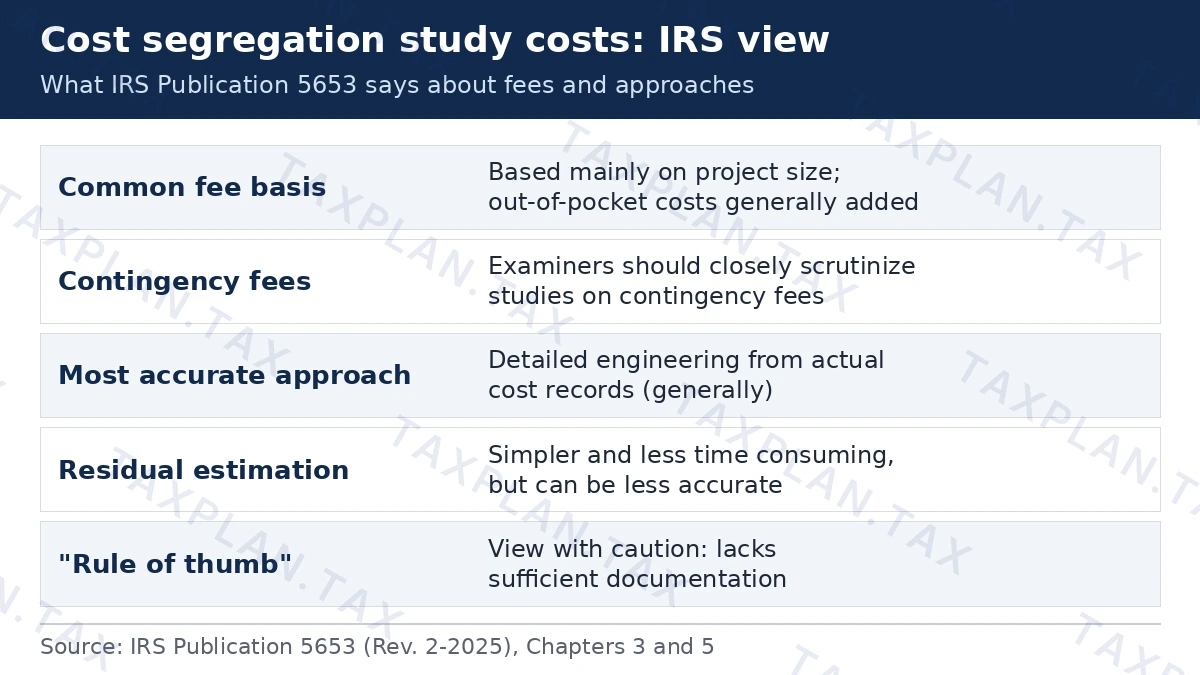

Cost segregation study costs are usually quoted as a fixed professional fee that scales with the size and complexity of the property, plus any out-of-pocket travel expenses. The IRS does not publish a fee schedule or price survey, so there is no official “standard” price. However, the IRS Cost Segregation Audit Techniques Guide (Publication 5653) states that many firms charge a fee based primarily on the size of the project, with out-of-pocket costs generally added. The same guide warns that examiners should closely scrutinize studies done on contingency fees.
In practice, what you should expect to pay depends on the property type, the records available, the approach used, and the deliverables you need. The best way to judge cost segregation study costs is to compare a written, fixed-fee quote with the after-tax value of the extra depreciation the study can support. This guide explains the price drivers, fee structures, tax treatment of the fee, and worked examples.
Key Takeaways
- No IRS fee schedule exists; quotes vary with property size, complexity, records, and scope.
- The IRS audit guide says many firms price by project size and add out-of-pocket costs.
- Contingency fees tied to tax savings draw closer IRS scrutiny under Publication 5653.
- Cheaper “rule of thumb” studies cost less up front but carry more audit risk.
- We found no published IRS guidance that specifically addresses whether the study fee is deductible, so confirm treatment with your tax adviser.
- Judge the fee against after-tax savings, not against the property price alone.
What Do Cost Segregation Study Costs Cover?
Direct answer: The fee pays for engineering analysis, cost estimating, tax classification, and a written report that can support your depreciation if the IRS asks.
A cost segregation study allocates a building’s cost among recovery classes. For example, some components are 5-, 7-, or 15-year property, while the shell stays 27.5-year or 39-year property. Specifically, the tax rules come from IRC §168 and the asset classes in IRS Publication 946. As a result, the work blends construction knowledge with tax law.
Publication 5653 lists 13 principal elements of a quality study. They include preparation by a person with expertise, a described methodology, appropriate documentation, interviews, a legal analysis, unit costs and engineering “take-offs,” and a reconciliation of allocated costs to actual costs. Each element takes professional time, so each one adds to cost segregation study costs. Therefore, a quote that includes all 13 elements will usually cost more than a quick estimate.
For an overview of each stage, see our Cost Segregation Study Process: Step-by-Step Breakdown.
How Are Cost Segregation Study Costs Priced?
Direct answer: Most quotes are fixed fees based on the project, although some firms propose fees tied to the tax benefit.
Fixed fees based on project size
According to Publication 5653, Chapter 5, many firms charge a fee based primarily on the size of the project. Out-of-pocket expenditures, such as travel for the site visit, are generally added. As a result, a fixed fee is simple to budget. It also removes any incentive to inflate the short-life property.
Contingency fees based on tax savings
By contrast, some firms base the fee on the tax benefits the study produces. The same chapter says these arrangements create an incentive to maximize costs assigned to §1245 property. It also adds that examiners should closely scrutinize studies performed on contingency fees and refers to Circular 230. So a contingency fee can raise your audit profile even when the study itself is sound.
What usually changes the quote?
Notably, the IRS does not list pricing factors. Still, the guide’s description of the work points to the main drivers:
- Property size and complexity. More systems and finishes mean more components to identify and cost.
- New construction or acquisition. New projects often have contractor records, whereas acquired buildings usually need estimates.
- Quality of records. Drawings, pay applications, and invoices shorten the analysis.
- Site visit and travel. The guide recommends a field inspection for all quality studies.
- Look-back work. A study for a prior-year property may need a Form 3115 and a §481(a) calculation.
- Number of properties. Sampling can lower per-property costs for nearly identical sites, but the guide warns about accuracy limits.
Why Do Some Cost Segregation Studies Cost More Than Others?
Direct answer: The approach drives the price, and the IRS treats some approaches as far more reliable than others.
Publication 5653, Chapter 3, describes six common approaches. The detailed engineering approach from actual cost records is, in general, the most methodical and accurate approach. Similarly, the detailed engineering cost estimate approach works when actual records are missing. In contrast, the residual estimation approach is simpler and less time consuming, but it can also be less accurate. The guide also says examiners should view the “rule of thumb” approach with caution because it lacks sufficient documentation.
| Approach (Pub. 5653, Ch. 3) | Typical inputs | IRS view in the guide |
|---|---|---|
| Detailed engineering, actual cost records | Contractor records, drawings, invoices | Generally the most methodical and accurate |
| Detailed engineering cost estimate | Drawings, site visit, published cost data | Methodical when sources are documented |
| Survey or letter | Contractor surveys of installed costs | Reasonably reliable with actual contractor data |
| Residual estimation | Short-life items only; residual to building | Simpler, but can be less accurate |
| Sampling or modeling | Template for nearly identical sites | Accuracy concerns; populations under 50 can limit accuracy |
| “Rule of thumb” | Industry percentages, little documentation | View with caution |
Consequently, low upfront cost segregation study costs do not guarantee a low total cost. After all, a thin study can lose deductions on audit, and the burden of proof stays with you.
Benefits and Opportunities: What Do Cost Segregation Study Costs Buy?
Direct answer: The fee buys earlier deductions and documentation, and current law makes those deductions larger in year one.
For qualified property acquired after January 19, 2025, Public Law 119-21 set bonus depreciation under §168(k) at 100%. IRS Notice 2026-11 provides interim guidance on that change. Bonus generally applies to property with a recovery period of 20 years or less. Thus, every dollar a study moves into the 5-, 7-, or 15-year classes may be deductible in the first year.
In addition, a quality study buys support. For instance, if the IRS examines the return, a well-documented report helps you show how each cost was classified. For a broader look at the value side, see When Is a Cost Segregation Study Worth It?
Legal and Regulatory Considerations for Cost Segregation Study Costs
Direct answer: The rules on classification, fee arrangements, and fee deductibility all affect what a study really costs you.
Classification must rest on the law
The Tax Court held in Hospital Corp. of America v. Commissioner, 109 T.C. 21 (1997), that the former investment tax credit tests still decide §1245 status under MACRS. Today, those tests appear in Treas. Reg. §1.48-1. So, a study needs a legal analysis, not just a cost estimate, and that analysis is part of what you pay for.
Weak support can cost more than the fee
In AmeriSouth XXXII, Ltd. v. Commissioner, T.C. Memo. 2012-67, the court ruled for the Commissioner on several disputed items. On one item, it quoted the principle that a party with the burden of proof must suffer the consequences of an inadequate record. In short, the savings from a cheap study can disappear if the records do not hold up.
Contingent fees and Circular 230
Circular 230, 31 C.F.R. §10.27, generally bars practitioners from charging a contingent fee for services in connection with a matter before the IRS, subject to listed exceptions. Moreover, the definition includes fees based on a percentage of the taxes saved. Here, practitioners include attorneys, CPAs, enrolled agents, and certain others listed in 31 C.F.R. §10.3. However, in Ridgely v. Lew, 55 F. Supp. 3d 89 (D.D.C. 2014), the court held that the IRS lacked statutory authority to apply those contingent fee restrictions to the preparation and filing of ordinary refund claims. Therefore, how §10.27 applies depends on who does the work and what services are involved.
Is the fee itself deductible?
We found no regulation, revenue ruling, or IRS publication that specifically addresses the tax treatment of cost segregation study fees. Under IRC §162 and §212, ordinary and necessary expenses of a business or income-producing activity are generally deductible. However, Treas. Reg. §1.263(a)-2(f) requires you to capitalize amounts paid to facilitate the acquisition of property. Its list of inherently facilitative costs includes appraisals and engineering services pertaining to particular properties. Meanwhile, the Supreme Court stated in INDOPCO, Inc. v. Commissioner, 503 U.S. 79 (1992), that deductions are exceptions to the norm of capitalization. As a result, timing and purpose matter, and you should confirm the treatment with your tax adviser. Full case citations appear in the Cases Cited section below.
Practical Examples: Weighing Cost Segregation Study Costs Against the Benefit
Direct answer: The examples below compare assumed fees with assumed first-year savings. All figures are illustrative assumptions, not price quotes or market data.
Example 1: Office building, first-year comparison
Assume an investor buys an office building in 2026 and places it in service in January. The depreciable basis, excluding land, is $1,500,000. First, without a study, first-year depreciation is $36,915, using the 2.461% January rate in Publication 946, Table A-7a.
Next, assume a study moves $300,000 into 5-, 7-, and 15-year property. With 100% bonus, that $300,000 is deductible in year one. Meanwhile, the remaining $1,200,000 produces $29,532 of 39-year depreciation. So first-year depreciation rises to $329,532, an increase of $292,617.
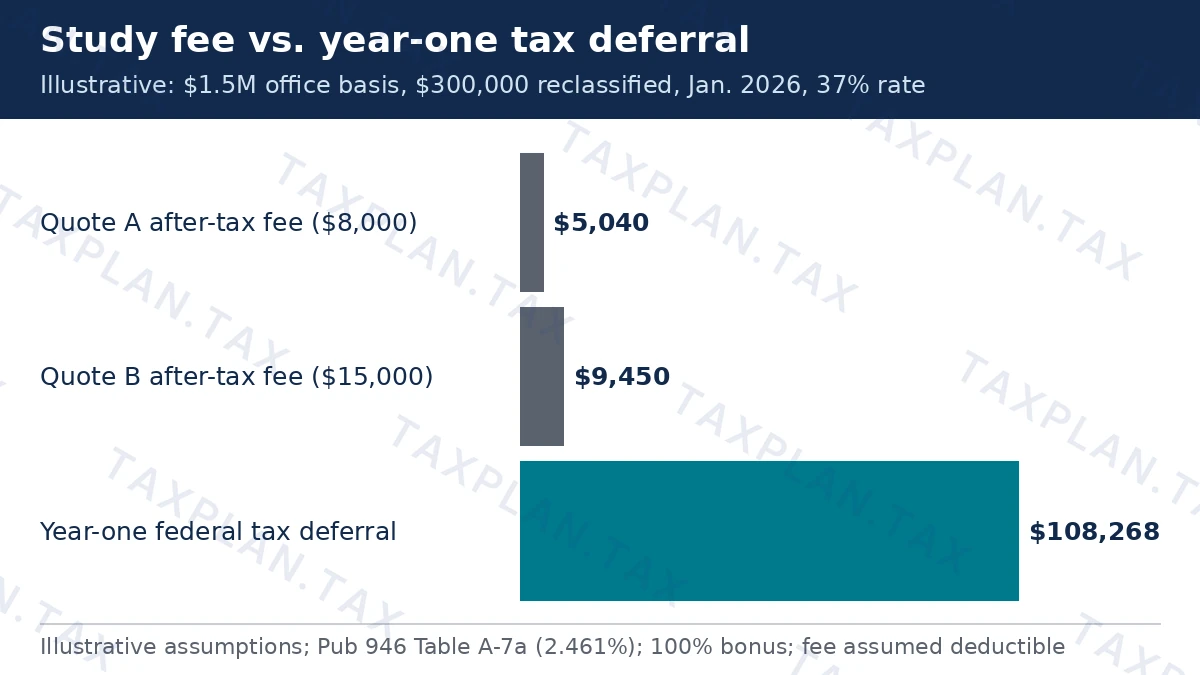
At an assumed 37% marginal federal rate, the extra deduction defers about $108,268 of federal tax in year one. Of course, that assumes the owner can use the loss, which the passive activity rules under §469 may limit.
Example 2: After-tax cost of two quotes
Now assume the investor receives two fixed-fee quotes: $8,000 and $15,000. If the fee is deductible and the 37% rate applies, the after-tax costs are $5,040 and $9,450. Either way, the fee is small next to $108,268 of first-year deferral. However, the right choice still depends on scope, approach, and audit support.
| Illustrative item | Quote A | Quote B |
|---|---|---|
| Fixed fee (assumed) | $8,000 | $15,000 |
| After-tax cost if deductible at 37% | $5,040 | $9,450 |
| First-year federal tax deferral (Example 1) | $108,268 | $108,268 |
| Reclassified basis needed for year-one savings to equal the fee | About $22,170 | About $41,560 |
In other words, the last row divides each fee by the year-one tax value of a reclassified dollar. That value equals 37% times (1 minus 2.461%), or about 36.1 cents. However, the test ignores recapture and the time value of money. Our article Cost Segregation ROI: How Quickly Do Studies Pay for Themselves? covers those issues in more depth.
Common Mistakes and Risks With Cost Segregation Study Costs
Direct answer: Most cost mistakes come from comparing price alone, ignoring scope, or choosing an arrangement that invites scrutiny.
- Shopping on price alone. A rule-of-thumb study may cost less, yet the IRS guide says to view it with caution.
- Accepting a contingency fee without thought. Publication 5653 tells examiners to closely scrutinize these studies.
- Ignoring what the quote excludes. Ask whether travel, Form 3115 support, and audit help are included.
- Skipping the purchase agreement. A binding price allocation in the contract can limit what a study can do.
- Assuming you can use the deductions. Passive loss and other limits can delay the benefit.
- Assuming the fee is deductible. We found no published IRS guidance on study fees specifically.
Frequently Asked Questions
How much does a cost segregation study cost?
There is no official price. In general, fees depend on project size, complexity, records, and scope, and many firms add out-of-pocket costs. For that reason, ask for a written, fixed-fee quote.
Why don’t you list a typical range for cost segregation study costs?
Because no IRS or government source publishes fee data, any range would be anecdotal. Instead, this guide shows how to test a quote against your own numbers.
Are cheaper desktop or rule-of-thumb studies a good deal?
Sometimes they are adequate for small properties, particularly when records are limited. Still, the IRS guide recommends a field inspection for all quality studies and cautions against rule-of-thumb allocations.
Is a contingency fee allowed?
Circular 230 limits contingent fees for practitioners, with exceptions, and one court limited the rule for ordinary refund claims. Separately, the IRS guide flags contingency-fee studies for closer scrutiny.
Can I deduct the cost of the study?
Possibly. We found no published guidance that addresses study fees directly. Also, the capitalization rules for acquisition costs may apply. Therefore, ask your tax adviser before filing.
Does a look-back study cost more?
It can, because the work may also include a Form 3115 and a §481(a) adjustment under Rev. Proc. 2025-23. So, ask whether those items are in the quote.
Do I pay less for several similar properties?
Possibly, since the IRS guide notes that sampling minimizes resources and costs for nearly identical facilities, although accuracy limits apply.
Conclusion: How Should You Evaluate Cost Segregation Study Costs?
In short, cost segregation study costs make sense only in relation to the benefit. First, start with a written, fixed-fee quote and a clear scope. Then compare the after-tax fee with the deductions you can actually use. Finally, favor an approach the IRS guide treats as reliable.
Emunah Cost Segregation helps owners and CPAs weigh study costs before they commit. Alan Goldstein, MBA, EA, reviews your property, records, and tax position before any study begins. Equally important, if a study will not pay for itself, he will tell you. Contact Emunah Cost Segregation in Coral Gables, Florida, to request a feasibility review.
Cases Cited
- Hospital Corp. of America v. Commissioner, 109 T.C. 21, 48-52 (1997) (United States Tax Court). Pinpoint verified against the reporter-paginated opinion text. Opinion
- AmeriSouth XXXII, Ltd. v. Commissioner, T.C. Memo. 2012-67, 103 T.C.M. (CCH) 1324 (2012) (United States Tax Court, memorandum opinion). Pinpoint uncertainty: T.C. Memos have no volume or reporter page of their own, and we could not confirm the T.C.M. (CCH) page numbers for the specific holdings. In the CourtListener text, the “inadequate record” statement appears at star page *53 and the utility-line holdings at *44-*46; we believe those star pages track the Lexis version, but we could not confirm that. Opinion
- INDOPCO, Inc. v. Commissioner, 503 U.S. 79, 84 (1992) (Supreme Court of the United States). Pinpoint verified against the reporter-paginated opinion text. Opinion
- Ridgely v. Lew, 55 F. Supp. 3d 89, 97-98 (D.D.C. 2014) (United States District Court for the District of Columbia). Pinpoint verified against the reporter-paginated opinion text. We did not verify any later appellate history. Opinion
Sources and Authorities
- IRS Publication 5653 (Rev. 2-2025), Cost Segregation Audit Techniques Guide, Chapters 3, 4, and 5: https://www.irs.gov/pub/irs-pdf/p5653.pdf
- IRS Publication 946, How To Depreciate Property, including Table A-7a: https://www.irs.gov/pub/irs-pdf/p946.pdf
- 26 U.S.C. §168: https://www.law.cornell.edu/uscode/text/26/168
- 26 U.S.C. §162: https://www.law.cornell.edu/uscode/text/26/162
- 26 U.S.C. §212: https://www.law.cornell.edu/uscode/text/26/212
- 26 U.S.C. §469: https://www.law.cornell.edu/uscode/text/26/469
- Public Law 119-21 (H.R. 1, 119th Congress), §70301: https://www.congress.gov/bill/119th-congress/house-bill/1
- IRS Notice 2026-11: https://www.irs.gov/pub/irs-drop/n-26-11.pdf
- Treas. Reg. §1.48-1: https://www.ecfr.gov/current/title-26/section-1.48-1
- Treas. Reg. §1.263(a)-2: https://www.ecfr.gov/current/title-26/section-1.263(a)-2
- 31 C.F.R. §10.27 (Circular 230, fees): https://www.ecfr.gov/current/title-31/section-10.27
- About Form 3115: https://www.irs.gov/forms-pubs/about-form-3115
- Rev. Proc. 2025-23: https://www.irs.gov/pub/irs-drop/rp-25-23.pdf
- Court opinions: see Cases Cited above.
This article is provided for general educational purposes and does not constitute individualized tax, legal, or accounting advice. Tax consequences depend on the taxpayer’s specific facts and applicable law.
