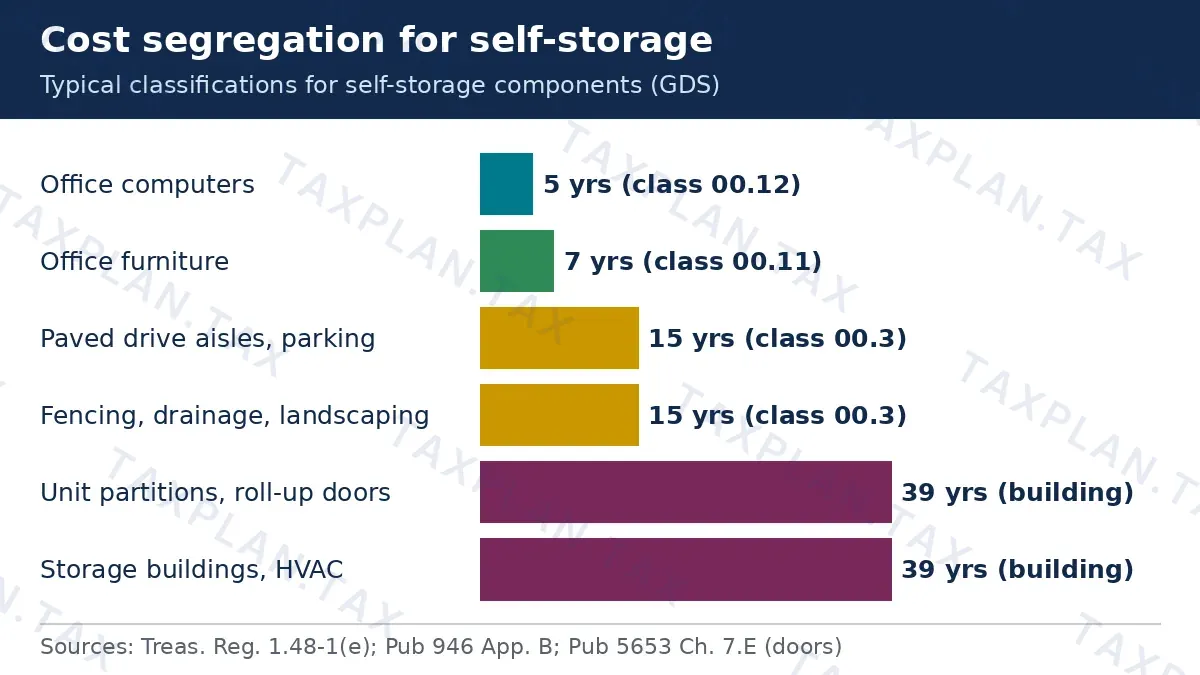

Cost segregation for self-storage facilities separates a storage property into building, personal property, and land improvement components, so part of the cost can be deducted sooner than 39 years. Self-storage buildings are generally nonresidential real property. In fact, the building definition in Treas. Reg. §1.48-1(e)(1) names warehouses as an example of a building. As a result, the storage buildings, roll-up doors, and building systems usually stay in the 39-year class. However, self-storage sites often have large paved drive aisles, perimeter fencing, site lighting, drainage, and landscaping. These are generally 15-year land improvements. In addition, the office, retail counter, and technology can include shorter-lived personal property.
Be careful, though. The IRS has not published a self-storage matrix in its Cost Segregation Audit Techniques Guide. So cost segregation for self-storage depends on general rules and careful documentation. This guide explains those rules, the uncertain areas, bonus depreciation timing, and two worked examples.
Key Takeaways
- Self-storage buildings are generally 39-year nonresidential real property under IRC §168(c).
- The IRS audit guide has no self-storage industry matrix, so classifications rest on general rules.
- Paving, fencing, site lighting, and landscaping are usually 15-year land improvements in asset class 00.3.
- Roll-up doors and building security systems are building components in the IRS matrices that address them.
- For property acquired after January 19, 2025, 5-, 7-, and 15-year parts can generally get 100% bonus depreciation.
- Conversions of vacant buildings into storage may include qualified improvement property.
What Is Cost Segregation for Self-Storage?
Direct answer: Cost segregation for self-storage is an engineering-based study that assigns each part of a storage facility’s cost to its correct depreciation class. It identifies site work and personal property that do not belong in the 39-year building class.
Self-storage facilities include drive-up single-story buildings, multi-story climate-controlled buildings, and conversions of older retail or industrial buildings. Under IRC §168(e)(2)(B), these are nonresidential real property. Therefore, the buildings and their structural components use a 39-year straight-line method with a mid-month convention.
The regulation defines a building as a structure that encloses space within its walls and is usually covered by a roof. It lists warehouses, garages, and stores as examples. Most storage buildings fit that description. So claims that drive-up storage buildings are equipment rather than buildings carry real audit risk. For a broader view of eligible property, read What Property Qualifies for a Cost Segregation Study?
Is there IRS guidance specific to self-storage?
Not in the audit guide. Chapter 7 of Publication 5653 lists industry guidance for retail, restaurants, biotech and pharmaceuticals, casinos, auto dealerships, auto manufacturing, and residential rental property. Self-storage is not on that list. Therefore, cost segregation for self-storage should explain each classification with general authorities and, where helpful, label any analogy to another industry’s matrix.
How Does Cost Segregation for Self-Storage Work?
Direct answer: A study team gathers cost records and site plans, tours the facility, removes land value, and classifies each component. Then it documents the reasoning for each line.
For new construction, contractor pay applications and invoices are the best support. For an acquisition, the team starts with the purchase price and removes land. Next, it prices the buildings and site work with cost estimating. Land often makes up a meaningful part of a storage purchase, so the land allocation deserves care. To see each step, read Cost Segregation Study Process: Step-by-Step Breakdown.
Which self-storage components often move to shorter lives?
Every site differs, but studies commonly review these items:
- Land improvements: paved drive aisles and parking, curbs, sidewalks, perimeter fencing, pole-mounted site lighting, storm drainage, and landscaping. Asset class 00.3 in Publication 946 gives these a 15-year life.
- Office furniture: desks, files, and safes in the management office fall in class 00.11, with a 7-year life.
- Computers: computers and peripherals used for business records fall in class 00.12, with a 5-year life.
- Retail counter items: fixtures used to sell boxes, locks, and packing supplies are assets used in retail trade, which class 57.0 covers.
- Surveillance equipment: cameras, recorders, and monitors may be personal property, as discussed below.
What usually stays in the 39-year class?
Structural components stay with the building. Treas. Reg. §1.48-1(e)(2) lists walls, partitions, floors, ceilings, doors, central heating and air conditioning, plumbing, wiring, lighting fixtures, elevators, and sprinkler systems. So interior unit partitions, the building wiring, and climate-control systems in a storage building generally remain 39-year property.
Roll-up doors deserve special mention. The IRS hotel and casino matrix in Chapter 7.E of the audit guide treats doors “regardless of decoration,” including overhead doors and roll-up grills, as building components. That matrix was written for another industry, so it is only an analogy. Even so, treating storage unit doors as 5-year property would conflict with it and with the regulation’s list of structural components.
What Are the Benefits of Cost Segregation for Self-Storage?
Direct answer: The main benefits are earlier deductions for site work and personal property, plus better records for later repairs and dispositions.
How does bonus depreciation apply?
Public Law 119-21, enacted July 4, 2025, made 100% bonus depreciation permanent for qualified property acquired after January 19, 2025. Bonus applies to property with a recovery period of 20 years or less, as IRS Notice 2026-11 explains. So the 5-, 7-, and 15-year parts identified through cost segregation for self-storage can qualify. However, property acquired under a written binding contract signed before January 20, 2025 stays under the old phase-down, which is 20% for property placed in service in 2026. Used property can also qualify under Treas. Reg. §1.168(k)-2 if you did not use it before.
Can conversions create qualified improvement property?
Often, yes. Many operators convert vacant big-box stores or warehouses into climate-controlled storage. Under IRC §168(e)(6), an improvement to an interior portion of a nonresidential building can be QIP. Also, Treas. Reg. §1.168(b)-1(a)(5) requires that the improvement be placed in service after the building was first placed in service by any person. So a buyer who converts an older building can generally meet that test.
QIP is 15-year property, so it can qualify for bonus. However, QIP excludes enlargements, elevators and escalators, and the internal structural framework. New mezzanine floors or added levels can raise those exclusions. Therefore, a conversion budget should be split line by line.
Can you deduct replaced components?
Sometimes. A partial disposition election under Treas. Reg. §1.168(i)-8 can let you deduct the remaining basis of a retired roof or other component. The regulation treats a cost segregation study as one reasonable way to find that basis.
What Legal Rules Govern Cost Segregation for Self-Storage?
Direct answer: The key authorities are IRC §168, the structural component regulations, Rev. Proc. 87-56 asset classes, and the IRS audit guide’s general principles.
- IRC §168: recovery periods, QIP, and bonus under §168(k).
- Treas. Reg. §1.48-1: the definitions of building and structural components.
- Rev. Proc. 87-56: asset classes 00.11, 00.12, 00.3, and 57.0, as reproduced in Publication 946.
- Publication 5653: general examination guidance and other industries’ matrices.
Two Tax Court cases discussed in the audit guide shape the analysis. In Hospital Corporation of America v. Commissioner, 109 T.C. 21 (1997), the court held that the former investment tax credit rules still decide §1245 status. Also, Whiteco Industries, Inc. v. Commissioner, 65 T.C. 664 (1975), set out factors for judging inherent permanence. Those factors matter for any claim that a storage structure is movable.
What asset class applies to other personal property?
This is an area of judgment. Under IRC §168(e)(3)(C)(v), property with no class life that is not otherwise classified is 7-year property. Some advisors assign certain self-storage personal property to class 57.0, which has a 5-year life. However, the IRS has not issued self-storage guidance on that point. So the study should state its basis for each class.
Are security systems personal property?
It depends on the system, and cost segregation for self-storage should trace each one. In the IRS retail and hotel/casino matrices, security equipment that protects the building is a building component. In contrast, surveillance cameras, recorders, and monitors appear as §1245 property in the hotel/casino matrix. Those matrices address other industries, so use them only as reference points in cost segregation for self-storage.
Does the production property allowance apply?
No. IRC §168(n) applies only to space used as an integral part of manufacturing, production, or refining. Renting storage units is not such an activity. Also, the statute excludes property a lessor leases to others.
What about recapture?
Gain on §1245 property is ordinary income up to prior depreciation under IRC §1245. Meanwhile, straight-line building depreciation creates unrecaptured §1250 gain, taxed at up to 25% under IRC §1(h). Land improvements are §1250 property in many cases, so recapture should be modeled item by item.
What Does Cost Segregation for Self-Storage Look Like in Practice?
Direct answer: The examples below show a facility purchase and a building conversion. All amounts are illustrative assumptions, not typical or guaranteed results.
Example 1: Buying a drive-up facility
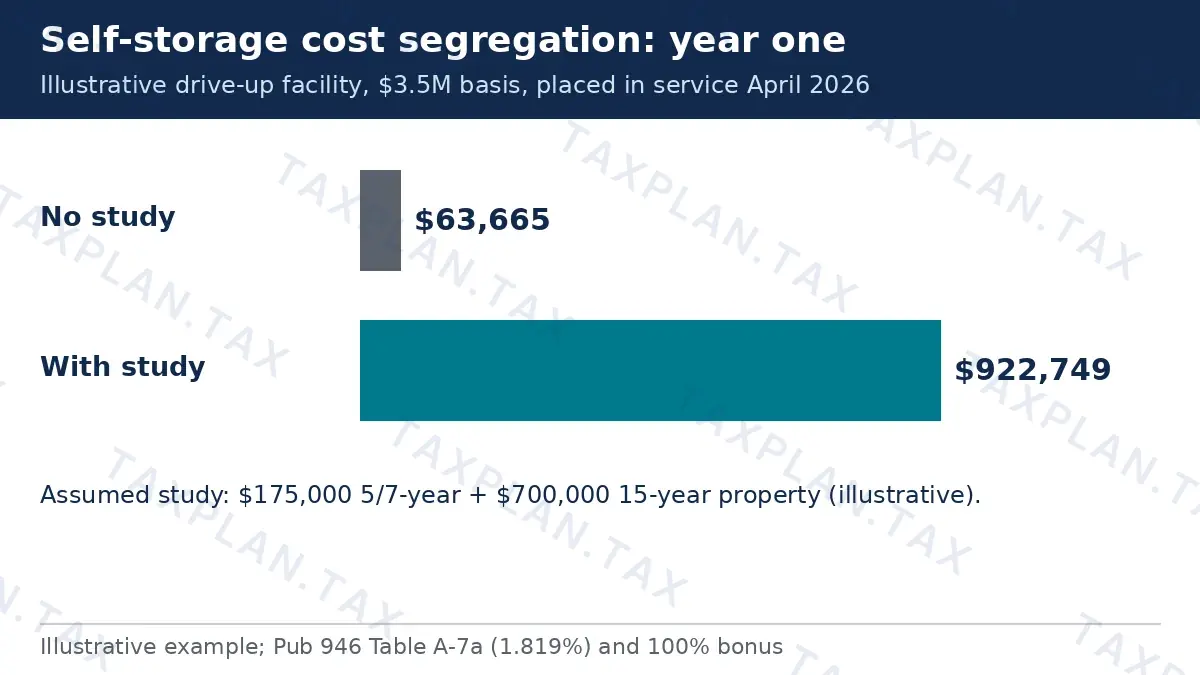
Assume an investor buys a single-story drive-up self-storage facility for $5,000,000 under a 2026 contract. The land is worth $1,500,000, so the depreciable basis is $3,500,000. The facility is placed in service in April 2026.
| Class (illustrative study) | Basis | Year-one depreciation |
|---|---|---|
| 5- and 7-year personal property | $175,000 | $175,000 (100% bonus) |
| 15-year paving, fencing, lighting, drainage (class 00.3) | $700,000 | $700,000 (100% bonus) |
| 39-year buildings, including unit doors | $2,625,000 | $47,749 |
| Total | $3,500,000 | $922,749 |
The 39-year figure uses the April rate of 1.819% from Publication 946, Table A-7a. Without a study, $3,500,000 at 1.819% gives $63,665. So in this example, cost segregation for self-storage adds about $859,084 of first-year depreciation. Notice that site work drives most of the benefit here.
Example 2: Converting a vacant store
Conversions are where cost segregation for self-storage often finds QIP. Next, assume an operator buys a vacant big-box store that was first placed in service in 2005. In 2026, it spends $1,200,000 to convert the interior to climate-controlled storage. The work includes $900,000 of interior unit partitions, doors, lighting, and HVAC distribution. It also includes $300,000 for a new mezzanine level.
The $900,000 of interior work may be QIP, so it may be 15-year property eligible for bonus. However, the mezzanine raises the enlargement and internal structural framework exclusions. In this illustration, the operator treats it as 39-year property. That conservative choice should be reviewed against the actual design.
What Are Common Mistakes With Cost Segregation for Self-Storage?
Direct answer: Most errors come from treating buildings as equipment, overstating personal property, or ignoring land allocation.
- Calling storage buildings equipment. The regulation names warehouses and garages as buildings.
- Treating unit doors or partitions as 5-year property. Doors and partitions are listed structural components.
- Overstating the building basis. A weak land allocation inflates every depreciation figure.
- Borrowing another industry’s matrix without saying so. Analogies should be labeled and explained.
- Calling a mezzanine QIP without analysis. Enlargements and structural framework are excluded.
- Ignoring state law. Some states do not follow federal bonus depreciation.
Frequently Asked Questions
Is cost segregation for self-storage worth it?
It can be, especially where site work is extensive. However, storage buildings usually hold less personal property than hotels or restaurants. Our guide When Is a Cost Segregation Study Worth It? explains how to decide.
Are self-storage buildings 39-year property?
Generally, yes. They are nonresidential real property, and the regulation’s building definition covers enclosed, roofed structures such as warehouses.
Are drive aisles and fencing 15-year property?
Usually, yes. Roads, sidewalks, fences, drainage, and landscaping are examples of land improvements in class 00.3, with a 15-year life.
Can I apply cost segregation for self-storage I bought years ago?
Yes. A look-back study claims missed depreciation through Form 3115 and a §481(a) adjustment. The automatic change list appears in Rev. Proc. 2025-23.
Are climate-control systems personal property?
Generally, no. Central heating and air conditioning systems are structural components. A narrow exception applies to machinery whose sole justification is meeting the needs of equipment, which rarely fits a storage building.
Does passive activity treatment matter?
Yes. Deductions from cost segregation for self-storage can be limited by the passive activity rules in IRC §469, depending on the facts. So review those limits with your CPA.
Conclusion: Is Cost Segregation for Self-Storage Right for You?
To sum up, cost segregation for self-storage usually finds its value in site work, technology, and conversions. For property acquired after January 19, 2025, the 5-, 7-, and 15-year parts can generally get 100% bonus depreciation. However, storage buildings, unit doors, and building systems usually stay in the 39-year class. Because the IRS has no self-storage matrix, careful documentation matters even more.
Emunah Cost Segregation works with self-storage owners and their CPAs. Alan Goldstein, EA, reviews your site plan, purchase documents, and improvement history before any study begins. Then he tells you plainly whether a study makes sense. Contact Emunah Cost Segregation in Coral Gables, Florida, to request a review. For related reading, see Cost Segregation for Commercial Real Estate.
Sources and Authorities
- 26 U.S.C. §168 (including §168(c), §168(e), §168(k), and §168(n)): https://www.law.cornell.edu/uscode/text/26/168
- 26 U.S.C. §469: https://www.law.cornell.edu/uscode/text/26/469
- 26 U.S.C. §1245: https://www.law.cornell.edu/uscode/text/26/1245
- 26 U.S.C. §1 (including §1(h)): https://www.law.cornell.edu/uscode/text/26/1
- Public Law 119-21 (H.R. 1, 119th Congress): https://www.congress.gov/bill/119th-congress/house-bill/1
- IRS Notice 2026-11: https://www.irs.gov/pub/irs-drop/n-26-11.pdf
- Treas. Reg. §1.48-1: https://www.ecfr.gov/current/title-26/section-1.48-1
- Treas. Reg. §1.168(b)-1: https://www.ecfr.gov/current/title-26/section-1.168(b)-1
- Treas. Reg. §1.168(i)-8: https://www.ecfr.gov/current/title-26/section-1.168(i)-8
- Treas. Reg. §1.168(k)-2: https://www.ecfr.gov/current/title-26/section-1.168(k)-2
- IRS Publication 946, including Table A-7a and Table B-1: https://www.irs.gov/pub/irs-pdf/p946.pdf
- IRS Publication 5653, Cost Segregation Audit Techniques Guide, including Chapter 7: https://www.irs.gov/pub/irs-pdf/p5653.pdf
- About Form 3115: https://www.irs.gov/forms-pubs/about-form-3115
- Rev. Proc. 2025-23: https://www.irs.gov/pub/irs-drop/rp-25-23.pdf
- Hospital Corporation of America v. Commissioner, 109 T.C. 21 (1997), and Whiteco Industries, Inc. v. Commissioner, 65 T.C. 664 (1975), as discussed in IRS Publication 5653.
This article is provided for general educational purposes and does not constitute individualized tax, legal, or accounting advice. Tax consequences depend on the taxpayer’s specific facts and applicable law.
