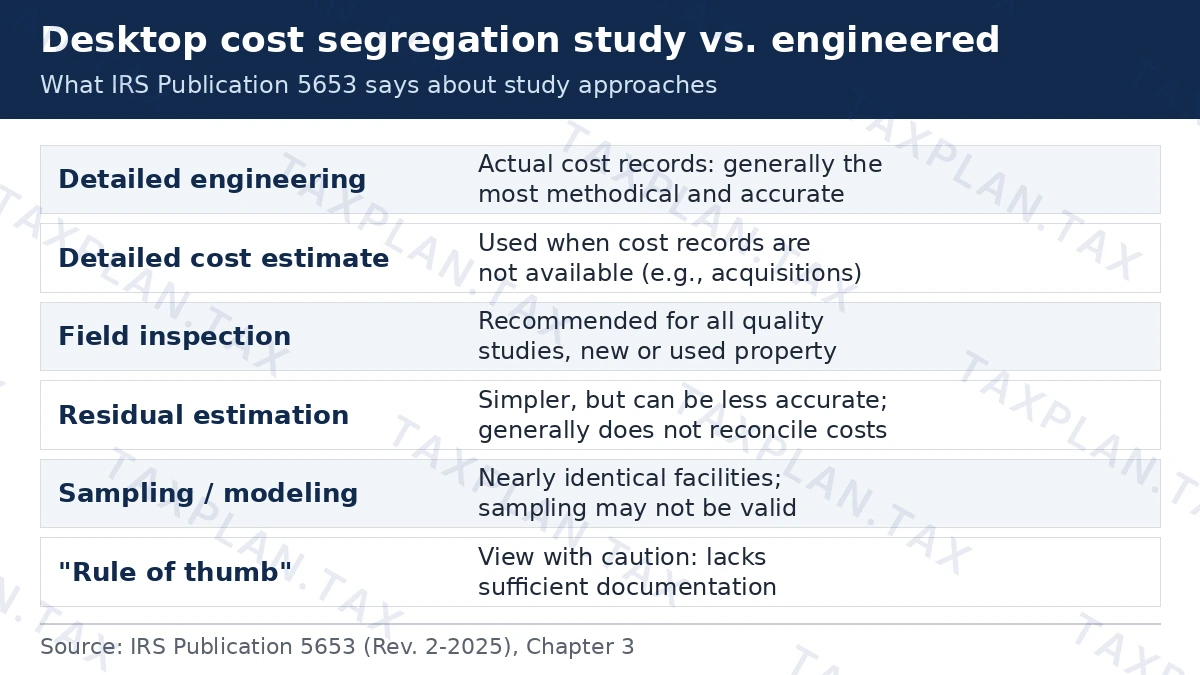

A desktop cost segregation study is prepared from documents, photos, and cost models without an engineer walking the property, while a fully engineered study combines a site visit with detailed quantity take-offs and unit costs. The IRS does not use the word “desktop,” and it has not mandated any single method. However, its Cost Segregation Audit Techniques Guide (Publication 5653) recommends a field inspection for all quality studies. It also calls the detailed engineering approach from actual cost records the most methodical and accurate approach.
So which should you choose? In short, a desktop cost segregation study can make sense for a smaller or repeat property type with good records. In contrast, a fully engineered study is usually the safer choice for larger, complex, or audit-sensitive assets. Either way, the study must tie every dollar to the actual cost basis and classify each item under IRC §168. This guide explains how each approach works, what the IRS guide says, and how to weigh the trade-offs with worked examples.
Key Takeaways
- “Desktop” is an industry label, not an IRS category; the IRS has set no required method.
- Publication 5653 recommends a field inspection for all quality studies, new or used.
- The detailed engineering approach from actual cost records is generally the most accurate.
- Residual and “rule of thumb” methods draw extra scrutiny because they skip reconciliation or documentation.
- A cheaper desktop cost segregation study can cost more later if the allocation fails on exam.
- Match the method to the property’s size, complexity, records, and your audit risk tolerance.
Introduction and Background: What Is a Desktop Cost Segregation Study?
Direct answer: It is a study completed remotely, using drawings, photos, closing documents, and cost data instead of an on-site inspection.
A cost segregation study allocates a building’s cost among recovery classes. For example, some parts are 5-year or 7-year personal property, and site work is often 15-year land improvements. Meanwhile, the structure stays 27.5-year residential rental property or 39-year nonresidential real property. The recovery periods appear in IRS Publication 946. For a broader primer, see What Is a Cost Segregation Study and How Does It Work?
Providers use the term “desktop” in different ways. Some mean a study built from owner-supplied photos and a virtual walk-through. Others mean a model or template applied to a common property type. Therefore, always ask the provider exactly what work is included and what is not.
By contrast, a “fully engineered” study usually means a site visit by an engineer or cost estimator, a review of drawings and cost records, and line-item quantity take-offs. Notably, neither term is defined in the Code or regulations. Instead, Publication 5653 describes six approaches and rates their strengths and weaknesses.
How Does Each Approach Work?
Direct answer: Both approaches identify assets, assign costs, and classify property, but they differ in how they gather facts and price components.
The six approaches in Publication 5653
Chapter 3 of the guide lists six approaches. First, the detailed engineering approach from actual cost records uses contractor records and invoices. Second, the detailed engineering cost estimate approach estimates costs when records are missing. Third, the survey or letter approach asks contractors for unit costs. Fourth, the residual estimation approach prices only short-lived assets and assigns the rest to the building. Fifth, the sampling or modeling approach applies a template to nearly identical facilities. Finally, the “rule of thumb” approach applies a fixed percentage based on “experience.”
How a fully engineered study works
The guide’s step list for the detailed engineering approach includes a site visit to inspect the facility. It also includes photographs, a review of record drawings and pay requests, and quantity take-offs. Next, unit costs are applied to each asset and reconciled to total actual contractor costs. Then indirect costs are allocated, and assets are grouped by class life and placed-in-service date. For details on each step, see our Cost Segregation Study Process: Step-by-Step Breakdown.
How a desktop cost segregation study works
A desktop study usually starts with the closing statement, the depreciation schedule, and any drawings or appraisals. Next, the owner or manager supplies photos or a video walk-through. Then the preparer estimates component costs from published cost data or a model of similar buildings. Finally, the estimates are scaled to the property’s depreciable basis.
In practice, many desktop studies resemble the guide’s detailed estimate, residual, or modeling approaches, just without the field inspection. That matters, because the guide says field inspection is a critical step when drawings and specifications are limited, as is often the case with acquired property.
Benefits and Opportunities: Desktop Cost Segregation Study vs. Engineered
Direct answer: Desktop studies trade some precision for speed and lower fees, while engineered studies trade cost for stronger support.
Where a desktop cost segregation study can fit
- Lower fees and faster turnaround: no travel and less field time.
- Smaller properties: for example, a single-family rental where the dollars at stake are modest.
- Repeat designs: the guide recognizes sampling or modeling for nearly identical facilities, such as chain retail outlets.
- Strong records: as-built drawings, contractor pay applications, and clear photos reduce guesswork.
Where a fully engineered study pays off
- Accuracy: the guide calls the detailed cost approach generally the most accurate.
- Audit support: site photos and take-offs document the use and installation of each asset.
- Complex property: hospitals, manufacturing plants, and hotels have many specialized systems.
- Large deductions: as a result, the cost of a weak allocation rises with the basis.
Also, with 100% bonus depreciation now permanent for qualified property acquired after January 19, 2025, more of each reclassified dollar lands in year one. Consequently, the quality of the allocation matters more, not less. See Bonus Depreciation and Cost Segregation for how the two interact.
Legal and Regulatory Considerations for a Desktop Cost Segregation Study
Direct answer: No rule requires a site visit, but the law requires accurate classification, and the IRS reviews methods that skip reconciliation or documentation.
What the IRS guide says about methods
Publication 5653 states that the IRS has not established any requirements or standards for preparing studies. Still, it gives examiners clear signals. For instance, it says the residual estimation approach can be less accurate and generally does not reconcile project costs. Similarly, it warns that sampling may not be statistically valid. Moreover, it tells examiners to view “rule of thumb” studies with caution because they lack sufficient documentation.
The guide’s quality study elements also include a site visit for both new construction and acquired property. In addition, its examination steps suggest asking the preparer whether the properties were inspected and whether photographs were relied on. To learn more about these elements, read What Makes a High-Quality Cost Segregation Study? Note that the guide (Rev. 2-2025) predates Public Law 119-21, so its bonus discussion is outdated.
Classification law is the same for both approaches
Whatever the method, the legal test does not change. In Hospital Corp. of America v. Commissioner, 109 T.C. 21 (1997), the Tax Court held that the former investment tax credit tests decide whether property is tangible personal property under ACRS and MACRS. Those tests draw on Treas. Reg. §1.48-1, which separates structural components from equipment. Likewise, Whiteco Industries, Inc. v. Commissioner, 65 T.C. 664 (1975), lists factors such as whether an item can be moved and whether it was designed to remain in place. Applying those factors well often requires seeing how an item is installed.
Bonus depreciation and other current rules
Under §168(k) as amended by P.L. 119-21, qualified property acquired after January 19, 2025, is eligible for a permanent 100% first-year deduction. The IRS confirmed the acquisition-date and binding-contract rules in Notice 2026-11. However, the 27.5-year and 39-year building components are not eligible. Therefore, the line between building and equipment drives most of the benefit.
Purchase agreements and changes in method
A study cannot override a binding price allocation that you agreed to. In Peco Foods, Inc. v. Commissioner, 522 F. App’x 840 (11th Cir. 2013), the taxpayer was held to the allocation schedules in its purchase agreements. Additionally, if you apply a study to property placed in service in an earlier year, you generally file Form 3115 under the automatic change procedures in Rev. Proc. 2025-23.
Practical Examples: Desktop Cost Segregation Study vs. Engineered
Direct answer: The examples below show why the dollars at stake, not the fee alone, should decide the method. All figures are illustrative assumptions.
Example 1: A $2 million office building
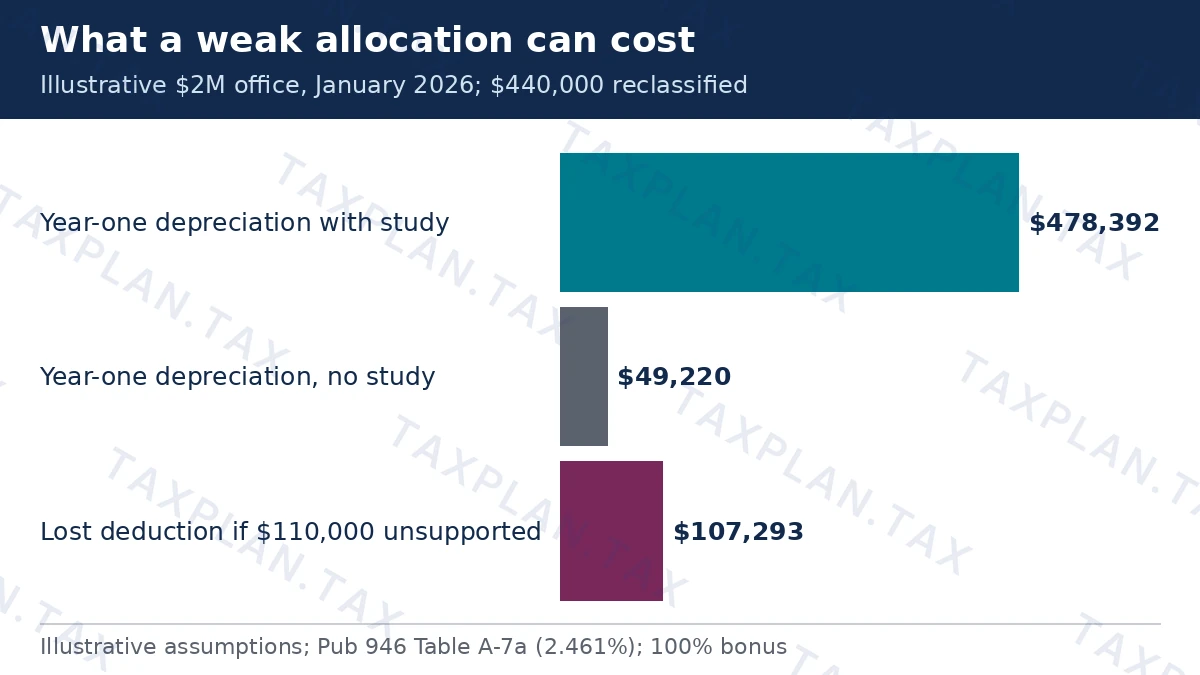
Assume an investor buys an office building in January 2026 with $2,000,000 of depreciable building basis, excluding land. Assume a study supports $440,000 of 5-, 7-, and 15-year property. With 100% bonus, that $440,000 is deductible in year one. Then the remaining $1,560,000 uses the 39-year rate of 2.461% for January from Publication 946, Table A-7a.
| Item (illustrative) | With study | Without study |
|---|---|---|
| Bonus on short-life property | $440,000 | $0 |
| 39-year building depreciation | $38,392 | $49,220 |
| Total year-one depreciation | $478,392 | $49,220 |
| Federal tax deferral at 37% | $158,793 (difference of $429,172 × 37%) | |
Example 2: What an unsupported allocation could cost
Now assume an examiner finds that $110,000 of the reclassified amount lacks support and moves it back to the building. As a result, year-one depreciation falls by $107,293 ($110,000 minus 2.461% of $110,000). At a 37% rate, that is about $39,698 of tax, plus interest, and possibly an accuracy-related penalty. In this case, the fee savings from a lighter study would need to outweigh that risk.
Example 3: A small rental with good records
By contrast, consider a single-family rental with clear photos, a recent appraisal, and a modest basis. Here, the deductions at stake are smaller, and the property type is simple. Therefore, a desktop cost segregation study may be reasonable, provided the preparer documents sources and reconciles to basis. For pricing context, see Cost Segregation Study Costs.
Common Mistakes and Risks With a Desktop Cost Segregation Study
Direct answer: Most problems come from weak documentation, not from the label on the study.
- Buying on price alone: a low fee does not help if the allocation cannot be defended.
- Using a percentage template: fixed “industry averages” are what the guide calls a rule of thumb.
- Skipping reconciliation: the total of all classes must tie to the actual depreciable basis.
- Ignoring land: land is not depreciable, so the land value must come out first.
- Misreading photos: without inspection, a preparer may misjudge how an item is attached or used.
- Overlooking contract allocations: a signed allocation schedule can bind you, as Peco Foods shows.
- Not asking what is included: confirm in writing whether anyone will visit the site.
Frequently Asked Questions
Is a desktop cost segregation study allowed by the IRS?
Yes. The IRS has not established any required method, so no rule bans a desktop cost segregation study. However, Publication 5653 recommends a field inspection for all quality studies. So a desktop study should still be well documented and reconciled to basis.
What does “fully engineered” mean?
Generally, it means an engineer or cost estimator inspects the property, reviews drawings and cost records, and prices assets through quantity take-offs. The term is industry usage. In fact, the guide’s closest match is the detailed engineering approach.
Is an engineered study more accurate?
Usually, yes. The guide calls the detailed engineering approach from actual cost records generally the most methodical and accurate. Even so, it notes classification issues can still arise with any approach.
When does a desktop cost segregation study make sense?
Typically, it fits smaller, simple properties with good records and modest deductions. It can also fit repeat designs where a validated model exists. By contrast, complex or high-value assets usually justify a site visit.
Can I upgrade a desktop cost segregation study to an engineered study later?
Often, yes. If you later commission a new study, you may need Form 3115 to change the depreciation of property already placed in service. Discuss timing with your tax advisor first.
Does the IRS audit a desktop cost segregation study more often?
The IRS does not publish audit rates by study type. Still, the guide tells examiners to scrutinize residual and rule-of-thumb methods. As a result, thin documentation tends to invite questions.
Does 100% bonus depreciation change the choice?
It raises the stakes. Since short-life property acquired after January 19, 2025, can be fully deducted in year one, each reclassified dollar has a larger immediate effect. Therefore, support for each dollar matters more.
What records help either type of study?
Useful records include the closing statement, appraisal, drawings, contractor pay applications, invoices, and photos. Also, any purchase agreement with a price allocation should be shared at the start.
Conclusion: Choosing Between Desktop and Fully Engineered
The right choice depends on what is at stake. A desktop cost segregation study can be a practical tool for simple, lower-value property with good records. However, a fully engineered study is usually the stronger choice for larger, complex, or audit-sensitive buildings. In both cases, the work must follow the classification law, reconcile to basis, and leave a clear audit trail.
Emunah Cost Segregation helps owners and CPAs match the study method to the property and the risk. Alan Goldstein, MBA, EA, reviews your records, basis, and goals before recommending a scope. Contact Emunah Cost Segregation in Coral Gables, Florida, to request a feasibility review.
Cases Cited
- Hospital Corp. of America v. Commissioner, 109 T.C. 21, 50-52, 54-55 (1997) (United States Tax Court). Pinpoints verified against the reporter-paginated opinion text. Opinion
- Whiteco Industries, Inc. v. Commissioner, 65 T.C. 664, 672-673 (1975) (United States Tax Court). Pinpoint verified against the reporter-paginated opinion text. Opinion
- Peco Foods, Inc. v. Commissioner, 522 F. App’x 840, 843-844 (11th Cir. 2013) (unpublished), aff’g T.C. Memo. 2012-18. Pinpoint verified against the reporter-paginated opinion text. Opinion
Sources and Authorities
- IRS Publication 5653 (Rev. 2-2025), Cost Segregation Audit Techniques Guide, Chapters 3, 4, and 5: https://www.irs.gov/pub/irs-pdf/p5653.pdf
- IRS Publication 946 (2025), How To Depreciate Property, Table A-7a: https://www.irs.gov/pub/irs-pdf/p946.pdf
- 26 U.S.C. §168: https://www.law.cornell.edu/uscode/text/26/168
- 26 U.S.C. §6662: https://www.law.cornell.edu/uscode/text/26/6662
- Public Law 119-21 (H.R. 1, 119th Congress), §70301: https://www.congress.gov/bill/119th-congress/house-bill/1
- IRS Notice 2026-11: https://www.irs.gov/pub/irs-drop/n-26-11.pdf
- Treas. Reg. §1.48-1: https://www.ecfr.gov/current/title-26/section-1.48-1
- About Form 3115: https://www.irs.gov/forms-pubs/about-form-3115
- Rev. Proc. 2025-23: https://www.irs.gov/pub/irs-drop/rp-25-23.pdf
- Court opinions: see Cases Cited above.
This article is provided for general educational purposes and does not constitute individualized tax, legal, or accounting advice. Tax consequences depend on the taxpayer’s specific facts and applicable law.
