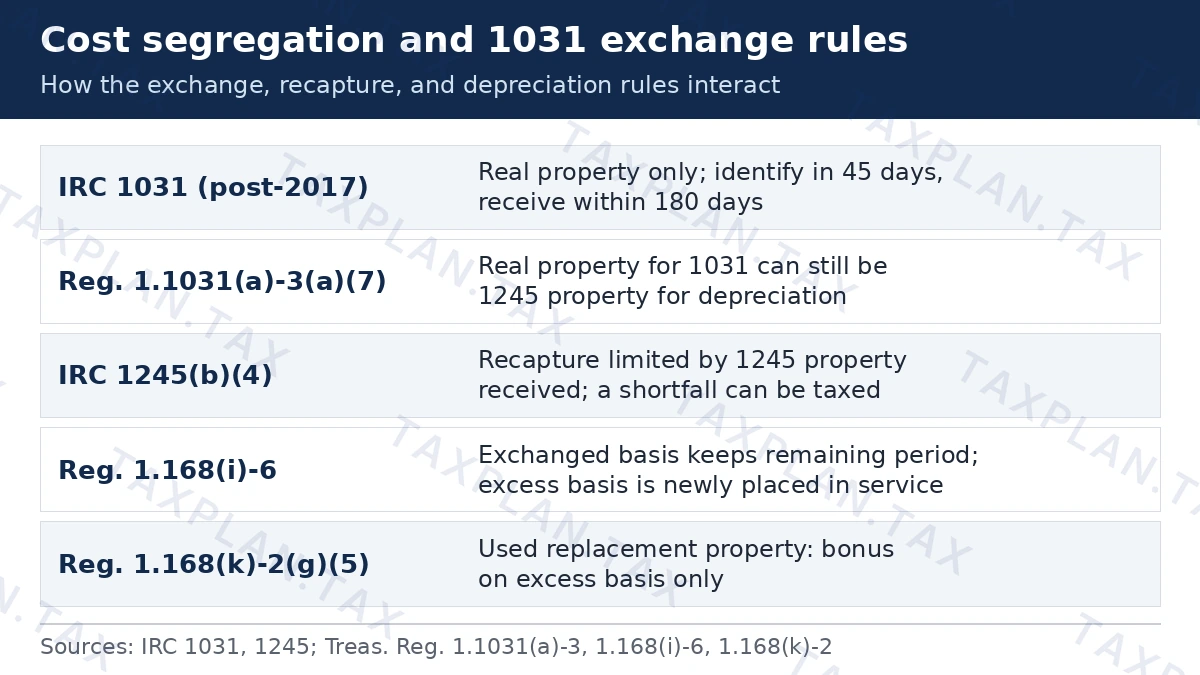

Yes, you can combine cost segregation and 1031 exchange planning, and the two often work well together. A Section 1031 exchange defers gain when you trade investment or business real property for like-kind real property. Meanwhile, a cost segregation study identifies parts of a building that qualify for shorter recovery periods under IRC §168. However, the combination has two traps. First, components you depreciated as §1245 property can trigger ordinary income recapture in an exchange, even when the rest of the gain is deferred. Second, only part of the replacement property’s basis may qualify for bonus depreciation.
The good news is that both traps are manageable with planning. In fact, the IRS’s own Instructions for Form 8824 show how §1245 recapture works in a like-kind exchange. Likewise, Treas. Reg. §1.168(i)-6 explains how to depreciate replacement property. This guide walks through both rules, with illustrative numbers, so you and your CPA can plan the exchange and the study together.
Key Takeaways
- Since 2018, Section 1031 applies only to real property, but many cost segregation components can still count as real property for exchange purposes.
- Components depreciated as §1245 property can create ordinary income recapture unless you acquire enough §1245 property in the exchange.
- For used replacement property, only the excess basis (new money) is eligible for bonus depreciation.
- Exchanged basis generally keeps the relinquished property’s remaining recovery period, unless you make the election in Treas. Reg. §1.168(i)-6(i).
- A study on the replacement property can both create new deductions and help reduce recapture in the exchange.
- The 45-day and 180-day deadlines still apply, so plan the study timeline around them.
Introduction and Background: How Do Cost Segregation and 1031 Exchanges Interact?
Direct answer: They interact through classification. Section 1031 asks whether property is real property, while depreciation asks whether it is §1245 or §1250 property.
Before 2018, Section 1031 also covered personal property. However, the Tax Cuts and Jobs Act (Pub. L. 115-97, §13303) limited it to real property for exchanges completed after December 31, 2017. As a result, today §1031(a)(1) covers only real property held for productive use in a trade or business or for investment. It also excludes real property held primarily for sale.
Cost segregation, by contrast, works inside the depreciation rules. In Hospital Corp. of America, the Tax Court applied the former investment tax credit tests to decide §1245 versus §1250 status (109 T.C. at 48-52). Under those tests, items such as certain carpeting and dedicated electrical systems can be 5-year or 7-year property. For background, see our guide to what assets can be reclassified in a cost segregation study.
Can a §1245 component still be real property for a 1031 exchange?
Often, yes. Treas. Reg. §1.1031(a)-3 defines real property for exchange purposes. It lists structural components such as wiring, plumbing, floors, and permanent coverings of floors and walls. Importantly, paragraph (a)(7) states that this definition applies only for Section 1031. It adds that a structure may be §1245 property for depreciation even though it is real property under the exchange rules. Therefore, the same item can be exchange-eligible and still carry §1245 recapture.
How Does Combining Cost Segregation and a 1031 Exchange Work?
Direct answer: You apply the exchange rules to the whole transaction, then apply the recapture and depreciation rules to each class of property.
Step 1: Classify the relinquished property
Start with the asset schedule from your existing study. Next, split it into three groups. The first group is §1250 real property, such as the building shell. The second group is §1245 property that is still real property under §1.1031(a)-3. The third group is personal property that is not real property at all, such as movable furniture. That last group is not like-kind, so it is generally treated like property sold for value outside the exchange.
Step 2: Test §1245 recapture
Then apply §1245(b)(4). It limits recapture in a like-kind exchange to the gain recognized plus the fair market value of non-§1245 property acquired. Under Treas. Reg. §1.1245-4(d), the amount realized for your §1245 property is matched first with §1245 property you receive. Any shortfall is matched with non-§1245 property, and that portion can be recaptured. Treas. Reg. §1.1250-3(d)(6) uses the same class-by-class matching, and its factory example shows no §1245 gain when enough §1245 property is acquired. In short, the more §1245 property the replacement contains, the less recapture you face.
Step 3: Depreciate the replacement property
Finally, apply Treas. Reg. §1.168(i)-6. It splits the replacement basis into exchanged basis and excess basis. Exchanged basis generally continues over the relinquished property’s remaining recovery period. If the replacement has a shorter recovery period, the exchanged basis still uses the relinquished property’s period. By contrast, excess basis is treated as newly placed in service, so it uses the recovery periods that apply at the time of replacement.
Benefits and Opportunities of Cost Segregation and 1031 Exchange Planning
Direct answer: The main benefits are new deductions on added basis and lower recapture in the exchange itself. Together, cost segregation and 1031 exchange rules reward investors who plan both at once.
- New bonus depreciation on excess basis. Under the One Big Beautiful Bill Act (Public Law 119-21, §70301), qualified property acquired after January 19, 2025 can receive 100% bonus depreciation. A study on the replacement property identifies which part of the excess basis qualifies.
- Recapture protection. Because §1245(b)(4) looks at the §1245 property you receive, a documented study of the replacement property can reduce or even eliminate recapture.
- Better records for the next exchange. Similarly, a component-level schedule makes the next sale or exchange easier to analyze.
- Partial dispositions later. In addition, a detailed asset list supports partial disposition elections when you replace a roof or HVAC unit.
For more on how bonus depreciation pairs with a study, see Bonus Depreciation and Cost Segregation: How They Work Together.
Legal and Regulatory Considerations for Cost Segregation and 1031 Exchange Deals
Direct answer: Five sets of rules control the outcome: §1031, §1245, Treas. Reg. §1.168(i)-6, Treas. Reg. §1.168(k)-2, and the IRS bonus guidance in Notice 2026-11.
What deadlines apply to the exchange?
Under §1031(a)(3), you must identify replacement property within 45 days after you transfer the relinquished property. You must also receive it by the earlier of 180 days or the due date, with extensions, of your return for that year. Notably, Starker v. United States held that a non-simultaneous transfer could still be a like-kind exchange (602 F.2d at 1352-1355). Congress later amended §1031(a) in 1984 (Pub. L. 98-369, §77), and the statute now sets these 45-day and 180-day limits.
Which part of the basis gets bonus depreciation?
Treas. Reg. §1.168(k)-2(g)(5)(iii)(A) answers this. If the replacement property meets the original use requirement, both exchanged and excess basis can qualify. However, if it is used property, only the excess basis qualifies. Most acquired buildings are used property, so plan on bonus applying to the excess basis only.
Also, IRS Notice 2026-11 tells taxpayers to apply rules consistent with §1.168(k)-2 for property acquired after January 19, 2025. It substitutes 100% for the applicable percentage. Note that the regulation text itself still shows pre-2025 date limits, so rely on the notice for current dates. Property acquired before January 20, 2025 stays under the old phase-down, which was 40% for property placed in service in 2025.
Can you elect out of the exchanged-basis rules?
Yes. Under §1.168(i)-6(i), you may elect to treat the total exchanged and excess basis as placed in service at the time of replacement. You make it on Form 4562, and revoking it requires IRS consent. Even so, the election does not change the used-property bonus limit. Therefore, model both methods before you file.
Do purchase contract allocations matter?
Yes, they can. In Peco Foods, the Eleventh Circuit held a buyer to the asset allocation in its purchase agreements (522 F. App’x at 843-844). Consequently, review any allocation language in the replacement contract before signing it.
The IRS also reports the exchange on Form 8824. Its line 21 captures §1245 recapture, and line 25 splits the basis of property received. In addition, Publication 544 covers like-kind exchanges in more detail.
Practical Examples: Cost Segregation and 1031 Exchange Math (Illustrative)
Direct answer: The numbers below are illustrative assumptions, not client results. They use the rules above and ignore state tax, passive loss limits, and boot.
Example 1: Recapture with and without a replacement study
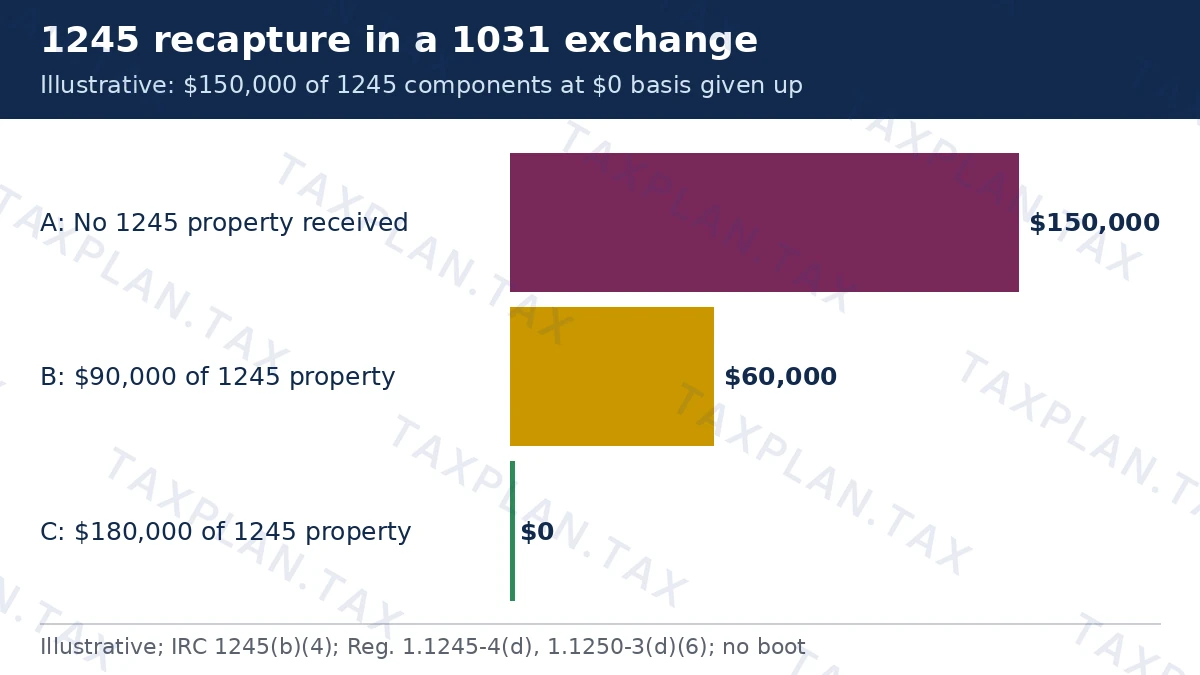
Assume an investor’s existing study classified components that are real property under §1.1031(a)-3 but §1245 property for depreciation. They cost $200,000 and were fully deducted with bonus depreciation, so their adjusted basis is $0. At the exchange, those components are worth $150,000. Without §1245(b)(4), the recapture would be $150,000, the lesser of $200,000 or $150,000, minus $0 of basis.
| Scenario | §1245 property received (FMV) | Shortfall matched with non-§1245 property | Ordinary income recapture | Federal tax at 37% |
|---|---|---|---|---|
| A: No §1245 property identified | $0 | $150,000 | $150,000 | $55,500 |
| B: Partial match | $90,000 | $60,000 | $60,000 | $22,200 |
| C: Full match | $180,000 | $0 | $0 | $0 |
In Scenario C, the investor receives at least $150,000 of §1245 property, so no recapture arises. However, this only works if the replacement property truly contains that property and a credible study documents it. The Form 8824 instructions include an IRS example like Scenario A, where an apartment owner receives only §1250 property and recaptures the full §1245 amount. Those line 21 instructions state the limit in short form, so the class-by-class matching for Scenarios B and C comes from the regulations above. Have your tax adviser confirm the computation.
Example 2: Bonus depreciation on the excess basis
Next, assume the investor buys a used replacement building for $3,000,000 in February 2026. The adjusted basis carried over from the relinquished property is $900,000. In addition, the investor adds $1,000,000 of new cash and debt, which becomes excess basis.
Assume the replacement study allocates the $1,000,000 of excess basis as follows: $200,000 to land, $560,000 to the building, $160,000 to 5-year property, and $80,000 to 15-year land improvements. Because the building is used property, only that excess basis can receive bonus depreciation. Therefore, the 5-year and 15-year amounts, $240,000 in total, could be deducted at 100% in 2026. At a 37% rate, that is about $88,800 of federal tax deferral, if the losses are usable.
Meanwhile, the $900,000 of exchanged basis continues on the relinquished property’s schedule, unless the investor makes the §1.168(i)-6(i) election. How exchanged basis is spread among replacement components is fact-specific, so work through it with your CPA.
Common Mistakes and Risks in Cost Segregation and 1031 Exchange Planning
Direct answer: Most problems come from treating the exchange and the study as separate projects. In other words, cost segregation and 1031 exchange work should run on one plan.
- Assuming the exchange defers all gain. It may not. §1245 recapture can still apply, as Example 1 shows.
- Claiming bonus on exchanged basis for used property. Under §1.168(k)-2(g)(5)(iii)(A), only excess basis qualifies in that case.
- Ignoring non-real property. Movable furniture and similar items are not like-kind real property, so their value is generally taxed outside the exchange.
- Missing the deadlines. The 45-day and 180-day limits in §1031(a)(3) do not stretch for a study.
- Signing a rigid allocation. As Peco Foods shows, a contract allocation can bind you.
- Forgetting the passive loss rules. Large deductions may be suspended under §469.
- Relying on a thin study. The IRS Cost Segregation Audit Techniques Guide says examiners should view “rule of thumb” studies with caution.
Also remember that an exchange defers gain rather than erasing it. For ways investors handle recapture after a study, see our article on depreciation recapture strategies.
Frequently Asked Questions
Can I do a cost segregation study on 1031 exchange replacement property?
Yes. A study can classify the replacement property’s components. However, for used property, bonus depreciation generally applies only to the excess basis.
Does a cost segregation study on my old property hurt my 1031 exchange?
No, it does not disqualify the exchange. Still, §1245 components can create ordinary income recapture unless you receive enough §1245 property in return.
Are §1245 components real property for a 1031 exchange?
Many are. Under Treas. Reg. §1.1031(a)-3(a)(7), the exchange definition does not control depreciation classification. So an item can be real property for Section 1031 and §1245 property for depreciation.
Is excess basis in a 1031 exchange eligible for 100% bonus depreciation?
Generally yes, if the property is qualified property acquired after January 19, 2025. Notice 2026-11 applies the 100% rate to such property.
Should I order the cost segregation study before or after the 1031 exchange closes?
Ideally, start before you sign the replacement contract. That way, the study can inform the price allocation and the recapture analysis.
What is the §1.168(i)-6(i) election?
It lets you treat the whole replacement basis as newly placed in service. As a result, it can simplify records, but you should model it before filing because revocation requires IRS consent.
Where do I report §1245 recapture from an exchange?
You figure it on Form 8824, line 21. Then follow the Form 8824 and Form 4797 instructions to carry it to your return.
Does a 1031 exchange eliminate cost segregation recapture?
No. It defers recognized gain, and the deferral is preserved through the lower basis of the replacement property under §1031(d).
Conclusion: Should You Combine Cost Segregation and a 1031 Exchange?
For many investors, yes. Cost segregation and 1031 exchange planning can create new deductions on the added basis and reduce recapture in the exchange. However, the benefits depend on careful classification, correct basis tracking, and tight deadlines. So bring your cost segregation provider in early, before you sign the replacement contract.
Emunah Cost Segregation works with investors, CPAs, and exchange advisors to plan the study around the exchange. Alan Goldstein, MBA, EA, reviews your existing study, the replacement contract, and your basis figures. Then he helps you model recapture and bonus depreciation before closing. Contact Emunah Cost Segregation in Coral Gables, Florida, to request a feasibility review.
Cases Cited
- Starker v. United States, 602 F.2d 1341, 1352-1355 (9th Cir. 1979). Pinpoint verified against the reporter-paginated opinion text. Opinion
- Hospital Corp. of America v. Commissioner, 109 T.C. 21, 48-52 (1997) (United States Tax Court). Pinpoint verified against the reporter-paginated opinion text. Opinion
- Peco Foods, Inc. v. Commissioner, 522 F. App’x 840, 843-844 (11th Cir. 2013) (unpublished), aff’g T.C. Memo. 2012-18. Pinpoint verified against the reporter-paginated opinion text. Opinion
Sources and Authorities
- 26 U.S.C. §1031: https://www.law.cornell.edu/uscode/text/26/1031
- 26 U.S.C. §1245: https://www.law.cornell.edu/uscode/text/26/1245
- 26 U.S.C. §168: https://www.law.cornell.edu/uscode/text/26/168
- 26 U.S.C. §469: https://www.law.cornell.edu/uscode/text/26/469
- Treas. Reg. §1.1031(a)-3: https://www.ecfr.gov/current/title-26/section-1.1031(a)-3
- Treas. Reg. §1.1250-3: https://www.ecfr.gov/current/title-26/section-1.1250-3
- Treas. Reg. §1.1245-4: https://www.ecfr.gov/current/title-26/section-1.1245-4
- Treas. Reg. §1.168(i)-6: https://www.ecfr.gov/current/title-26/section-1.168(i)-6
- Treas. Reg. §1.168(k)-2: https://www.ecfr.gov/current/title-26/section-1.168(k)-2
- Public Law 119-21 (H.R. 1, 119th Congress), §70301: https://www.congress.gov/bill/119th-congress/house-bill/1
- IRS Notice 2026-11: https://www.irs.gov/pub/irs-drop/n-26-11.pdf
- 2026 Instructions for Form 8824: https://www.irs.gov/pub/irs-pdf/i8824.pdf
- About Form 8824: https://www.irs.gov/forms-pubs/about-form-8824
- IRS Publication 544, Sales and Other Dispositions of Assets: https://www.irs.gov/pub/irs-pdf/p544.pdf
- IRS Publication 5653 (Rev. 2-2025), Cost Segregation Audit Techniques Guide: https://www.irs.gov/pub/irs-pdf/p5653.pdf
- Court opinions: see Cases Cited above.
This article is provided for general educational purposes and does not constitute individualized tax, legal, or accounting advice. Tax consequences depend on the taxpayer’s specific facts and applicable law.
